

Global climate leaders gather in Riyadh to address water scarcity, extreme weather

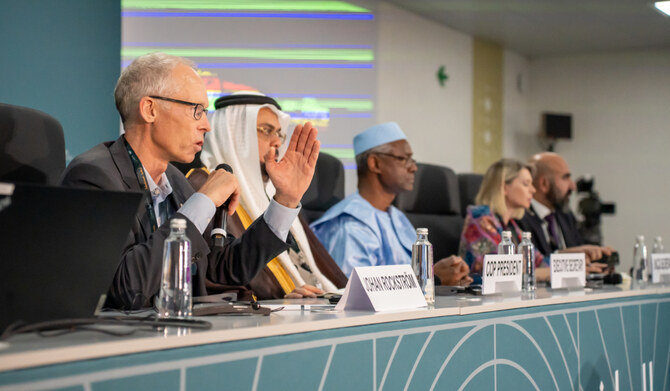
Osama Faqeeha, Saudi deputy minister for environment, along with UNCCD officials and other experts during a press conference on the first day of COP 16 in Riyadh. (AN photo by Huda Bashatah)
Short Url
Updated 07 December 2024
Follow

Global climate leaders gather in Riyadh to address water scarcity, extreme weather

  • In 2020, Crown Prince Mohammed bin Salman launched the Regional Center for Climate Change, which provides research on climate conditions in Saudi Arabia and the Gulf Cooperation Council

RIYADH: International experts convened in Riyadh for the 16th session of the Conference of the Parties to the UN Convention to Combat Desertification from Dec. 2-13 to address the increasing prevalence of floods and droughts and how to mitigate their impact.

In Saudi Arabia, a nation known for its arid climate and vast deserts, such extreme weather events could heavily affect water resources.

Andrew Robertson, senior research scientist at Columbia University’s Center for Climate System Research and the International Research Institute for Climate and Society, said that climate change is impacting this region, which has some of the highest temperature increases in the world, more than the global average.

Robertson highlighted advancements that could help Saudi Arabia mitigate harsh climate conditions in the future.

“Heatwave early warning … (will) be important in the future here,” Robertson said.

Advanced seasonal forecasting capabilities can significantly help people adapt to extreme weather conditions, he added.

“The weather is not constant; it fluctuates daily and even annually,” Robertson said.

Although Saudi Arabia’s climate is predominantly dry, it is not immune to flooding. Intense rainfall, often linked to seasonal weather patterns, can cause urban flooding, particularly in areas with inadequate drainage systems.

A notable example is the devastating 2009 flood in Jeddah, which led to significant property damage, loss of life, and economic disruption.

Floods not only damage infrastructure but also exacerbate issues like soil erosion and water pollution, further straining the country’s already limited water resources.

In 2020, Crown Prince Mohammed bin Salman launched the Regional Center for Climate Change, which provides research on climate conditions in Saudi Arabia and the Gulf Cooperation Council.

Mazen Asiri, executive director of the center, told Arab News that the center aims to develop a high-resolution climate change database projecting up to 2100. The database will analyze various climate scenarios to assess climate change and the impact of human activity on the environment.

Another major challenge in Saudi Arabia is drought, as the country is among the most water-scarce in the world. With no rivers, it relies heavily on desalination and underground water for its supply.

Recognizing the threat of drought, the Saudi government is actively implementing water conservation and management strategies. Initiatives such as rainwater harvesting and cloud seeding offer promising solutions to address the nation’s water challenges.

Asiri said: “We have seen examples today of how we can use techniques such as ‘seeding the skies’ in mountainous areas during the winter season to create snow. This is a recent but ongoing study that might succeed in mountainous locations here, such as Tabuk.”

He added: “This method may help improve tourism as well as support the water supply. It will also enhance vegetation cover and biodiversity.”

Asiri emphasized the importance of raising public awareness in addressing environmental issues and the role of the media in helping to achieve this. “We should focus on education from a young age to have thriving results in the future. We also offer workshops at our center and other similar entities, which are significant in raising awareness of these issues,” he said.


Minzal brings Saudi traditions to life in Diriyah

Updated 07 January 2026
Follow

Minzal brings Saudi traditions to life in Diriyah

  • From leather crafts and archery to Saudi coffee, Minzal offers a lesson in ‘Sloum Al-Arab’

RIYADH: This season of Minzal places social norms and traditional etiquette at its center, with tents set up to teach what is locally known as “Sloum Al-Arab” alongside gatherings for coffee, dinner and stargazing around campfires.

“Sloum Al-Arab” refers to the unwritten customers and values that have shaped Arab and Bedouin society for centuries, including generosity, coffee preparation, courage and archery. 

In Saudi Arabia, these traditions are closely ties to cultural identity and religious belief. 

Leather products and the making of leather goods is one of the crafts featured at Minzal this year and is one of the oldest crafts still practiced in the kingdom.

“The most difficult thing I faced to work on was camel leather because it is a little tough,” Nada Samman, a leather trainer and craftsman at Minzal, told Arab News. 

Minzal continues to evolve with each season, offering activities that highlight Bedouin values, traditional skills and sports. (AN photo by Haifa Alshammari)

“The work on leather is wonderful whether it is goat leather, cow leather, Sawakni sheep, and of course, camel leather. At Minzal, we are offering multiple handicraft workshops, most specifically the leather handicrafts. We want visitors to spend time at something useful and fun."

Samman explained the workshops allowed participants to preserve heritage while engaging in meaning, hands on activities. 

Faisal Al-Khaled, a visual artist and craftsman specializing in Saudi designs at Minzal, shared a similar goal: “I want people to have, by the end of this experience, a unique and traditional art piece created by them, and that I know I helped them to preserve this craft.”

Minzal, which has been organized for several years now, continues to evolve with each season, offering activities that highlight Bedouin values, traditional skills and sports. Archery is a key feature, reflecting its deep roots in Arab and Islamic history.

Mohammed Al-Sharif, a certified archery player and coach with the Saudi Archery Federation since 2028, said the sport was closely connected to Saudi culture. It was encouraged by the Prophet Muhammad, which led people to learn and teach it through generations.

“Our traditional bow is considered one of the most important and widely used bows in Arab culture,” Al-Sharif said. “We have several styles, and professional archers specializing in traditional bow shooting … There are various types of archery, such as horseback archery and standing archery, where bow sizes vary according to specific needs, such as types used for hunting and others used during warfare.”

He explained that archery was historically part of daily life, used for protection and hunting. 

Saudi coffee also plays a significant role in the Minzal experience, with live demonstrations. One of the most frequently consumed beverages in the Kingdom, it is a symbol of hospitality and generosity.

Ahmed Al-Shuaibi explained how it was prepared at the Sloum tent, first by roasting the beans and then allowing them to cool. The beans are ground with spices in a Nigr.

“Coffee is passed from our grandparents,” he added. “In significant majlis, you see them offering our local coffee and not other types of coffee. We organized this corner so that young generations can visit and learn this.”