Middle East climate leaders and global partners vow to step up climate action

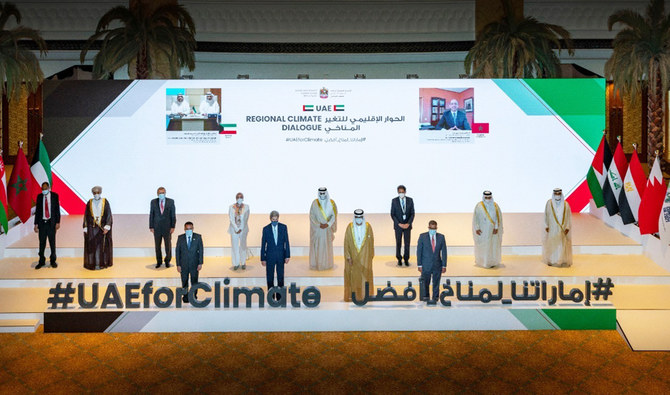
The delegates committed to reducing emission levels by 2030. (Photo/Twitter)
Short Url
Updated 06 April 2021
Follow

Middle East climate leaders and global partners vow to step up climate action

  • The delegates committed to reducing emission levels by 2030, working collectively to help the region adapt to the serious effects of climate change, and collaborating on mobilizing investment in a new energy economy
  • Participants in UAE meeting reiterate commitment to ensuring success of the Paris Agreement and enhancing climate ambitions

ABU DHABI: The UAE Regional Dialogue for Climate Action concluded on Sunday with climate leaders from across the Middle East and North Africa region vowing to accelerate progress on climate targets.

The participants affirmed a commitment to ensuring the success of the Paris Agreement, and build on the momentum ahead of US President Joe Biden’s Leaders’ Summit on Climate, which will be hosted by Washington this month, and the 26th UN Climate Change Conference of the Parties (COP26) in Glasgow, Scotland in November.

The presidency of COP26, which is held by the UK, welcomed the group statement by the delegates at the UAE meeting, along with progress on climate action in the region. It also reiterated a call for the submission of enhanced nationally determined contributions, which detail the efforts by nations to tackle climate change, and net-zero commitments ahead of the conference.

The regional meeting on Sunday provided a constructive platform for participating countries to collaborate on responses to climate change and enhance global climate ambitions. Another aim was to enable climate leaders in the region to discuss ways in which they can initiate a new low-carbon development path and enhance cooperation with the international community to transform climate challenges into economic opportunities.

“Accelerating climate action is both necessary and a huge opportunity,” said Sultan Ahmad Al Jaber, the UAE’s special envoy for climate change and minister of industry and advanced technology.

The region has enormous potential to contribute to tackling the global challenges of climate change, he added, and by working together “we can maximize our contribution, leverage the latest technologies and focus smart investment to ensure truly sustainable development that facilitates economic growth.”

The delegates committed to reducing emission levels by 2030, working collectively to help the region adapt to the serious effects of climate change, and collaborating on mobilizing investment in a new energy economy.

Guests at the meeting included high-level dignitaries including US Special Envoy for Climate John Kerry, COP26 President Alok Sharma, ministers from countries in the region, and representatives of the International Renewable Energy Agency.

The event covered a number of core issues such as: stepping up the deployment of renewable energy; exploring the potential of new zero-carbon energy sources; maximizing the effect of mitigation technologies, including investments in innovative new and emerging solutions as well as carbon capture; and reducing the carbon-emission intensity of hydrocarbon fuels.

“There are huge investment opportunities, in the transition to renewable energy, to grow our economies, create jobs and reduce the risk of climate disaster,” said Sharma.


Hundreds mourn in Syria’s Homs after deadly mosque bombing

Updated 27 December 2025
Follow

Hundreds mourn in Syria’s Homs after deadly mosque bombing

  • Officials have said the preliminary investigations indicate explosive devices were planted inside the mosque but have not yet publicly identified a suspect

HOMS: Hundreds of mourners gathered Saturday despite rain and cold outside of a mosque in the Syrian city of Homs where a bombing the day before killed eight people and wounded 18.
The crowd gathered next to the Imam Ali ibn Abi Talib Mosque in the Wadi Al-Dhahab neighborhood, where the population is predominantly from the Alawite minority, before driving in convoys to bury the victims.
Officials have said the preliminary investigations indicate explosive devices were planted inside the mosque but have not yet publicly identified a suspect.
A little-known group calling itself Saraya Ansar Al-Sunna claimed responsibility for the attack in a statement posted on its Telegram channel, in which it indicated that the attack intended to target members of the Alawite sect, an offshoot of Shia Islam whom hard-line Islamists consider to be apostates.
The same group had previously claimed a suicide attack in June in which a gunman opened fire and then detonated an explosive vest inside a Greek Orthodox church in Dweil’a, on the outskirts of Damascus, killing 25 people as worshippers prayed on a Sunday.
A neighbor of the mosque, who asked to be identified only by the honorific Abu Ahmad (“father of Ahmad“) out of security concerns, said he was at home when he heard the sound of a “very very strong explosion.”
He and other neighbors went to the mosque and saw terrified people running out of it, he said. They entered and began trying to help the wounded, amid blood and scattered body parts on the floor.
While the neighborhood is primarily Alawite, he said the mosque had always been open to members of all sects to pray.
“It’s the house of God,” he said. “The mosque’s door is open to everyone. No one ever asked questions. Whoever wants to enter can enter.”
Mourners were unable to enter the mosque to pray Saturday because the crime scene remained cordoned off, so they prayed outside.
Some then marched through the streets chanting “Ya Ali,” in reference to the Prophet Muhammad’s cousin and son-in-law whom Shiite Muslims consider to be his rightful successor.