WASHINGTON/BOGOTA: Days after threatening Colombia with military action, US President Donald Trump on Wednesday said arrangements were being made for the country’s President Gustavo Petro to visit the White House, following a call between the two leaders. Trump and Petro said they discussed relations between the two countries in their first call since the US president on Sunday said that a US military operation focused on Colombia’s government “sounds good” to him. That threat followed Trump ordering the US capture of the president of neighboring Venezuela, who was flown to the US to face drug and weapons charges.
“It was a great honor to speak with the President of Colombia, Gustavo Petro, who called to explain the situation of drugs and other disagreements that we have had. I appreciated his call and tone, and look forward to meeting him in the near future,” Trump wrote on social media.
Trump added “arrangements are being made” for a meeting in Washington between himself and Petro, Colombia’s first leftist president, but gave no specific date for a meeting.
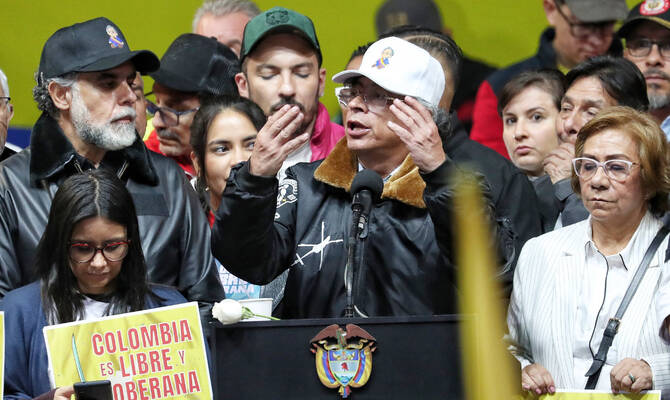
“We have spoken by phone for the first time since he became president,” Petro told supporters gathered at a rally in Bogota meant to celebrate Colombia’s sovereignty, adding he had requested a restart of dialogue between the two countries.
A source in Petro’s office told Reuters the call was “cordial” and “respectful.”
Relations between Trump and Petro have been frosty since the Republican returned to the White House in January 2025.
Trump has repeatedly accused the administration of Petro, without evidence, of enabling a steady flow of cocaine into the US, imposing sanctions on the Colombian leader in October.
On Sunday Trump referred to Petro as “a sick man, who likes making cocaine and selling it to the United States.”
The US in September had revoked Petro’s visa after he joined a pro-Palestinian demonstration in New York following a meeting of the United Nations General Assembly and called on US soldiers to “disobey the orders of Trump.”
Petro, who has been a vocal opponent of Israel’s war in Gaza, had accused Trump of being “complicit in genocide” in Gaza and called for “criminal proceedings” over US missile attacks on suspected drug-running boats in Caribbean waters.
The Trump administration has carried out more than 30 strikes against suspected drug boats since September, in a campaign that has killed at least 110 people.

Trump invites Colombia’s Petro to White House after earlier threat of military action
https://arab.news/z2yqd
Trump invites Colombia’s Petro to White House after earlier threat of military action
- Relations between Trump and Petro have been frosty since the Republican returned to the White House in January 2025
Bangladesh readies for polls, worry among Hasina supporters
- The Muslim-majority nation of 170 million people will hold elections on February 12, its first since the uprising
- Hasina was sentenced to death for crimes against humanity in Nov. and her former ruling party has been outlawed
Gopalganj: Bangladesh is preparing for the first election since the overthrow of Sheikh Hasina, but supporters of her banned Awami League (AL) are struggling to decide whether to shift their allegiance.
In Gopalganj, south of the capital Dhaka and a strong bastion of Hasina’s iron-grip rule, residents are grappling with an election without the party that shaped their political lives for decades.
“Sheikh Hasina may have done wrong — she and her friends and allies — but what did the millions of Awami League supporters do?” said tricycle delivery driver Mohammad Shahjahan Fakir, 68, adding that he would not vote.
“Why won’t the ‘boat’ symbol be there on the ballot paper?” he said, referring to AL’s former election icon.
The Muslim-majority nation of 170 million people will hold elections on February 12, its first since the uprising.
Hasina, who crushed opposition parties during her rule, won landslide victories in Gopalganj in every election since 1991.
After a failed attempt to cling to power and a brutal crackdown on protesters, she was ousted as prime minister in August 2024 and fled to India.
She was sentenced to death in absentia for crimes against humanity by a court in Dhaka in November, and her former ruling party, once the country’s most popular, has been outlawed.
Human Rights Watch has condemned the AL ban as “draconian.”
“There’s so much confusion right now,” said Mohammad Shafayet Biswas, 46, a banana and betel leaf seller in Gopalganj.
“A couple of candidates are running from this constituency — I don’t even know who they are.”
As a crowd gathered in the district, one man shouted: “Who is going to the polling centers? We don’t even have our candidates this time.”
‘DEHUMANISE’
Hasina’s father, Sheikh Mujibur Rahman, the founding president of Bangladesh, hailed from Gopalganj and is buried in the town.
Statues of Rahman have been torn down nationwide, but in Gopalganj, murals and statues are well-maintained.
Since Hasina’s downfall, clashes have broken out during campaigning by other parties, including one between police and AL supporters in July 2025, after which authorities filed more than 8,000 cases against residents.
Sazzad Siddiqui, a professor at Dhaka University, believes voter turnout in Gopalganj could be the lowest in the country.
“Many people here are still in denial that Sheikh Hasina did something very wrong,” said Siddiqui, who sat on a government commission formed after the 2025 unrest.
“At the same time, the government has constantly tried to dehumanize them.”
This time, frontrunners include candidates from the Bangladesh Nationalist Party (BNP) and Jamaat-e-Islami, the country’s largest religious party.
Both are from Hasina’s arch-rivals, now eyeing power.
“I am going door to door,” BNP candidate S.M Zilany, 57, told AFP, saying many would-be voters had never had a candidate canvass for their backing.
“I promise them I will stand by them.”
Zilany said he had run twice against Hasina — and was struck down by 34 legal cases he claimed had been politically motivated.
This time, he said that there was “a campaign to discourage voters from turning up.”
Jamaat candidate M.M Rezaul Karim, 53, said that under Hasina, the party had been driven underground.
“People want a change in leadership,” Karim told AFP, saying he was open to all voters, whatever their previous loyalties.
“We believe in coexistence; those involved in crimes should be punished; others must be spared,” Karim said.
Those once loyal to Hasina appear disillusioned. Some say they had abandoned the AL, but remain unsure whom to support.
“I am not going to vote,” said one woman, who asked not to be named.
“Who should I vote for except Hasina? She is like a sister.”