

Pakistan’s finmin says efficient management of state resources key to improving fiscal position

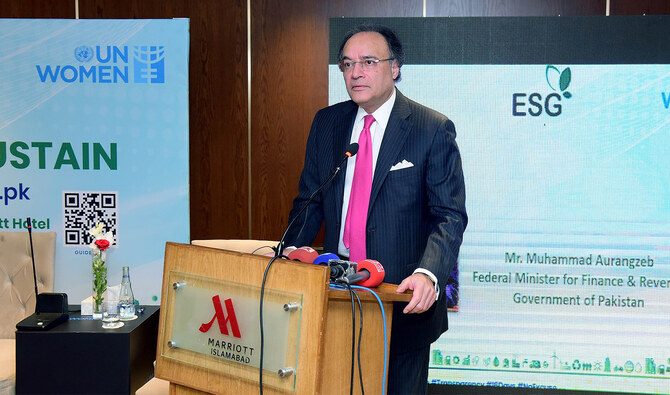
Pakistan’s Finance Minister Muhammad Aurangzeb is addressing a ceremony in Islamabad, Pakistan, onn December 5, 2024. (@Financegovpk/File)
Short Url
Updated 07 December 2024
Follow

Pakistan’s finmin says efficient management of state resources key to improving fiscal position

  • Pakistan is actively trying to sell its stakes in state-owned assets to private investors
  • Muhammad Aurangzeb urges private companies to focus on export-oriented growth 

ISLAMABAD: Pakistan’s Finance Minister Muhammad Aurangzeb on Saturday stressed the importance of efficient management of state assets by private investors in improving the country’s fiscal position, calling on the private sector to focus on increasing the country’s exports. 

Islamabad has sought to privatize loss-making state enterprises which have accumulated losses in the billions over decades, by handing over their management to private companies to create fiscal space. 

Pakistan has identified 25 public sector enterprises for privatization, including the flagship carrier Pakistan International Airlines (PIA), banks, hotels and power generation and distribution companies. Islamabad’s move to privatize the PIA and other state-owned enterprises is part of a deal with the IMF for financial bailout programs. 

“This is very important and I keep saying this repeatedly that the private sector has to lead this country,” Aurangzeb said during an event in Karachi. 

He added that SOEs were inflicting losses worth Rs2.2 billion [$7.9 million] per day to Pakistan, adding this amounts to Rs6 trillion [$21.5 billion] yearly. 

“Think about this, this year we have to collect taxes worth Rs12.9 trillion [$46.3 million], so approximately 50 percent of this, if there is no [financial] drag of the SOEs, if all of them are being run by the private sector, if this drag is not there then you can imagine our fiscal balance or imbalance it will become so much better,” he said. 

The Pakistani minister urged private companies to focus on exports, adding that while the country had achieved economic stability, it needed to achieve growth as well. 

“If we have to end this boom-bust cycle and if we have to take this economy toward to a 5, 6 and 7 percent growth, it has to be an export-led growth,” Aurangzeb said. 

Pakistan has made some economic gains in recent months, with the stock market performing impressively and breaching over 109,000 points at close of trade on Friday. 

Inflation in the country, which reached a record high of 38 percent in May 2023, slowed to 4.9 percent in November, lower than the government’s forecast. 


Pakistan, Saudi Arabia discuss regional situation, upcoming engagements

Updated 5 sec ago
Follow

Pakistan, Saudi Arabia discuss regional situation, upcoming engagements

  • Ishaq Dar and Prince Faisal bin Farhan agree to stay in contact amid Middle East tensions
  • The two officials speak ahead of Trump’s Feb. 19 Board of Peace meeting in Washington, DC

ISLAMABAD: Pakistan’s Deputy Prime Minister and Foreign Minister Ishaq Dar discussed regional developments and upcoming international engagements with Saudi Foreign Minister Prince Faisal bin Farhan in a phone call on Saturday, according to the foreign office in Islamabad.

The conversation took place against the backdrop of deepening strategic ties between Islamabad and Riyadh. In September last year, the two countries signed a bilateral defense agreement that formalized decades of military cooperation and included a commitment to view aggression against one as an attack on both countries.

“Deputy Prime Minister/Foreign Minister Mohammad Ishaq Dar held a telephonic conversation today with the Foreign Minister of Saudi Arabia, Faisal bin Farhan Al Saud,” Pakistan’s foreign ministry said in a statement.

“The two leaders discussed the evolving regional situation, forthcoming international engagements, and agreed to remain in close contact,” it added.

The two officials spoke at a time of heightened tensions in the Middle East, with the conflict in Gaza far from resolution amid ongoing ceasefire violations by Israel.

The region has also been on edge as the United States pursues nuclear negotiations with Iran, prompting regional states to call for diplomacy rather than new military flare-ups.

Both Pakistan and Saudi Arabia are participants in US President Donald Trump’s Board of Peace, which is scheduled to meet on Feb. 19 in Washington.

Islamabad and Riyadh have consistently coordinated positions over regional and global issues.

The foreign ministry did not provide further details of the discussion.