US Supreme Court to weigh bid to sue Palestinian authorities over attacks

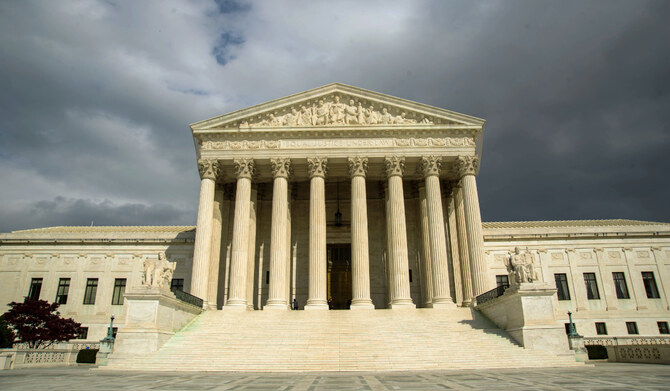
In this file photo taken on March 31, 2012 the US Supreme Court building is seen on Capitol Hill in Washington, DC. (AFP file photo)
Short Url
Updated 07 December 2024
Follow

US Supreme Court to weigh bid to sue Palestinian authorities over attacks

  • US courts for years have grappled over whether they have jurisdiction in cases involving the Palestinian Authority and PLO for actions taken abroad

WASHINGTON: The US Supreme Court agreed on Friday to decide the legality of a 2019 federal statute meant to facilitate lawsuits against Palestinian authorities by Americans killed or injured in attacks in Israel and elsewhere. The justices took up appeals by President Joe Biden’s administration and a group of American victims and their families of a lower court’s ruling that this law violated the rights of the Palestinian Authority and Palestine Liberation Organization to due process under the US Constitution.
The law is called the Promoting Security and Justice for Victims of Terrorism Act.
The Supreme Court is expected to hold arguments in the case and rule by the end of June. Its decision to hear the case comes during the Gaza war in which Israel launched an air and ground assault on the Hamas-ruled enclave after Palestinian militants stormed Israeli border communities in October 2023.
US courts for years have grappled over whether they have jurisdiction in cases involving the Palestinian Authority and PLO for actions taken abroad. Under the language at issue in the 2019 law, the PLO and Palestinian Authority would automatically “consent” to jurisdiction if they conduct activities in the United States or make payments to people who attack Americans. The plaintiffs in the litigation before the Supreme Court include families who in 2015 won a $655 million judgment in a civil case alleging that the Palestinian organizations were responsible for a series of shootings and bombings around Jerusalem from 2002 to 2004. Officials and employees of the two organizations planned, directed and participated in these attacks, according to the plaintiffs. The Manhattan-based 2nd US Circuit Court of Appeals threw out the award in 2016, finding that American courts lacked jurisdiction over the Palestinian defendants. Congress subsequently passed the Promoting Security and Justice for Victims of Terrorism Act, and new litigation was brought by the families as well as by relatives of Ari Fuld, a Jewish settler in the Israel-occupied West Bank who was fatally stabbed by a Palestinian in 2018. A New York-based federal judge in 2022 ruled that the law was unconstitutional because of due process violations. Congress, US District Judge Jesse Furman wrote, “cannot simply declare anything it wants to be consent.” Plaintiffs asked the 2nd Circuit to revive their claims, but it refused, prompting the appeal to the Supreme Court.
“We’re encouraged by the court’s acceptance of the case for review, and our families are looking forward to restoration of the judgment in their favor and a long-overdue measure of justice for the horrific attacks against them,” said Kent Yalowitz, a lawyer representing families in the case.
A lawyer representing the two Palestinian organizations did not immediately respond to a request for comment.


Sweden seizes false-flagged ship with suspected stolen Ukrainian grain

Updated 08 March 2026
Follow

Sweden seizes false-flagged ship with suspected stolen Ukrainian grain

  • The Russian embassy in Stockholm said it had been informed by the Swedish coast guard that 10 of the crew were Russian citizens

STOCKHOLM: Police in Sweden have seized a false-flagged cargo ship off its southern coast believed to belong to Russia’s shadow fleet and suspected of transporting stolen Ukrainian grain, authorities said Saturday.
The 96-meter (315-foot) Caffa left Casablanca in Morocco on February 24 and was headed for Saint Petersburg, Russia when armed Swedish police boarded it on Friday off the southern town of Trelleborg.
“The vessel is on the Ukraine sanctions list. Information indicates that it has essentially been used to transport grain that is stolen, as we understand it, from Ukraine,” the coast guard’s acting head of operations, Daniel Stenling, told a press conference.
“We have been able to establish that the vessel is sailing under a false flag. She is registered in Guinea, but that registration is in fact false,” he added.
“A majority” of the 11 crew members were Russian, Stenling said.
The Russian embassy in Stockholm said it had been informed by the Swedish coast guard that 10 of the crew were Russian citizens.
“The Russian embassy in Sweden is in contact with the competent Swedish authorities and is ready, if necessary, to provide consular assistance to the Russian nationals among the crew,” it wrote on Telegram.
One crew member was under investigation for violation of the maritime code on seaworthiness and on ship safety, Stenling said, refusing to disclose the suspect’s identity or crew role.
“The investigative measures we have taken so far reinforce our suspicions and our view that there are extensive maritime safety deficiencies on this vessel,” he said.
The Swedish Transport Agency was to inspect the ship and determine whether it was seaworthy and authorized to continue its journey.

- ‘Risk of accidents’ -

Moscow’s “shadow fleet” consists of vessels with opaque ownership used to skirt Western sanctions.
“It’s a problem for us that we are seeing more ships that don’t respect the law of the sea,” Stenling said, noting that “the risk of accidents increases when ships are not certified.”
“We might not even know what kind of crew is on board, what kind of skills they have, what certifications they hold, and they often lack insurance if something were to happen,” he added.
Ukrainian Foreign Minister Andriy Sybiga on Saturday thanked Sweden.
“Collective action against such vessels is gaining momentum. This is a welcome development,” he wrote on X.
“Sanctions work when they are strictly enforced. Together, we must stop the activities of Russia’s shadow fleet to protect Europe’s security and environment.”