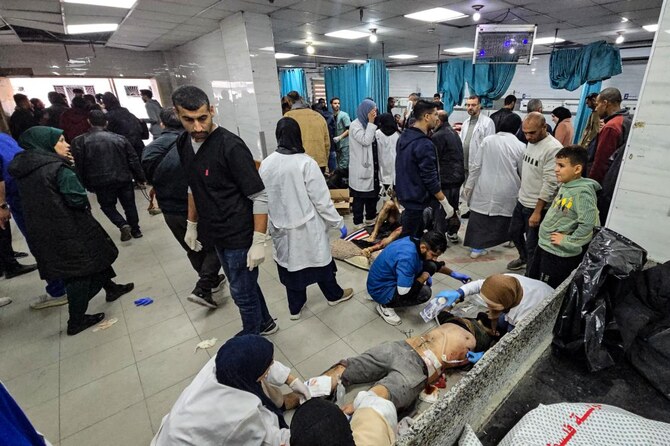
JERUSALEM: Gaza’s civil defense agency Friday reported deadly air strikes around Kamal Adwan Hospital in the territory’s north as well as “direct fire” on the health facility, which the Israeli army firmly denied.
Several witnesses described intense bombings in the vicinity of the hospital.
“There was a series of air strikes on the northern and western sides of the hospital, accompanied by intense and direct fire,” said hospital director Hossam Abu Safieh, adding that four staff were killed.
The Israeli military on Friday denied claims it had struck or entered Kamal Adwan Hospital, saying it was operating next to the facility.
“Contrary to the reports made over the past day, the (military) did not strike the Kamal Adwan Hospital or operate within it,” it said in a statement.
It said it would “continue to operate against terror infrastructure and terrorists” in northern Gaza, including “adjacent to” the hospital.
Gaza’s civil defense agency said 29 people were killed and dozens wounded on Friday by Israeli shelling in north Gaza, “especially around Kamal Adwan,” one of the area’s last functioning health centers.
The agency’s spokesman, Mahmud Bassal, told AFP that the Israeli army entered the hospital, evacuated patients and arrested several Palestinians.
Abu Safieh said that following the latest raid, no surgeons were left.
Beit Lahia has been the site of a major Israeli military operation for the past two months that has again escalated in recent days, forcing thousands to flee, the civil defense agency said.
Israeli forces have stormed Kamal Adwan on several occasions since the start of the war nearly 14 months ago.
The hospital said its intensive care unit director Ahmad Al-Kahlut was killed in an air strike late last month.
The latest strikes came just days after the World Health Organization said an emergency medical team had reached the hospital for the first time in 60 days.
Dr. Faradina Sulistiyani, a surgeon on the team, told AFP from Gaza City that all seven of her team members left the premises on foot as the bombing went on.
The UN agency’s representative in the Palestinian territories, Rik Peeperkorn, told reporters he had “extremely concerning information” from the Kamal Adwan.
He said the Israeli army was first spotted outside the hospital at 4:00 am (0200 GMT).
He said that the international medical team said that “panic caused by the bombing and shelling, along with the panicked crowd inside the hospital” caused Gazans and the team to leave the hospital despite there being “no official evacuation order.”
Peeperkorn said that a “substantial amount” of people including patients and staff remained in the hospital, which is still “minimum operational.”
With little to no aid reaching the hospital since the start of the Israeli operation in early October, the hospital had run out of most supplies, including fuel.
The Israeli army said Friday that it is “in continuous contact with the hospital in order to deliver supplies, food and medical equipment.”
The Israeli army says its operation in the far north aims to keep Hamas militants from regrouping there.
Human rights groups have accused it of pursuing a plan to evacuate or starve all those remaining there, a goal which Israel denies.
Israeli government spokesman David Mencer said on Thursday that displaced Palestinians would not be allowed to move back to Gaza’s north as long as the military operations are ongoing.
The war in Gaza was sparked by Hamas’s surprise October 7, 2023 attack which resulted in the deaths of 1,208 people, mostly civilians, according to an AFP tally based on official figures.
Israel’s retaliatory military campaign in Gaza has killed at least 44,612 people, mostly civilians, according to figures from the territory’s Hamas-run health ministry which the UN considers reliable.

North Gaza air strikes bring chaos to nearby hospital
https://arab.news/9yebm
North Gaza air strikes bring chaos to nearby hospital
- Beit Lahia has been the site of an intense Israeli military operation for the past two months
- The Israeli army has stormed Kamal Adwan on several occasions since the start of their offensive nearly 14 months ago
Oman and Lebanon call for full Israeli withdrawal, urge end to attacks
- Joseph Aoun and Sultan Haitham bin Tariq make a joint call for an immediate halt to Israeli attacks on Lebanese territory
- Reaffirmation of the unified Arab position on ending the Israeli occupation and establishing an independent Palestinian state based on the 1967 borders
BEIRUT: Lebanese President Joseph Aoun and his Omani counterpart Sultan Haitham bin Tariq on Wednesday made a joint call for an immediate halt to Israeli attacks on Lebanese territory and a full withdrawal from all occupied Arab lands, warning that continued violations pose a direct threat to regional stability.
The statement came during a high-level summit in Muscat, where both leaders voiced “serious concern over the ongoing Israeli aggression” and described the occupation as a “clear violation” of UN Security Council Resolution 1701 and other international resolutions.
The two sides also expressed support for international efforts to de-escalate tensions, stabilize the situation on the ground, facilitate the return of displaced persons, and advance post-conflict reconstruction.
Aoun led a Lebanese ministerial delegation to Oman that included Lebanon’s ministers of foreign affairs, interior, defense, health, and agriculture for talks with Omani officials.
The joint statement emphasized the strengthening of bilateral ties and expanding cooperation in key sectors including politics, the economy, investment, banking, tourism, transport, and logistics.
Both sides called for early preparations to hold the first session of the Omani-Lebanese Joint Committee, chaired by the two foreign ministers in Muscat, and to pursue new agreements and memorandums of understanding intended to enhance collaboration in trade, culture, and science. The statement also highlighted the need to boost private sector engagement in shared development opportunities.
The Omani side reaffirmed its full support for Lebanon’s sovereignty, independence, and territorial integrity, as well as for strengthening Lebanese state institutions, particularly the army and legitimate security forces, and backing the country’s ongoing economic, financial, and administrative reforms.
The two sides reaffirmed the unified Arab position on ending the Israeli occupation and establishing an independent Palestinian state based on the 1967 borders, with East Jerusalem as its capital. They also underscored the importance of strengthening Arab solidarity, respecting the sovereignty of states, and upholding the principles of good neighborliness and international law.
Aoun’s official visit to Oman took place within the context of Muscat’s established role as a regional and international mediator. During his meetings, Aoun praised Oman’s diplomatic standing and approach, describing it as “wise and responsible.”
He commended Oman’s foreign policy, grounded in dialogue, mediation, balance, and good neighborliness, saying it had earned the sultanate a “distinguished status and a pivotal role in promoting stability and resolving conflicts through peaceful means.”
Aoun said that, in Lebanon, “we hold this wise approach in high regard and deeply value the sultanate’s steadfast support for Lebanon in various international forums, as well as its support as we confront the challenges before us.”
For his part, Sultan Haitham bin Tariq reaffirmed Oman’s continued commitment to Lebanon’s stability and its close monitoring of the latest developments in the country.
He emphasized the deep-rooted relations between the two countries and the importance of strengthening bilateral cooperation and coordination. The sultan also praised the positive contributions of the Lebanese community in Oman.
On the sidelines of the visit, Lebanese Interior Minister Ahmed Al-Hajjar held a meeting with his Omani counterpart Hamoud bin Faisal Al-Busaidi at Al-Alam Palace in Muscat. They underlined the enhancement of joint cooperation, particularly in security and policing.
According to a joint statement, the discussions also covered Lebanon’s efforts to consolidate internal security and maintain stability.
Participating on the Omani side in the expanded talks were Al-Busaidi; Shihab bin Tarik Al-Said, deputy prime minister for defense affairs; Badr bin Hamad Al-Busaidi, foreign minister of Oman; Hamad bin Said Al-Aufi, head of the private office; Mahad bin Said Ba’owain, minister of labor and head of the honorary mission; Saud bin Hamoud Al-Habsi, minister of agricultural, fisheries and water resources; and Hilal bin Ali Al-Sabti, minister of health.


