

Grand jirga brokers ‘indefinite ceasefire’ in Pakistan district after sectarian clashes— official

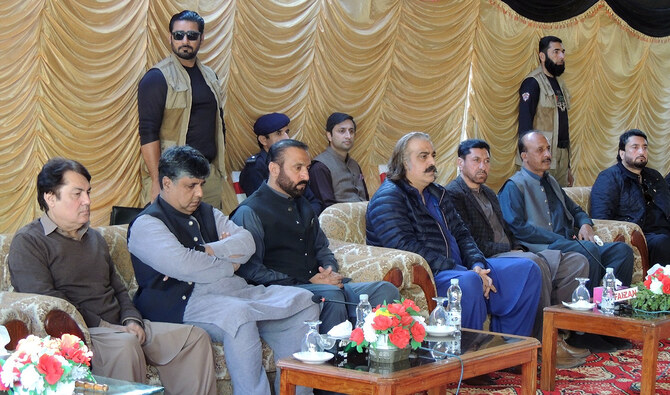
Khyber Pakhtunkhwa Chief Minister Ali Amin Gandapur (center, seated) attends a grand jirga in Kohat, Pakistan, on November 30, 2024, to discuss the security situation in Kurram district. (Photo courtesy: Chief Minister’s Office)
Short Url
Updated 06 December 2024
Follow

Grand jirga brokers ‘indefinite ceasefire’ in Pakistan district after sectarian clashes— official

  • Sectarian clashes between Shiite and Sunni tribes have killed 133, injured over 170 since Nov. 21
  • Shiite and Sunni jirga members say resolving land disputes key to avoiding future conflicts in Kurram

ISLAMABAD: A grand council of elders formed by the Khyber Pakhtunkhwa (KP) government has brokered a ceasefire in the restive Kurram district for an indefinite period, an official said on Friday, where sectarian clashes since last month have killed at least 133. 

The KP government this week formed the grand jirga or council of elders comprising former parliamentarians and senators from tribal districts, with representation from both the Sunni and Shiite sects, to broker a truce between warring tribes. The decision was taken after clashes in the volatile Kurram district killed 133 and injured 171 since Nov. 21. 

Pakistan is a Sunni-majority country, but Kurram has a large Shiite population, and the communities have clashed for decades. The latest round of clashes broke out in the restive district after a caravan of Shiites was attacked in Parachinar town last Thursday, killing 41. 

“The grand jirga held individual as well as collective settings with both the sides and after the hours-long deliberations, agreed on a ceasefire in Kurram district for an indefinite period,” Commissioner Kohat Division Syed Motasim Billah Shah said in a statement. 

“And the bunkers will remain empty until the final decision of the grand jirga.”

Javedullah Mehsud, Kurram district’s deputy commissioner, said authorities were using a “multi-pronged policy” to resolve the issue, which included the deployment of security officials in sensitive locations and the jirga engaging in talks with rival sides. 

“The jirga is heading in the right direction and we expect a permanent ceasefire in the next three, four or five days,” Mehsud told Arab News. 

Shaheen Bangash, a Sunni member of the council, said both warring tribes earnestly want peace and harmony. However, he doubted the jirga could succeed in striking a peace deal. 

“De-weaponizing Kurram region was the shortest possible route to avoid bloody clashes in future,” he said. 

Bangash urged the government to help resolve land disputes in Kurram, pointing out that in most cases, a small dispute developed into an armed clash leading to tensions. 

“The government, Shiite and Sunni are the three main stakeholders in the Kurram saga,” Bangash said.” And there are a few people who created constant disharmony in this sensitive region.”

Since last Thursday, days of fighting with light and heavy weapons have brought the region to a standstill, with major roads closed and mobile phone services cut as the death toll surged.

Kurram police spokesperson Riaz Hussain told Arab News that no fresh clashes had been reported during the last two days. 

However, he said the main highways connecting the district with Peshawar and other adjacent areas such as the Thall-Parachinar Road had been blocked for the movement of passenger vehicles.

“The ceasefire is so far in place in Kurram and no fresh firing incident has been reported as of yet,” he added.

Hajji Abid Hussain, a Shiite elder and former president of Anjuman-e- Hussainia Parachinar, the biggest social, religious and political platform of the Shiite community in the district, told Arab News that he was optimistic about the jirga’s progress in maintaining peace in the area. 

Hussain, also a member of the jirga, was also of the view that resolving small land disputes was a prerequisite to ensure lasting peace in the district. 

“The jirga members are shuttling between both the rival sides, holding negotiations with the elders,” he said. “I’m very optimistic that a breakthrough to achieve durable ceasefire is expected very soon.” 


Pakistan to play India in T20 World Cup, government says

Updated 09 February 2026
Follow

Pakistan to play India in T20 World Cup, government says

  • Islamabad announced boycotting the Feb. 15 match in Colombo to protest the ICC’s exclusion of Bangladesh from the T20 World Cup
  • Pakistan’s government says the decision to play India is taken to protect ‘spirit of cricket and to support the continuity of global sport’

ISLAMABAD: Pakistan Prime Minister Shehbaz Sharif has cleared the country’s cricket team to play India in the T20 World Cup on Feb. 15, the Pakistani government announced late Monday, ending a week-long standoff.

Islamabad announced boycotting the Feb. 15 match in Colombo to protest the International Cricket Council’s (ICC) exclusion of Bangladesh from the T20 World Cup, following Dhaka’s decision to not play matches in India owing to security fears.

On Sunday, ICC Deputy Chairman Imran Khwaja arrived in Lahore for talks with Pakistan Cricket Board (PCB) officials and Bangladesh Cricket Board (BCB) President Aminul Islam as the sport’s governing body strived to save the high-stakes T20 World Cup encounter.

PCB Chairman Mohsin Naqvi met PM Sharif late Monday and briefed him regarding the outcomes of high-level deliberations held between the PCB, Bangladesh board and ICC representatives, the Pakistani government said on X.

“The Government of Pakistan has reviewed the formal requests extended to the PCB by the Bangladesh Cricket Board, as well as the supporting communications from Sri Lanka, the United Arab Emirates, and other member nations. These correspondences sought Pakistan’s leadership in securing a viable solution to recent challenges,” the Pakistani government said.

“In view of the outcomes achieved in multilateral discussions, as well as the request of friendly countries, the Government of Pakistan hereby directs the Pakistan National Cricket Team to take the field on February 15, 2026, for its scheduled fixture in the ICC Men’s T20 World Cup.”

The BCB earlier thanked the PCB, ICC and all others for their positive roles in trying to “overcome recent challenges,” particularly thanking PCB Chairman Naqvi and Pakistani cricket fans for demonstrating “exemplary sportsmanship and solidarity.”

“We are deeply moved by Pakistan’s efforts to go above and beyond in supporting Bangladesh during this period. Long may our brotherhood flourish,” BCB President Islam said in a statement.

“Following my short visit to Pakistan yesterday and given the forthcoming outcomes of our discussions, I request Pakistan to play the ICC T20 World Cup game on 15 February against India for the benefit of the entire cricket ecosystem.”

The dispute stemmed from the ICC’s decision to replace Bangladesh with Scotland last month after Bangladesh refused to play tournament matches in India. Dhaka’s decision followed the removal of Mustafizur Rahman from the Indian Premier League (IPL). He was bought for $1 million by the IPL’s Kolkata Knight Riders, but on Jan. 3 the Board of Control for Cricket in India (BCCI) ordered Kolkata to release Mustafizur without a public explanation but amid regional tensions.

Pakistani cricket authorities subsequently announced boycotting the match against India at R. Premadasa Stadium in Colombo on Feb. 15. An India-Pakistan fixture is the sport’s most lucrative asset, generating a massive share of global broadcasting and sponsorship revenue.

“This decision [to play India in T20 World Cup] has been taken with the aim of protecting the spirit of cricket, and to support the continuity of this global sport in all participating nations,” the Pakistani government said.

“We remain confident that our team will carry the spirit of sportsmanship and national pride onto the field as they compete for global glory.”