

Grand jirga brokers ‘indefinite ceasefire’ in Pakistan district after sectarian clashes— official

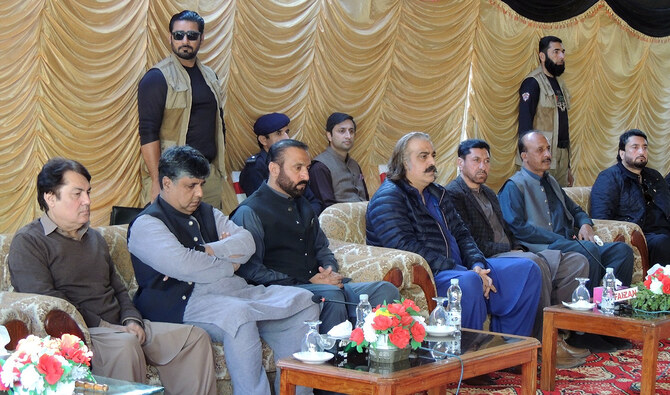
Khyber Pakhtunkhwa Chief Minister Ali Amin Gandapur (center, seated) attends a grand jirga in Kohat, Pakistan, on November 30, 2024, to discuss the security situation in Kurram district. (Photo courtesy: Chief Minister’s Office)
Short Url
Updated 06 December 2024
Follow

Grand jirga brokers ‘indefinite ceasefire’ in Pakistan district after sectarian clashes— official

  • Sectarian clashes between Shiite and Sunni tribes have killed 133, injured over 170 since Nov. 21
  • Shiite and Sunni jirga members say resolving land disputes key to avoiding future conflicts in Kurram

ISLAMABAD: A grand council of elders formed by the Khyber Pakhtunkhwa (KP) government has brokered a ceasefire in the restive Kurram district for an indefinite period, an official said on Friday, where sectarian clashes since last month have killed at least 133. 

The KP government this week formed the grand jirga or council of elders comprising former parliamentarians and senators from tribal districts, with representation from both the Sunni and Shiite sects, to broker a truce between warring tribes. The decision was taken after clashes in the volatile Kurram district killed 133 and injured 171 since Nov. 21. 

Pakistan is a Sunni-majority country, but Kurram has a large Shiite population, and the communities have clashed for decades. The latest round of clashes broke out in the restive district after a caravan of Shiites was attacked in Parachinar town last Thursday, killing 41. 

“The grand jirga held individual as well as collective settings with both the sides and after the hours-long deliberations, agreed on a ceasefire in Kurram district for an indefinite period,” Commissioner Kohat Division Syed Motasim Billah Shah said in a statement. 

“And the bunkers will remain empty until the final decision of the grand jirga.”

Javedullah Mehsud, Kurram district’s deputy commissioner, said authorities were using a “multi-pronged policy” to resolve the issue, which included the deployment of security officials in sensitive locations and the jirga engaging in talks with rival sides. 

“The jirga is heading in the right direction and we expect a permanent ceasefire in the next three, four or five days,” Mehsud told Arab News. 

Shaheen Bangash, a Sunni member of the council, said both warring tribes earnestly want peace and harmony. However, he doubted the jirga could succeed in striking a peace deal. 

“De-weaponizing Kurram region was the shortest possible route to avoid bloody clashes in future,” he said. 

Bangash urged the government to help resolve land disputes in Kurram, pointing out that in most cases, a small dispute developed into an armed clash leading to tensions. 

“The government, Shiite and Sunni are the three main stakeholders in the Kurram saga,” Bangash said.” And there are a few people who created constant disharmony in this sensitive region.”

Since last Thursday, days of fighting with light and heavy weapons have brought the region to a standstill, with major roads closed and mobile phone services cut as the death toll surged.

Kurram police spokesperson Riaz Hussain told Arab News that no fresh clashes had been reported during the last two days. 

However, he said the main highways connecting the district with Peshawar and other adjacent areas such as the Thall-Parachinar Road had been blocked for the movement of passenger vehicles.

“The ceasefire is so far in place in Kurram and no fresh firing incident has been reported as of yet,” he added.

Hajji Abid Hussain, a Shiite elder and former president of Anjuman-e- Hussainia Parachinar, the biggest social, religious and political platform of the Shiite community in the district, told Arab News that he was optimistic about the jirga’s progress in maintaining peace in the area. 

Hussain, also a member of the jirga, was also of the view that resolving small land disputes was a prerequisite to ensure lasting peace in the district. 

“The jirga members are shuttling between both the rival sides, holding negotiations with the elders,” he said. “I’m very optimistic that a breakthrough to achieve durable ceasefire is expected very soon.” 


Pakistan, global crypto exchange discuss modernizing digital payments, creating job prospects 

Updated 05 December 2025
Follow

Pakistan, global crypto exchange discuss modernizing digital payments, creating job prospects 

  • Pakistani officials, Binance team discuss coordination between Islamabad, local banks and global exchanges
  • Pakistan has attempted to tap into growing crypto market to curb illicit transactions, improve oversight

ISLAMABAD: Pakistan’s finance officials and the team of a global cryptocurrency exchange on Friday held discussions aimed at modernizing the country’s digital payments system and building local talent pipelines to meet rising demand for blockchain and Web3 skills, the finance ministry said.

The development took place during a high-level meeting between Finance Minister Muhammad Aurangzeb, Pakistan Virtual Assets Regulatory Authority (PVARA) Chairman Bilal bin Saqib, domestic bank presidents and a Binance team led by Global CEO Richard Teng. The meeting was held to advance work on Pakistan’s National Digital Asset Framework, a regulatory setup to govern Pakistan’s digital assets.

Pakistan has been moving to regulate its fast-growing crypto and digital assets market by bringing virtual asset service providers (VASPs) under a formal licensing regime. Officials say the push is aimed at curbing illicit transactions, improving oversight, and encouraging innovation in blockchain-based financial services.

“Participants reviewed opportunities to modernize Pakistan’s digital payments landscape, noting that blockchain-based systems could significantly reduce costs from the country’s $38 billion annual remittance flows,” the finance ministry said in a statement. 

“Discussions also emphasized building local talent pipelines to meet rising global demand for blockchain and Web3 skills, creating high-value employment prospects for Pakistani youth.”

Blockchain is a type of digital database that is shared, transparent and tamper-resistant. Instead of being stored on one computer, the data is kept on a distributed network of computers, making it very hard to alter or hack.

Web3 refers to the next generation of the Internet built using blockchain, focusing on giving users more control over their data, identity and digital assets rather than big tech companies controlling it.

Participants of the meeting also discussed sovereign debt tokenization, which is the process of converting a country’s debt such as government bonds, into digital tokens on a blockchain, the ministry said. 

Aurangzeb called for close coordination between the government, domestic banks and global exchanges to modernize Pakistan’s payment landscape.

Participants of the meeting also discussed considering a “time-bound amnesty” to encourage users to move assets onto regulated platforms, stressing the need for stronger verifications and a risk-mitigation system.

Pakistan has attempted in recent months to tap into the country’s growing crypto market, crack down on money laundering and terror financing, and promote responsible innovation — a move analysts say could bring an estimated $25 billion in virtual assets into the tax net.

In September, Islamabad invited international crypto exchanges and other VASPs to apply for licenses to operate in the country, a step aimed at formalizing and regulating its fast-growing digital market.