

Saudi Arabia unveils Riyadh Action Agenda to address land restoration, drought 

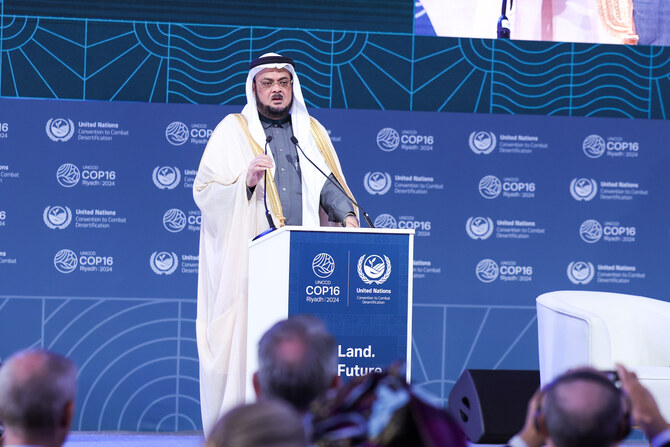
The announcement was made by Osama Faqeeha, deputy minister for environment at the Ministry of Environment, Water and Agriculture, and advisor to the UNCCD COP16 presidency. Supplied
Short Url
Updated 06 December 2024
Follow

Saudi Arabia unveils Riyadh Action Agenda to address land restoration, drought 

  • Initiative launched during Agri-Food System Day at COP16 in Riyadh 

RIYADH: Saudi Arabia has introduced the Riyadh Action Agenda, an initiative to unite stakeholders in tackling land degradation, desertification, and drought. 

The announcement was made by Osama Faqeeha, deputy minister for environment at the Ministry of Environment, Water and Agriculture, and advisor to the UNCCD COP16 presidency, during a keynote address at a high-level dialogue on sustainable agri-food systems. 

The agenda will leverage COP16’s momentum over the two-year presidency, engaging diverse stakeholders to drive tangible impact for farmers, indigenous peoples, and other affected groups. 

Speaking during a keynote address, Faqeeha said: “If we are to accelerate land restoration and drought resilience initiatives at the pace and scale required, then it is critical we continue to mobilize and incentivize action long after COP16 in Riyadh ends, reaffirming Saudi Arabia’s leadership in land restoration, and leaving a lasting legacy of global change.”  

The launch took place on Agri-Food System Day, one of seven thematic days at COP16. Agriculture, a leading driver of land degradation, accounts for 23 percent of global greenhouse gas emissions, 80 percent of deforestation, and 70 percent of freshwater use, according to the UNCCD. 

Agri-Food System Day featured discussions on sustainable agricultural practices, with topics including soil health, resilient crops, and private sector involvement in transforming food systems. The day coincided with World Soil Day, which highlights the importance of sustainable soil management. 

“Around 95 percent of our food comes from the soil, and yet we continue to treat it like dirt,” Faqeeha said. “Unsustainable practices are causing significant soil loss annually, worsening global food and water security, and affecting farmers and consumers alike.” 

The UNCCD estimates that by 2050, global crop yields could decline by 10 percent, with worst-hit regions facing a 50 percent drop. Food prices could rise by 30 percent due to shrinking arable land and rising population demands. 

“We do not need to reinvent the wheel to deliver urgent solutions,” Faqeeha added. “Reinvesting harmful agricultural subsidies could immediately support land restoration and reform unsustainable practices.” 

The UNCCD COP16 conference, themed Our Land. Our Future., is being held from Dec. 2-13, 2024, at Boulevard Riyadh World. The event marks the UNCCD’s 30th anniversary and aims to address issues like drought resilience and land tenure. 


Saudi stock market soars on historic foreign investment reform

Updated 8 sec ago
Follow

Saudi stock market soars on historic foreign investment reform

RIYADH: Saudi Arabia’s Tadawul All Share Index surged at opening on Jan. 7, posting its largest single-day gain since September 2025, following the Kingdom’s Capital Market Authority decision to fully open the market to all categories of foreign investors.

The benchmark index opened with a sharp rise, climbing 2.5 percent and breaking through the 10,500-point barrier. The rally was broad-based, with 260 listed companies advancing, while only three declined and three remained unchanged. The index later settled slightly below that peak, trading near 10,460 points.

The CMA announced that, effective Feb, 1, it will eliminate the previous framework that restricted direct market access primarily to Qualified Foreign Investors and those using swap agreements. The regulatory change will allow all international investors to participate directly in the Main Market without needing to meet prior qualification requirements.

“This is a historic decision and the most positively impactful market development in ten years,” Hesham Abou Jamee, chief adviser at Naif Al Rajhi Investments told Asharq Business. He emphasized that the market impact is immediate, despite full implementation being weeks away, and should help the market recover recent losses.

The CMA stated the amendments aim to expand and diversify the investor base, supporting investment inflows and enhancing market liquidity.

Al-Eqtisadiah newspaper financial analyst Ikrami Abdullah agreed on the decision’s positive impact, noting its timing coincides with a period of market decline and weak liquidity, as reported by Asharq Business.

Official data shows foreign investor ownership in the Saudi capital market exceeded SR590 billion ($157.32 billion) by the end of the third quarter of 2025, with international investments in the Main Market reaching approximately SR519 billion.

Market participants are now anticipating a follow-up decision to raise the current 49 percent ceiling on foreign ownership in listed companies.

Asharq Business reported that analysts suggest such a move could unlock substantial inflows, with J.P. Morgan estimating that lifting the limit to 100 percent could attract an additional $10.6 billion.

The reform is a key part of Saudi Arabia’s broader economic diversification agenda, following other initiatives to attract foreign capital, such as establishing exchange-traded funds with partners in Japan and Hong Kong.

Leading financial institutions welcomed the move. SNB Capital congratulated the CMA on this “fundamental development that enhances liquidity and market depth,” while Al Rajhi Capital greeted “investors from around the world,” calling it “a new step toward wider opportunities and more open investment.”