WASHINGTON: Billionaire Elon Musk and fellow entrepreneur Vivek Ramaswamy spent several hours Thursday swapping ideas with lawmakers about President-elect Donald Trump’s DOGE initiative to dismantle parts of the federal government.
Meeting behind closed doors at the Capitol, Musk told the mostly Republican lawmakers they would be keeping a “naughty and nice” list of those who join in the budget slashing proposals and those who don’t, according to lawmakers who attended.
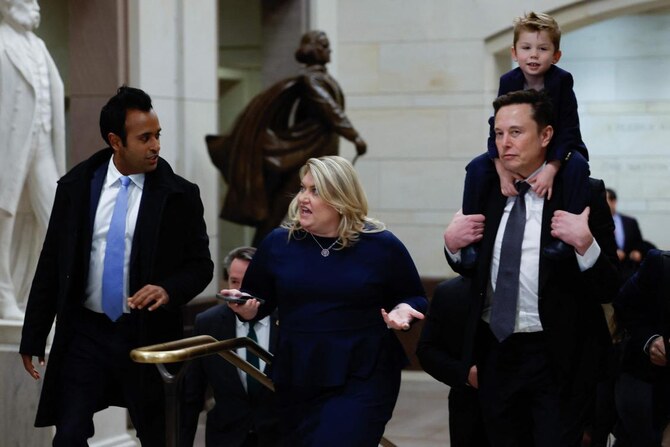
“We’re going to see a lot of change around here in Washington,” said House Speaker Mike Johnson, as Musk, with his young son on his shoulders, breezed by and into the private meeting.
Trump tapped the two business titans to head his Department of Government Efficiency, or DOGE, a nongovernmental task force assigned to find ways to fire federal workers, cut programs and slash federal regulations — all part of what he calls his “Save America” agenda for a second term in the White House.
Washington has seen this before, with ambitious efforts to reduce the size and scope of the federal government that historically have run into resistance when the public is confronted with cuts to trusted programs that millions of Americans depend on for jobs, health care, military security and everyday needs.
But this time Trump is staffing his administration with battle-tested architects of sweeping proposals, some outlined in Project 2025, to severely reduce and reshape the government. Musk and Ramaswamy have said they plan to work alongside the White House’s Office of Management and Budget, headed by Trump’s nominee Russ Vought, a mastermind of past cuts.
“DOGE has a historic opportunity for structural reductions in the federal government,” Musk and Ramaswamy wrote in an op-ed in The Wall Street Journal. “We are prepared for the onslaught.”
Trump said Thursday that he would also name venture capitalist and former PayPal executive David Sacks to be the “White House A.I. & Crypto Czar” and lead the Presidential Council of Advisers for Science and Technology. Trump said in a social media post that Sacks would help “steer us away from Big Tech bias and censorship.” Trump’s transition team didn’t say whether Sacks would be a government employee or a temporary government worker who would not be bound by the same ethics and disclosure rules.
Sacks visited Mar-a-Lago earlier Thursday, according to an investor who held an event at Trump’s Florida club. The longtime conservative was key to introducing Vice President-elect JD Vance to donors, helping him prove he could raise money. Sacks hosted a fundraiser for Trump and Vance at his San Francisco home.
Musk and Ramaswamy faced a first test as they sat on a auditorium stage in the Capitol basement, as House and Senate lawmakers, almost exclusively Republicans, lined up at the microphones to share ideas for ways to address the nation’s budget imbalances.
Rep. Virginia Foxx, R-N.C., the chair of the Education and Workforce Committee, brought up the Department of Education as a good place to cut. Rep. Derrick Van Orden, R-Wisconsin, said to look at office space and how little of it is being used. Others talked about the need for workers to return to their offices.
Afterward, Johnson declined to say if Medicare, Social Security or other popular programs were off limits for cuts, describing this first meeting as a “brainstorming” session with more to come.
“They said everything has to be looked at,” said Rep. Aaron Bean, R-Fla., who joined with Rep. Pete Sessions, R-Texas, in launching what they are calling the DOGE caucus in the House, with more than 50 Republicans and two Democratic members.
Musk and Ramaswamy appeared to be taking it all in, Musk at times even taking notes, lawmakers said — experiencing a day in the life of congressional leadership, as the meeting went on and on, with lawmakers lined up 20-deep for their chance to speak.
“It was just what I’d hoped for, where it was a question and answer session, so that members could come up, express their ideas, concerns, ask questions,” said Rep. Marjorie Taylor Greene, R-Ga., who will chair a House Oversight subcommittee in the new year on DOGE.
To be sure, it wasn’t the full Congress participating, as most Democrats did not join.
New York Democratic Rep. Tom Suozzi said when he heard Musk mention that he was open to hearing from Democrats, he dashed over to join toward the end of the session.
“Let’s do some things to try and make government more efficient — without hurting people,” Suozzi said.
Musk and Ramaswamy left lawmakers with the impression they would be back for more, holding regular meetings and starting a podcast or some other way to share information with Americans to gauge public support — or opposition — to the proposals.
While neither Musk nor Ramaswamy have much public service experience, they bring track records in private business — Musk’s operations have vast government contracts — and enthusiasm for Trump’s agenda, having campaigned alongside him in the final stretch of the election.
The world’s richest man, Musk poured millions into a get-out-the-vote effort to help the former president return to the White House. He is known politically for having transformed the popular social media site formerly known as Twitter into X, a platform embraced by Trump’s “Make America Great Again” enthusiasts.
Despite its name, the Department of Government Efficiency is neither a department nor part of the government, which frees Musk and Ramaswamy from having to go through the typical ethics and background checks required for federal employment. They said they will not be paid for their work.
One good-government group has said that DOGE, as a presidential advisory panel, should be expected to adhere to traditional practices of transparency, equal representation and public input — as happened with similar advisory entities from the Reagan to the Obama administrations.
The Federal Advisory Committee Act “is designed expressly for situations like this,” wrote Lisa Gilbert and Robert Weissman, the co-chairs of Public Citizen, in a letter to the Trump transition team.
“If the government is going to turn to unelected and politically unaccountable persons to make recommendations as grand as $2 trillion in budget cuts, it must ensure those recommendations come from a balanced and transparent process not rigged to benefit insiders.”
The nation’s $6 trillion federal budget routinely runs a deficit, which this year ran $1.8 trillion, a historic high, according to the Congressional Budget Office. It has not been balanced since the Clinton administration more than two decades ago.
Republicans generally blame what they see as exorbitant spending for the deficit, while Democrats point to tax cuts enacted under Republican presidents Trump and George W. Bush as the major driver.
Receipts last year as a percentage of gross domestic product came in just below the average for the past 50 years, while outlays were equal to 23.4 percent of GDP, compared to the 50-year average of 21.1 percent.
Some of the biggest increases in spending last year occurred with politically popular programs that lawmakers will be reticent to touch. For example, spending on Social Security benefits went up 8 percent, Medicare outlays increased 9 percent, spending on defense went up 7 percent and spending on veterans health care rose 14 percent, according to the Congressional Budget Office.
Rep. Clay Higgins, R-Louisiana, said the significance of the meeting was that it was even taking place, “that there’s honest dialogue between Congress and two, like, rock star administration guys.”
Rep. Ro Khanna, D-Calif., said he would like to see Musk testify before the House Armed Services Committee on the “bloated defense budget.”
“I’d like to see Elon recommend some cuts. Let’s have him testify,” Khanna said.


![]()

Elon Musk and Vivek Ramaswamy bring Trump’s DOGE to Capitol Hill
Short Url
https://arab.news/bte7x
Elon Musk and Vivek Ramaswamy bring Trump’s DOGE to Capitol Hill
Latest updates


© 2026 SAUDI RESEARCH & PUBLISHING COMPANY, All Rights Reserved And subject to Terms of Use Agreement.