

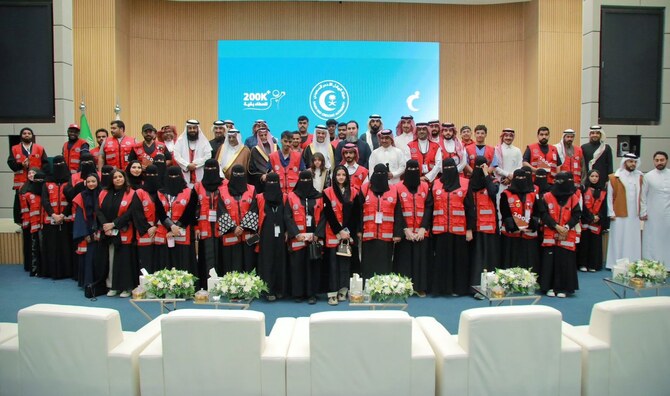
Saudi Arabia’s Red Crescent celebrates contributions from volunteers

Saudi volunteers were honored at the Red Crescent Authority's annual ceremony, Dec. 4 (SPA)
Short Url
Updated 05 December 2024
Follow

Saudi Arabia’s Red Crescent celebrates contributions from volunteers

  • 47,946 volunteer opportunities across the Kingdom in 2024, contributing nearly 119m hours
  • Organization says women significantly outnumber men, 54 percent of volunteer base 

RIYADH: The Saudi Red Crescent Authority honored its volunteers at its annual ceremony on Wednesday, revealing statistics of financial outcomes and volunteer projects in 2024.

In the presence of key figures in the humanitarian sector, the SRCA stressed that volunteering remained central to its social mission and an integral part of Vision 2030.

The SRCA honored the efforts put into projects in the health, educational, environmental, and media sectors by some 211,703 officially registered volunteers in 2024. 

It said that 78 percent of its volunteers were under 30, with women significantly outnumbering men at 54 percent of the volunteer base, the Saudi Press Agency reported.

The SRCA recorded 47,946 volunteer opportunities across Saudi Arabia during the year, leading to nearly 119 million volunteering hours that contributed an estimated SR366 million ($97m) to the national economy. 

The SRCA also facilitated a diverse range of volunteer activities in 2024, the SPA reported.

In the ambulance services it supported 8,435 opportunities, contributing to nearly 20 million hours of work, while it created 7,965 humanitarian aid openings which led to 88 million hours, and 13,770 educational initiatives with nine million hours of volunteering.

In the environmental sector it supported 935 opportunities totaling 258,023 hours, while media activities saw 924 opportunities with 108,563 hours, and administrative roles had 5,917 opportunities adding up to 899,058 hours.

The SRCA thanked its partners in the country’s public and private sectors for promoting a volunteer culture within their organizations. It also celebrated the success of Kafo, a program designed to incentivize and reward volunteering efforts.


Iranian ambassador thanks Saudi for not allowing territory to be used during war

Updated 43 min 55 sec ago
Follow

Iranian ambassador thanks Saudi for not allowing territory to be used during war

  • Alireza Enayati tells AFP Iran appreciates Kingdom's pledge not to allow its 'airspace, waters, or territory' to be used in US attacks
  • Envoy also denies that his country hit the US embassy in Riyadh this week with drones

RIYADH: Iran’s ambassador to Saudi Arabia Alireza Enayati said on Thursday his country remained appreciative of Saudi Arabia’s pledge to not allow its airspace or territory to be used during the ongoing war with the US and Israel.
“We appreciate what we have repeatedly heard from Saudi Arabia — that it does not allow its airspace, waters, or territory to be used against the Islamic Republic of Iran,” he told AFP.
Before the outbreak of war, Riyadh had thrown its support behind diplomatic efforts to diffuse tensions between Tehran and Washington and vowed that its airspace would not be allowed to be used for attacks against Iran.
Enayati also categorically denied that his country hit the US embassy in Riyadh this week, after Saudi officials said Iran targeted the compound with drones.
Saudi Arabia has repeatedly accused Tehran of launching missile salvos and drone attacks at its territory and warned that the kingdom reserved the right to defend itself, including by retaliating.
Iran had earlier denied attacking the sprawling Ras Tanura refinery — one of the largest in the Middle East — which Riyadh had also accused Tehran of targeting twice with drones.
Enayati added to the denial, saying Iran also had no hand in the targeting of the US embassy that triggered a fire at the compound.
“We confirmed that Iran has no role in the attack on the US embassy in Riyadh,” the ambassador told AFP.
“If the operations command in Tehran attacks somewhere, it takes responsibility for it.”
The war in the Middle East has engulfed the otherwise stable Gulf region as Iran retaliates over US and Israeli strikes that killed its supreme leader, launching strikes at Israel, the wider region and beyond.
At least 13 people have been killed in the Gulf, including seven civilians, since Iran began its attacks on Saturday.
Enayati, however, denied that Iran was waging a regional war as retaliation for the attacks on his country by the US and Israel.
“This is not a regional war and it is not our war. It was imposed on the region,” he told AFP.