

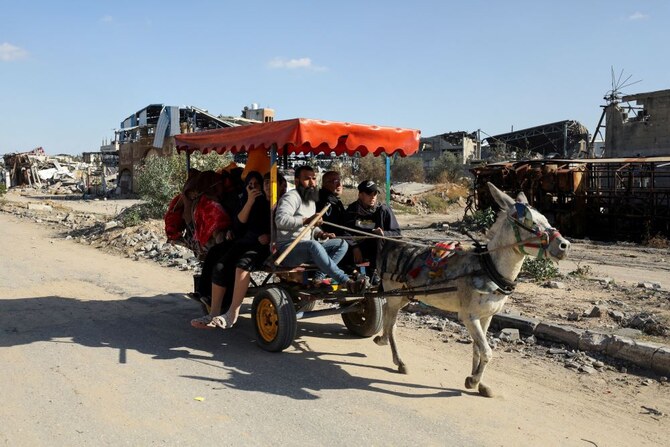

NEW YORK: Nearly 76 million people around the world are currently displaced within their own countries, according to the UN’s special advisor on internal displacement, Robert Piper.
This staggering number highlights the growing crisis of internally displaced persons who, unlike refugees, have not crossed international borders and often remain hidden from global attention.
Speaking in New York at a conference marking the end of his mandate, Piper highlighted the severe challenges in addressing the plight of IDPs, particularly those displaced by conflict, disasters and criminal violence.
“Seventy-six million people have lost their homes, livelihoods and communities. They make up the overwhelming majority of the world’s 120 million displaced persons,” he said.
“Yet they remain largely invisible, with no dedicated global agency or global treaty or compact for IDPs, no international day that singles them out, and their numbers have doubled in just the last 10 years.”
Piper told Arab News that in the past five years alone, 20 million IDPs were added to the global total, with much of the increase coming from conflict zones such as Ukraine, Gaza, Lebanon, the Democratic Republic of Congo and Sudan, “which has unfortunately broken all the records.”
Climate change is exacerbating the problem as extreme weather events displace millions each year.
“There has been a tremendous amount of disaster-induced displacement during the past five years as well. Pakistan’s floods displaced 8 million people. The Turkish earthquake displaced millions,” Piper said.
“But the difference is that generally speaking, people are getting home much more quickly after disasters,” whereas tens of millions of people displaced because of conflicts remain so for many years, he added.
So the UN’s approach has shifted in recent years, with a growing recognition that long-term solutions, not just humanitarian aid, are required.
Piper emphasized that while governments in countries such as Iraq, Somalia and Nigeria have taken significant steps toward resolving displacement issues, more needs to be done.
These countries have developed national strategies to assist displaced populations, with Iraq and Libya, for example, committing to fully fund their own solutions processes.
Somalia’s recent commitment of $140 million for land purchases to integrate displaced people marks another important milestone.
Piper told Arab News that “pathways to solutions” involve ensuring displaced people have access to housing, services and livelihoods.
They also focus on compensation and justice, helping IDPs restore their legal rights and integrate into local communities.
“It’s access to services, restoring those services if they’ve gone home, or giving them access to services in their place of displacement, if that’s where they choose to settle,” Piper said.
“It’s about access to a livelihood of some kind, whether it’s agricultural or urban. These are the fairly obvious kinds of conditions that everyone needs to rebuild a life.
“Perhaps less obvious are other elements of this work, compensation and justice, a recognition of what has happened to them, what they’ve lost, their inclusion in civic life.
“Often this involves allowing them to be elected, to vote in their local constituency. And in some cases it’s restoring their documentation, their identity because, indeed, many IDPs are displaced so rapidly that they lose their legal documentation.”
Piper stressed that the core of these efforts is government leadership. “Governments must take responsibility, but they also need the right kind of support from the international system, more investment in development, better capacity building, and less focus on short-term fixes,” he said.
The UN has also reorganized its structures to better support governments in resolving displacement issues.
New funding mechanisms, such as the Solutions Fund, have been created to accelerate progress, while financial institutions such as the World Bank and the African Development Bank have begun incorporating IDP solutions into their assessments and scorecards.
Piper also highlighted the challenges of working in conflict zones where governments may be part of the problem rather than the solution.
He pointed to Gaza, Myanmar and Sudan, where ongoing violence and political instability make it impossible to implement the UN’s model for long-term displacement solutions.
“In places like Gaza, the conditions aren’t conducive to solutions at this moment,” he said. “The UN’s role is primarily focused on humanitarian aid and protection, not on the long-term solutions we’re advocating in other countries.”
Piper highlighted the importance of moving beyond humanitarian assistance to address the root causes of displacement and ensure long-term stability for displaced populations.
He pointed to the UN’s efforts to make IDP solutions a priority at the international level, including discussions at climate change conferences and other forums.
Piper expressed confidence that the groundwork has been laid for more effective solutions, but stressed that continued global attention and investment are critical. “The numbers are rising, and without continued progress, this crisis will only deepen,” he warned.
The focus on long-term solutions, he said, is not only about addressing the immediate needs of IDPs, but also about creating the conditions for them to rebuild their lives and communities sustainably.


