

Saudi Arabia to increase green spaces, promote afforestation

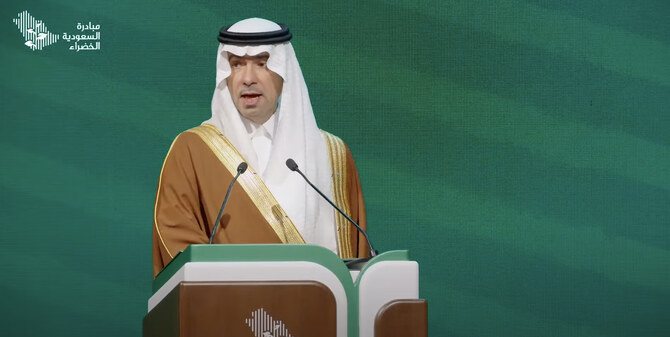
Saudi Minister of Municipal, Rural Affairs, and Housing Majid Al-Hogail said his ministry has developed initiatives and an effective strategic plan to support the Saudi Green Initiative.
Short Url
Updated 04 December 2024
Follow

Saudi Arabia to increase green spaces, promote afforestation

RIYADH: Saudi Arabia is working to expand its green spaces and accelerate afforestation efforts, according to the Kingdom's minister of municipal, rural affairs, and housing.

During the keynote address at the session titled "Urban Green Spaces: Leveraging Nature-Based Carbon Capture Solutions" on the second day of the fourth Saudi Green Initiative Forum in Riyadh, Majid Al-Hogail shared that the Ministry of Municipal, Rural Affairs, and Housing has developed initiatives and an effective strategic plan to support the Saudi Green Initiative.

This aligns with the critical role urban green spaces play in utilizing nature-based carbon capture solutions to address climate change. It also complements the Kingdom’s commitment to rehabilitating over 74 million hectares of land. To date, 94,000 hectares of degraded land have been restored, and since 2021, 49 million plants and shrubs have been planted.

“The Ministry of Municipalities and Housing is part of this transformation,” Al-Hogail said. “We are pleased to increase the percentage of green spaces, encourage afforestation, and ensure the efficient use of resources within the framework of Saudi Vision 2030, which prioritizes citizens' quality of life.”

He added, “The Kingdom has made tangible progress in enhancing environmental sustainability, improving air quality, and reducing carbon emissions.”

Al-Hogail also emphasized that achieving SGI’s goals requires coordinated efforts from all sectors and individuals.

“What the Ministry of Municipalities and Housing has done in this regard is far greater than what has been reviewed. However, we confirm that we will remain an active partner in realizing this ambitious vision and our commitment to transforming the cities of the Kingdom into global models of innovation and quality of life, building a greener future,” he said. “We have also encouraged the private sector to adopt social responsibility programs to support afforestation, reflecting the collaboration between the public and private sectors in achieving our common goals.”

During the panel discussion, Aljawhara Al-Quayid, head of the Climate and Sustainability Program at the King Abdullah Petroleum Studies and Research Center, highlighted the role cities must play in reducing emissions.

“Utilizing and optimizing all potential solutions is definitely a priority, and one of these is maximizing the carbon sequestration potential of urban green spaces,” Al-Quayid stated.

She further explained that Saudi Arabia recently launched the Saudi Greenhouse Gas Crediting Mechanism, a milestone that lays the foundation for an effective carbon market in the Kingdom and the broader region.

“These initiatives are driven not only by the government but also by the Public Investment Fund’s creation of a trading platform through its regional voluntary carbon market company,” she added. “These two accrediting mechanisms and the trading platform are the key enablers of the carbon market.”

Donnel Baird, founder of BlocPower, also participated in the session, explaining his company's work.

“My company, BlocPower, turns buildings into Teslas. What does that mean? Just as Tesla replaced fossil fuel engines in cars with all-electric engines, we can replace fossil fuel-based heating, cooling, and hot water systems in buildings with solar-powered, wind-powered, all-electric systems,” Baird explained.

This year’s Saudi Green Initiative Forum, held on Dec. 3-4 as part of COP16, is addressing global environmental challenges such as land rehabilitation, carbon reduction, and sustainable financing. The event also explores the role of natural solutions in helping communities adapt to climate change, while emphasizing efforts to preserve the Kingdom’s rich biodiversity, according to an official statement.


SABIC sells European petrochemicals, engineering plastics units in $950m portfolio restructuring 

Updated 14 sec ago
Follow

SABIC sells European petrochemicals, engineering plastics units in $950m portfolio restructuring 

RIYADH: Saudi Basic Industries Corp. is selling two overseas businesses for a combined $950 million as the world’s biggest petrochemicals maker continues to streamline its portfolio and redeploy capital toward higher-return segments. 

The Riyadh-based company agreed to sell its European petrochemicals business to investment firm AEQUITA for $500 million and its engineering thermoplastics operations in the Americas and Europe to turnaround specialist Mutares for $450 million, SABIC said in a release.

The plastics deal includes an earn-out linked to future cash flow and a potential resale. 

The transactions are part of SABIC’s portfolio optimization program launched in 2022, which has already seen divestments including Functional Forms, Hadeed and Alba. The company aims to sharpen its focus, improve returns, and free up capital for higher-growth opportunities. 

Abdulrahman Al-Fageeh, CEO of SABIC, said: “This strategic approach allows us to actively reshape our portfolio and sharpen our focus on areas where SABIC has clear and sustainable competitive advantages in a rapidly changing landscape.” 

He added: “I am pleased that both AEQUITA and Mutares will work with us in the future to ensure that we continue to serve our global customers in a seamless manner.” 

The European petrochemicals business produces ethylene, propylene, various grades of polyethylene, polypropylene and polymer compounds. Its manufacturing footprint includes sites in the UK, the Netherlands, Germany and Belgium. 

The engineering thermoplastics business in the Americas and Europe produces polycarbonate, polybutylene terephthalate and acrylonitrile butadiene styrene. Its facilities are located in the US, Mexico, Brazil, Spain and the Netherlands. 

“The Board endeavored to achieve these transactions, which represent a significant milestone in the execution of our strategy to further optimize our portfolio and maximize shareholder value by enhancing the Company’s cash generation capacity and achieving the highest possible return on our global businesses,” said Khalid Al-Dabbagh, chairman of the board of directors of SABIC. 

Chief Financial Officer Salah Al-Hareky said the transactions demonstrate a “disciplined approach” to capital allocation and active portfolio management, aimed at improving return on capital employed and free cash flow. 

Despite the divestments, SABIC said it will maintain strategic market access through exports to Europe and the Americas, while preserving its focus on technology, innovation and customer service. 

Both buyers have committed to ensuring business continuity, retaining workforce expertise and maintaining high safety and customer service standards during the transition. 

Axel Geuer, president and co-CEO of AEQUITA, said: “This transaction represents a further step in the expansion of our European chemicals platform.” 

He added: “The assets are highly synergistic with the olefins and polyolefins business we recently acquired from LYB; with complementary markets, infrastructure and operational capabilities, we see substantial potential to realize synergies and drive operational improvements across both businesses.” 

Geuer, noted that under AEQUITA’s active ownership model, the focus will be on supporting the teams on the ground, ensuring a seamless integration, and building a scaled, competitive platform positioned for long-term, sustainable value creation. 

Robin Laik, co-founder and CEO of MUTARES, said: “The Engineering Thermoplastics (ETP) business in the Americas and Europe has a highly skilled workforce and strong customer relationships.” 

He added: “Under focused ownership, our priority is to ensure continuity, support employees through the transition, and unlock the full potential of our asset base as a standalone ETP platform.” 

The deals are subject to customary closing conditions, regulatory approvals, and, where applicable, employee consultation processes.
