ISLAMABAD: Punjab Chief Minister Maryam Nawaz Sharif has launched a first of its kind project to clean up cities and villages in Pakistan’s largest province, setting a three-month zero waste target as the South Asian nation of 240 million grapples with a growing waste management problem.
According to the Waste Management update by the International Trade Administration, Pakistan generates nearly 49.6 million tons of solid waste annually. In big cities, 60 percent of the solid waste is collected daily while 40 percent remains in empty plots, street corners, abandoned buildings, open drains and nullahs.
Pakistan has few managed landfill sites for waste disposal. Most collected solid waste in Punjab, which has a population of around 128 million, is simply dumped in open sites.
All major cities face enormous challenges on how to manage urban waste. Bureaucratic hurdles, lack of urban planning, inadequate waste management equipment and technology, and low public awareness contribute to the problem.
“For the first time, the Punjab government has launched a program to clean cities and villages on a uniform basis,” Sharif said at a ceremony to launch the ‘Suthra Punjab’ program across the province. “Keeping our streets and neighborhods like our own houses is our foremost duty.”
She said around 100,000 people would be employed for the project within a few weeks and engaged to clean city roads and streets.
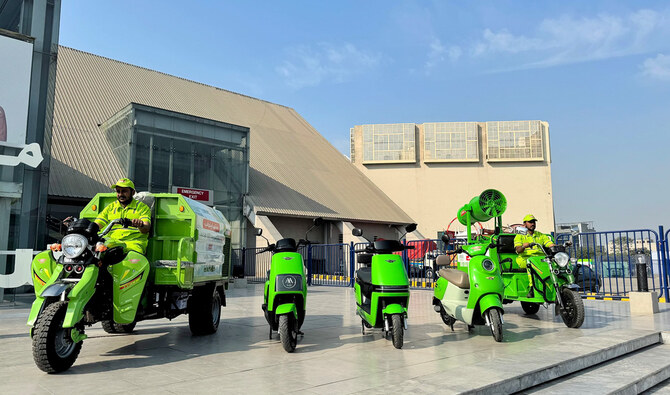
“As many as 21,000 modern machines and more than 80,000 equipment are being provided for cleaning and garbage collection across Punjab,” the CM said. “The industry related to sanitation and waste management will be promoted.”
Local and municipal governments are responsible for collecting waste throughout most of Pakistan’s major cities. In cities, about 60–70 percent of solid garbage is collected, with the garbage collection fleet typically consisting of open trucks, tractor/trolley systems, and arm roll containers/trucks for secondary collection and transfer. Handcarts and donkey pull-carts are used for primary collection. Some municipalities hire street sweepers and sanitary workers to augment other collection methods. They use wheelbarrows and brooms to collect solid waste from small heaps and dustbins, then store it in formal and informal depots.
Karachi, Pakistan’s largest city, makes use of three sanitary landfill sites, whereas Lahore, the country’s second-largest city and the provincial capital of Punjab, has two such sites. There are plans to construct appropriate landfill sites in other major cities as well. In several regions, solid waste is disposed of outside the boundaries of the urban areas.
Solid waste management capabilities and systems vary by province. In Punjab, Lahore is the only city with a proper solid waste management, treatment, and disposal system, which was outsourced to Turkish companies Albayrak and OzPak.
In Sindh, the Sindh Solid Waste Management Board (SSWMB) aims to improve solid waste management services in 20 cities, and regularly announces tenders for a wide range of waste management projects in the province. In Khyber Pakhtunkhwa, the Water and Sanitation Services Peshawar (WSSP) is planning to build a sanitary landfill. Balochistan, Pakistan’s largest province by area but with a sparse population of 6.9 million, has no significant infrastructure for waste management.
Much of Pakistan’s solid waste is retrieved for recycling, primarily by scavengers, before it ever reaches disposal locations, and a large portion of the country’s solid waste never makes it to final disposal sites.


![]()

Pakistan’s largest province launches project to clean cities, sets three-month zero waste target
Short Url
https://arab.news/4646v
Pakistan’s largest province launches project to clean cities, sets three-month zero waste target
- Pakistan is estimated to generate approximately 49.6 million tons of solid waste per year
- Most collected waste in Punjab, province of 128 million people, is dumped in open sites
Latest updates





© 2026 SAUDI RESEARCH & PUBLISHING COMPANY, All Rights Reserved And subject to Terms of Use Agreement.