DHAKA: A court in southeastern Bangladesh on Tuesday rescheduled a bail hearing for a jailed prominent Hindu leader who led large rallies in the Muslim-majority country demanding better security for minority groups.
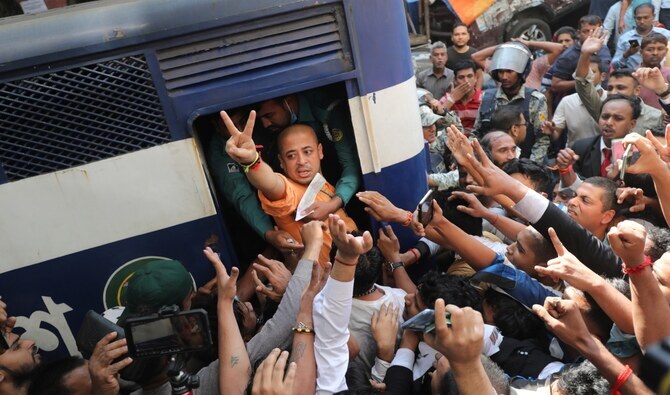
Krishna Das Prabhu, who was arrested in Bangladesh’s capital, Dhaka, last week, faces charges of sedition after he led huge rallies in the southeastern city of Chattogram. Hindu groups say there have been thousands of attacks against Hindus since early August, when the secular government of Prime Minister Sheikh Hasina was overthrown.
Prabhu’s arrest comes as tensions spiked following reports of the desecration of the Indian flag across Bangladesh, with some burning it and others laying it on the floor for people to step on.
Bangladesh’s Foreign Ministry on Tuesday summoned India’s envoy, Pranay Verma, a day after a group of Hindus in Agartala, the capital of the northeastern Indian state of Tripura, stormed a consulate office of Bangladesh in protest over Prabhu’s arrest.
Anti-India protests were held in Dhaka, where security at the Indian High Commission was increased, and elsewhere over the incident in Agartala.
Relations between India and Bangladesh deteriorated after Hasina fled to India in the wake of mass protests which left hundreds of protesters dead and thousands wounded. India has since stopped issuing visas for Bangladeshi nationals, except for medical treatment.
India, which sheltered 10 million refugees and helped Bangladesh gain independence through a nine-month bloody war against Pakistan in 1971, considers Hasina as a trusted friend. Hasina’s father Sheikh Mujibur Rahman was the independence leader of Bangladesh, then the eastern part of present day Pakistan.
The detention of Prabhu sparked violent protests by his supporters. A Muslim lawyer was hacked to death near the court in Chattogram hours after the news of his jailing surfaced and his supporters clashed with security forces. The situation caused concern in Hindu-majority India and the Bangladesh interim government, led by Nobel peace laurate Muhammad Yunus.
No reason was given why Prabhu, also known as Chinmoy Krishna Das Brahmachari, did not attend Tuesday’s court hearing.
Public Prosecutor Mofizul Haque Bhuiyan told The Associated Press by phone that Chattogram Metropolitan Session Judge Saiful Islam ordered a bail hearing be held on Jan. 2 after the prosecution petitioned for more time to study the case. He also said no defense lawyer represented Prabhu in court.
Two Hindu leaders who are close to Prabhu said that they were afraid to attend the court as many of the lawyers who represented Prabhu had faced cases after last week’s violence.
“A group of lawyers stood last time for him (Prabhu). Cases have been filed against at least 70 of them and many others willing to take part in the hearing today have been threatened,” one Hindu leader in Chattogram told the AP on condition of anonymity.
“Why was he (Prabhu) not brought to the court today? He is in police custody. He could have spoken for himself before the court if he was taken to the court. It’s a ploy to delay his release from prison, this is not justice,” the leader said.
In Dhaka, a group of Islamists under the banner of Islamic Movement Bangladesh rallied in front of the country’s main Baitul Mukarram Mosque in protest at Monday’s incident in Agartala. Another group, under the banner of Bangladesh Citizens’ Society, separately marched through the streets.
Protests were also organized by the Bangladesh Nationalist Party, headed by former Prime Minister Khaleda Zia, in Barishal and Khulna cities. Hasina and Zia are arch rivals.
India’s Ministry of External Affairs said Monday that the attack on the Bangladesh Assistant High Commission in Agartala was “deeply regrettable.”
“Diplomatic and consular properties should not be targeted under any circumstances,” a ministry statement said.
It added that India was stepping up security arrangements at the Bangladesh High Commission in New Delhi and other diplomatic offices in the country.
Bangladesh’s Ministry of Foreign Affairs condemned the attack in Agartala and demanded security to prevent any further acts of violence against its diplomatic missions in India.
“The accounts received conclusively attest that the protesters were allowed to aggress into the premises by breaking down the main gate of Bangladesh Assistant High Commission in a pre-planned manner,” the foreign ministry said.
The Bangladesh Hindu Buddhist Christian Unity Council, an umbrella organization of the country’s minority groups, has denounced the arrest of Prabhu and called for his release.
Prabhu is a spokesman for the Bangladesh Sammilito Sanatan Jagaran Jote group. He was also associated with the International Society for Krishna Consciousness, widely known as the Hare Krishna movement.
Hindus and members of other minority groups say they have faced attacks since the ouster of Hasina. Yunus has said the threat to Hindus has been exaggerated.
Around 91 percent of Bangladesh’s population is Muslim, with Hindus making up almost all of the rest.
Bangladesh has faced political and social tensions since Hasina’s fall after a mass uprising ended her 15-year rule. Her critics had accused her of becoming autocratic.
The interim government has been struggling to establish order amid a background of mob justice, street protests, police administration issues and political uncertainty, with Yunus repeatedly urging for calm.


![]()

Bangladesh court defers Hindu leader’s bail hearing as tensions with India spike
Short Url
https://arab.news/4z7ga
Bangladesh court defers Hindu leader’s bail hearing as tensions with India spike
- Krishna Das Prabhu, who was arrested in Bangladesh’s capital last week, faces charges of sedition after he led rallies in Chattogram
- Hindu groups say there have been thousands of attacks against them since August, when secular government of PM Hasina was overthrown
Latest updates



© 2026 SAUDI RESEARCH & PUBLISHING COMPANY, All Rights Reserved And subject to Terms of Use Agreement.