Pakistani PM says prioritizing participation in leadership roles for people with disabilities

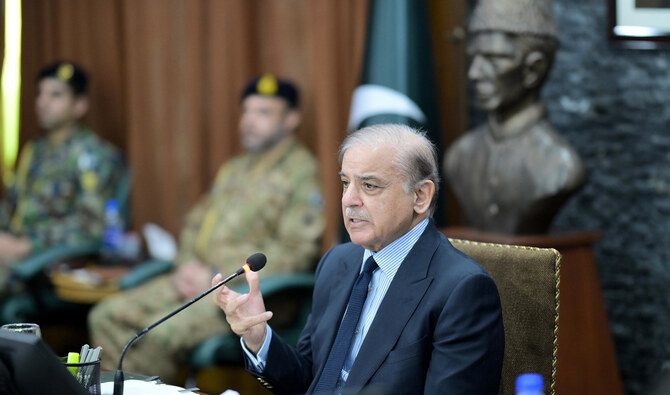
In this file photo, taken on November 6, 2024, Pakistan Prime Minister Shehbaz Sharif speaks during a special meeting with Gilgit Baltistan Cabinet in Gilgit. (Photo courtesy: PMO/File)
Short Url
Updated 03 December 2024
Follow

Pakistani PM says prioritizing participation in leadership roles for people with disabilities

  • 2024 theme for International Day Of Persons With Disabilities is ‘Amplifying leadership of persons with disabilities’
  • As many as 27 million people in Pakistan may be living with disabilities, both intellectual and physical, HRW says

ISLAMABAD: Pakistan is prioritizing the participation in leadership roles of people with disabilities, Prime Minister Shehbaz Sharif said as he joined the international community in commemorating the International Day Of Persons With Disabilities today, Tuesday.
The 2024 theme for the annual day is ‘Amplifying the leadership of persons with disabilities for an inclusive and sustainable future,’ connoting the basic requirements of participation, representation and inclusion and calls for persons with disabilities to actively shape the conditions of their lives.
People with disabilities can play important roles in leadership, and their unique perspectives can lead to better services for people with disabilities, rights bodies say. They can also help ensure that organizations are accountable for actions that affect people with disabilities.
“This year’s theme, ‘Amplifying the Leadership of Persons with Disabilities for an Inclusive and Sustainable Future,’ highlights a vital truth: the journey toward a more inclusive world must be led by those who understand its challenges firsthand,” Sharif said in a statement. 
“We are prioritizing their participation in leadership roles, ensuring that their perspectives guide our national development strategies, and building a society that values their contributions as leaders, innovators, and changemakers.”
An estimated 1.3 billion people – about 16 percent of the global population – currently experience significant disability. As many as 27 million people in Pakistan may be living with disabilities, both intellectual and physical, according to Human Rights Watch.
Sharif said initiatives such as enhancing access to assistive technologies, improving inclusive infrastructure, and ensuring the implementation of disability-friendly laws were central to Pakistan’s vision.
“We are taking meaningful steps to ensure that persons with disabilities are provided with equal opportunities in education, employment, health care, and public life. Our government is working diligently to implement comprehensive policies that address accessibility, empower individuals with disabilities, and break down societal barriers that hinder their full participation.”
Sharif also highlighted the need to acknowledge the invaluable contributions of caregivers, advocates, and organizations working to support persons with disabilities.
“I urge our institutions, businesses, and civil society to play their role in breaking down barriers and fostering environments where persons with disabilities can contribute as leaders,” the PM added. 
“We must also make conscious efforts to challenge behaviors and attitudes that perpetuate stigma and discrimination, replacing them with understanding and respect.”


Pakistan rules out military operation in northwestern Tirah Valley 

Updated 1 min 16 sec ago
Follow

Pakistan rules out military operation in northwestern Tirah Valley 

  • Residents in the northwestern Tirah Valley fled their homes this month fearing a military operation against militants
  • Khawaja Asif says army conducting intelligence-based operations in area, migration “routine” practice due to harsh cold 

ISLAMABAD: Defense Minister Khawaja Asif on Tuesday clarified that the military was not conducting a military operation in the northwestern Tirah Valley, saying that the ongoing residents’ migration from the area was a routine practice due to the harsh cold in the area during the winter season. 

The defense minister’s clarification came as residents of Tirah Valley in Pakistan’s northwestern Khyber Pakhtunkhwa (KP) province bordering Afghanistan fled their homes this month, fearing a planned military operation by the army against militants, particularly the Tehreek-e-Taliban Pakistan (TTP) group. 

Pakistan’s information ministry on Sunday issued a clarification that the armed forces were not involved in the “depopulation” of the valley. It pointed to a notification from the provincial Khyber Pakhtunkhwa Relief, Rehabilitation and Resettlement Department in December which demanded the release of funds, reportedly Rs4 billion [$14.24 million], for the voluntary movement of people from Tirah Valley. 

Speaking to reporters at a news conference alongside Information Minister Attaullah Tarar and Special Assistant to the PM for Information and KP Affairs Ikhtiar Wali Khan, Asif said the last military operation in the area was conducted several years ago. He said the military had decided that intelligence-based operations (IBOs) were more effective than military operations as they resulted in lower civilian casualties. 

“So over a long period of time, the army gave up [military] operation in favor of IBOs,” Asif said. “For many years this practice has been continuing. Hence, there is no question of an operation there.”

The defense minister described the migration of residents from Tirah Valley as a “routine” practice that has been taking place since decades due to the freezing cold in the winter season. 

He criticized the provincial government, led by the Pakistan Tehreek-e-Insaf (PTI) party for not serving the people of the area, accusing it of not building any schools, hospitals, or police stations in Tirah Valley.

Asif said around 400-500 TTP members lived in the valley with their families, alleging that hemp was being harvested there on over 12,000 acres of land. He said that while hemp is also used for medicinal and construction purposes, its dividends were going to militants and politicians. 

“All of this hemp is harvested there and the dividends from it either go to the people associated with politics or the TTP,” the minister said.

“We have initiated the process to stop this so that the people benefit from this harvest and so that schools and hospitals are constructed there.”

The minister said that a district-level jirga or tribal council met representatives of the KP government on Dec. 11, 24 and 31 to decide matters related to the residents’ migration in the area. 

Holding up the KP Relief, Rehabilitation and Resettlement Department notification, Asif said:

“In the presence of this notification, in the presence of this tribal council and in the presence of all of these things, where do you see the army?“

The minister accused the provincial government of deflecting its “failures” in the province to the armed forces or to a military operation that did not exist. 

The migration has exposed tensions between the provincial government and the military establishment over the use of force in the region.

KP Law Minister Aftab Alam Afridi said earlier this month that the provincial government will not allow a military operation to take place in the area, arguing that past military campaigns had failed to deliver lasting stability.