CHAKWAL, Pakistan: A public school in Pakistan’s Punjab province has set up a special center offering free education and speech and behavioral therapy to over a dozen children with autism spectrum disorder (ASD), a neurological and developmental disorder that affects how people interact with others, communicate, learn, and behave.
According to the non-profit Autism Society of Pakistan (ASP), around 350,000 children in the country have ASD, though there is no reliable official data to corroborate this figure. Autism spectrum disorders range from Asperger syndrome, a relatively mild communication disorder, to severe autism in which patients communicate little or not at all with others and may display severely debilitating behaviors such as rocking or banging their heads. About 40 percent of children with autism do not speak at all.
Autism is usually diagnosed between the ages of 3 and 5. There is no cure and no one knows the causes, but doctors are eager to identify autism as early as possible because therapeutic intervention can reduce its effects at an early age.
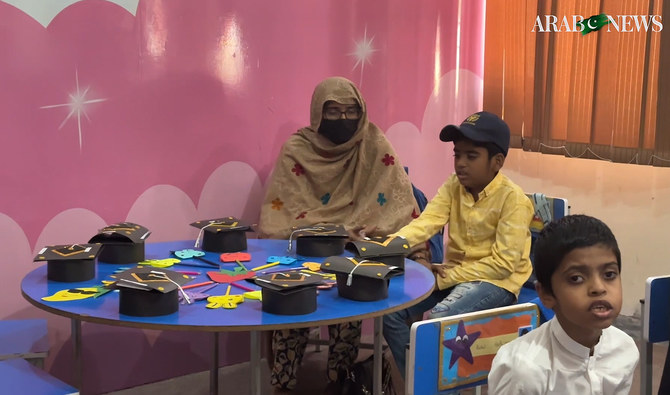
This intervention is exactly what is being offered at a special center established in the District Public School of Punjab’s Chakwal city last year. Seventeen children were initially enrolled in the center out of which two have graduated and gone on to attend mainstream schools, while 15 remain in the care of psychologists and therapists.
The center offers sensory, behavioral and speech therapy and has ADL (activities of daily living) classrooms where children are taught things like eating, bathing, brushing teeth, toileting, washing hands, dressing and undressing, and grooming. The center also has a separate bathroom and kitchen for children with ASD.
“A psychologist tests the children when the parents schedule a visit,” a teacher at the autism center, Umme Kulsoom, told Arab News. “We admit the child If they are diagnosed with autism level one,” the mildest, or “highest functioning” form of autism.
The work of Kulsoom and other teachers at the center is to determine the autistic child’s academic level by using various techniques such as testing their handgrip with pencils, coloring, drawing, and letter and sound recognition. Teachers the work with the children to improve their educational skills.
“Autism is a disorder in which the child’s focus and concentration needs to be worked on. Children can’t perform up to par academically as they have weak motor skills,” Kulsoom explained, saying the focus was on improving the child’s weaknesses before helping them pursue academics.
Psychologists working at the center give individual attention to each student to help them improve the performance of daily activities with sensory integration.
“It’s difficult to deal with these children as they have tantrums and mood swings but we are trained to handle them by using relaxation techniques to calm them down,” psychologist Maryam Jadoon said.
Psychologists at the center use a portage guide, a home-visiting educational service for pre-school children with additional support needs and their families, as well as applied behavioral analysis procedures that can help increase language and communication skills and improve attention, focus, social skills, memory, and academics.
The ADL room at the center has a bed, cupboard, hangers, and shirts to teach autistic children how to sleep, wake up, walk, comb their hair, brush their teeth, hand wash and dress.
Besides classwork, the teachers have also set up a dedicated WhatsApp group for parents on which they share videos and lessons to help them engage and teach children at home as well.
“We were not aware of autism before. When our daughter was diagnosed, we learned that there is a word like ‘autism’,” Javeria Arqam, a mother of two children with ASD, told Arab News.
“We visited different institutions in Chakwal, Islamabad, Karachi and Lahore before it, but the basic issue was that either they were offering [facilities for] academic or therapies. We were not able to find both of them together, but after coming here, we are getting almost all the facilities.
“QUITE WIDESPREAD”
The state-of-the-art autism center is the brainchild of the Punjab government and Chakwal Deputy Commissioner, Quratulain Malik.
“We provide speech therapy, clinical services, psychological assessments, cognitive disorders treatment and all other facilities required for boosting children’s confidence level,” Malik told Arab News.
“Ever since we have established this autism center, we have realized that the problem persists at quite a significant level, but parents were actually unaware,” she added.
“Now, they would bring their children and once they are diagnosed or once they are not diagnosed, at least they know where does the child stand. Many mothers who used to keep their child’s condition to themselves are now cooperative.”
Arab News sent a letter to the secretary of Punjab’s special education department seeking information on ASD figures and facilities, but didn’t receive a response till the filing of this report.
But while appreciating the efforts of the government, especially in providing free care for families that could not otherwise afford specialized care for ASD children, activists and experts said authorities needed to involve the private sector at public centers to improve facilities, clinical therapies, and education.
“Autism spectrum disorder is quite widespread in Pakistan as one in every three children is affected by it,” Maheen Gul-Malik, the founder of the Lahore Autism Center, told Arab News.
“The therapists and teachers hired in the public schools are not trained enough to extend individual attention to autistic children. There is also a need for constant monitoring of all activities at these centers through cameras.”


Government center in Pakistan’s Chakwal offers free education, therapy for children with autism
https://arab.news/vrwet
Government center in Pakistan’s Chakwal offers free education, therapy for children with autism

- Non-profit Autism Society of Pakistan says 350,000 children in the country have autism spectrum disaster
- 15 children currently enrolled at Chakwal center where they receive sensory, behavioral and speech therapy

Pakistan welcomes Afghan scholars’ reported resolution against use of soil for cross-border attacks
- Around 1,000 Afghan scholars passed a resolution this week prohibiting use of Afghan soil for cross-border attacks against another country, Afghan media reported
- Development takes place as tensions persist between Pakistan and Afghanistan amid Islamabad’s allegations of Taliban supporting cross-border attacks against it
ISLAMABAD: Pakistan’s foreign office spokesperson on Thursday welcomed a resolution reportedly passed by Afghan scholars against allowing the use of Afghan soil for attacks against any other country, but still demanded written assurances of the same from the Afghan leadership.
According to a report published by Afghan news channel Tolo News, around 1,000 Afghan scholars gathered in Kabul on Wednesday to pass a resolution that, among other things, said no one will be allowed to use Afghanistan’s soil against other countries for attacks. The resolution also said that if anyone fails to comply with this decision, the Afghan government has the right to take action against them.
The development takes place as tensions persist between Afghanistan and Pakistan. Both countries have engaged in border clashes since October, with Islamabad accusing Kabul of harboring militants that launch attacks on Pakistan.
Afghanistan denies the allegation and says it cannot be held responsible for Pakistan’s security.
Speaking to reporters during a weekly press briefing, Foreign Office spokesperson Tahir Andrabi said he had not seen the full text of the resolution.
“Any developments with regards to the fact that Afghan leadership, the segment of Afghan society, realized the gravity of the situation that their soil is being used by not just TTP, but also by their own nationals to perpetrate terrorism in Pakistan — any realization to this effect is positive and one would certainly welcome it,” Andrabi said.
However, he said similar commitments by Kabul on preventing cross-border attacks have been made in the past but were not honored.
Pakistan and Kabul engaged in a series of peace talks in Istanbul and Doha recently after their deadly border clashes in October. Andrabi pointed out that Islamabad had insisted on getting written assurances from the Afghan leadership that they would prevent Afghan soil from being used by the Pakistani Taliban and other militant groups. However, he said Islamabad had not received any.
He said the resolution by Afghan scholars does not qualify as a proper written assurance from Kabul as it does not explicitly mention Pakistan or the Pakistani Taliban.
’NO FORMAL EXTRADITION TREATY’
Commenting on media reports of Islamabad seeking extradition of certain individuals from the UK, Andrabi confirmed that there exists no formal extradition treaty between Pakistan and the UK. However, he said cases can still be processed individually.
“In the absence of a formal treaty, the extradition cases can be processed on a case-to-case basis,” the FO spokesperson said. “And certain cases were submitted to the British High Commission in Islamabad for their consideration.”
Pakistan last week asked the UK to extradite two prominent pro-Imran Khan figures, former accountability aide Shehzad Akbar and YouTuber-commentator Adil Raja, saying they were wanted on charges of anti-state propaganda.
The issue had been brought up during Pakistan Interior Minister Mohsin Naqvi’s meeting with British High Commissioner Jane Marriott in Islamabad. The Interior Ministry said Naqvi had formally handed over Pakistan’s extradition documents, requesting that Raja and Akbar be returned to Pakistan without delay.