

Saudi Arabia establishes ‘Friends of the Chair’ group to advance COP16 outcomes 

Short Url
Updated 02 December 2024
Follow

Saudi Arabia establishes ‘Friends of the Chair’ group to advance COP16 outcomes 

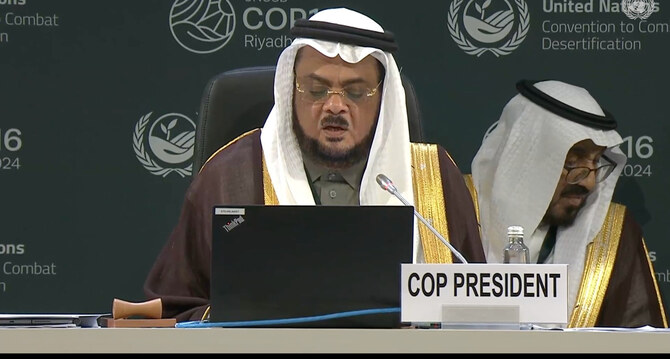
RIYADH: Saudi Arabia aims to secure concrete outcomes from COP16 by establishing a “Friends of the Chair” group tasked with drafting the Riyadh Policy Declaration, a key outcome document of the conference. 

Osama Faqeeha, Saudi deputy minister of environment and adviser to the COP16 presidency, announced the formation of the group, emphasizing its role in shaping the conference’s ministerial declaration. 

“The Friends of the Chair group will be facilitated by a group representing the COP presidency, and a report on the outcomes of its work will be submitted directly to me in my capacity as president,” Faqeeha said. 

This initiative underscores Saudi Arabia’s commitment to ensuring collaborative and actionable results from the conference. 

A Friends of the Chair group is an informal working body established during international conferences to assist in drafting key outcome documents or resolving complex issues. It is composed of representatives selected to support the conference presidency’s objectives. 

Gender equality and sustainable land management were among the major themes discussed at COP16. 

Hungary’s representative highlighted the critical importance of women in addressing challenges like desertification, land degradation, and drought, commending COP16 for its gender-focused initiatives. 

“We particularly welcome the efforts made by the UNCCD secretariat and the global mechanism to promote gender equality and empowerment of all women in the implementation of the convention, considering the crucial role of women in reaching these objectives,” the Hungarian representative said. 

Hungary’s remarks were part of broader discussions on pressing global issues, including drought resilience, sand and dust storms, and sustainable land use. 

These conversations reflected a growing international consensus on the need for gender-inclusive approaches to climate resilience and sustainability. 

Azerbaijan also contributed to the dialogue, emphasizing the importance of sustainable land management in achieving global climate and biodiversity targets, particularly those under the UN Sustainable Development Goal 15. 

“SDG 15, target three, which aims to strive toward land degradation neutrality by 2030, is a driving force for many countries to strengthen policies for sustainable land management,” the representative said. 

Azerbaijan further called for expanding the scope of the UNCCD to include all terrestrial ecosystems beyond the current focus on arid and semi-arid regions. 

“We encourage UNCCD to take further actions to consider the full range of terrestrial ecosystems for the UNCCD to be fully recognized as a global document,” the representative added. 

They also highlighted priorities like drought preparedness, wildfire management, and public-private partnerships to advance regional cooperation and sustainability. 

Running from Dec. 2 to 13, the first few days of COP16 are set to see a number of high-profile summits, ministerial dialogues, and announcements to address the pressing challenges associated with land degradation, degradation and drought. 

French President Emmanuel Macron is expected to be among the attendees, as is the President of the World Bank Ajay Banga. 


India and US release a framework for an interim trade agreement to reduce Trump tariffs

Updated 13 sec ago
Follow

India and US release a framework for an interim trade agreement to reduce Trump tariffs

NEW DELHI: India and the United States released a framework for an interim trade agreement to lower tariffs on Indian goods, which Indian opposition accused of favoring Washington.
The joint statement, released Friday, came after US President Donald Trump announced his plan last week to reduce import tariffs on the South Asian country, six months after imposing steep taxes to press New Delhi to cut its reliance on cheap Russian crude.
Under the deal, tariffs on goods from India would be lowered to 18 percent, from 25 percent, after Indian Prime Minister Narendra Modi agreed to stop buying Russian oil, Trump had said.
The two countries called the agreement “reciprocal and mutually beneficial” and expressed commitment to work toward a broader trade deal that “will include additional market access commitments and support more resilient supply chains.” The framework said that more negotiations will be needed to formalize the agreement.
India would also “eliminate or reduce tariffs” on all US industrial goods and a wide range of food and agricultural products, Friday’s statement said.
The US president had said that India would start to reduce its import taxes on US goods to zero and buy $500 billion worth of American products over five years, part of the Trump administration’s bid to seek greater market access and zero tariffs on almost all American exports.
Trump also signed an executive order on Friday to revoke a separate 25 percent tariff on Indian goods he imposed last year.
Indian Prime Minister Narendra Modi thanked Trump “for his personal commitment to robust ties.”
“This framework reflects the growing depth, trust and dynamism of our partnership,” Modi said on social media, adding it will “further deepen investment and technology partnerships between us.”
India’s opposition political parties have largely criticized the deal, saying it heavily favors the US and negatively impacts sensitive sectors such as agriculture. In the past, New Delhi had opposed tariffs on sectors such as agriculture and dairy, which employ the bulk of the country’s population.
Meanwhile, Piyush Goyal, Indian Trade Minister, said the deal protects “sensitive agricultural and dairy products” including maize, wheat, rice, ethanol, tobacco, and some vegetables.
“This (agreement) will open a $30 trillion market for Indian exporters,” Goyal said in a social media post, referring to the US annual GDP. He said the increase in exports was likely to create hundreds of thousands of new job opportunities.
Goyal also said tariffs will go down to zero on a wide range of Indian goods exported to the US, including generic pharmaceuticals, gems and diamonds, and aircraft parts, further enhancing the country’s export competitiveness.
India and the European Union recently reached a free trade agreement that could affect as many as 2 billion people after nearly two decades of negotiations. That deal would enable free trade on almost all goods between the EU’s 27 members and India, covering everything from textiles to medicines, and bringing down high import taxes for European wine and cars.
India also signed a comprehensive economic partnership agreement with Oman in December and concluded talks for a free trade deal with New Zealand.