

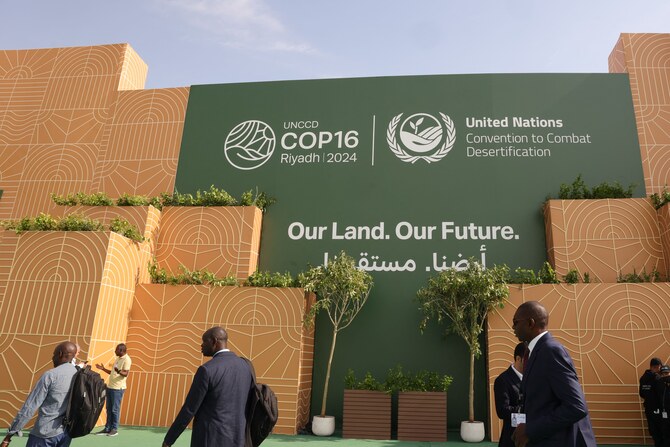
COP16 opens in Riyadh with $2bn pledged to combat global drought crisis

COP16 will run from Dec. 2 to 13 in Riyadh. AFP
Short Url
Updated 02 December 2024
Follow

COP16 opens in Riyadh with $2bn pledged to combat global drought crisis

RIYADH: A landmark initiative to tackle droughts secured $2 billion in funding on the opening day of COP16 in Riyadh.

In what is the largest-ever meeting of the UN Convention to Combat Desertification, COP16 President Abdulrahman Abdulmohsen Al-Fadhley announced the Riyadh Drought Resilience Partnership during a first day filled with high-level speeches.

Initially funded with $150 million from Saudi Arabia, more financing for the partnership was announced by the Islamic Development Bank and the OPEC Fund for International Development, with both pledging $1 billion each.

Drought has become a persistent reality for much of the world, increasing by nearly 30 percent over the past two decades and now accounting for 15 percent of all natural disasters globally. By 2050, three out of every four people on Earth could be affected, according to data shared during the opening session of COP16, which runs from Dec. 2 to 13.

“The launching of the Riyadh Global Drought Resilience Partnership aims at promoting multilateral efforts to promote resilience, namely in the countries most impacted by drought. It includes proactive partnerships to support the UNCCD,” Al-Fadhley said as he announced the new initiative.

During the Ministerial Dialogue on Drought Resilience, chairman of the Islamic Development Bank Muhammad Al-Jasser set out his institution’s motivation for injecting funds into the partnership, saying: “Drought remains an ever-present challenge. Of the 10 countries most exposed in 2024, six are Islamic Development Bank members.”

A delegate representing the OPEC Fund for International Development said its “substantial commitment” reflects a determination to support proactive solutions that restore degraded land, strengthen resilience, and enhance the well-being of vulnerable communities.

Saudi Arabia’s leadership in launching the Riyadh Drought Resilience Partnership was lauded as a proactive move to address the escalating crisis. 

“The global community is looking to us for tangible solutions. Strong political will and ambitious targets are essential,” said a South African delegate, urging the adoption of practical measures, including public-private partnerships and harmonized financial flows to build resilience.

Growing crisis: ‘Drought is no longer a future threat’

Speakers at the high-level ministerial dialogue painted a stark picture of the cascading effects of drought, from reduced crop yields and food insecurity to disrupted water and energy systems.

“A child born during a drought is more likely to suffer permanent learning deficiencies, which may pass on to future generations. This crisis perpetuates cycles of poverty and fragility,” warned Saroj Kumar Jha, global director for water at the World Bank.

The organization has discovered that developing economies are ten times more likely to suffer severe economic repercussions from drought compared to wealthier nations.

A call for unified action

Innovation also took center stage at COP16, with the launch of the World Drought Atlas. The Atlas provides critical insights into drought’s impacts on agriculture, ecosystems, and vulnerable communities.

Technologies like early warning systems and satellite monitoring were highlighted as vital tools in forecasting and mitigating drought risks.

“For every dollar invested in proactive measures such as land restoration, the return can be up to $10,” said the UNCCD Executive Secretary Ibrahim Thiaw.

A defining moment for global resilience

The conference signals a turning point in addressing drought not as an isolated event but as a systemic crisis requiring coordinated global action. 

“Drought management must shift from reactive crisis response to long-term preparedness and resilience,” said Thiaw, calling for investments in sustainable land management, inclusive solutions, and innovative financing mechanisms.


Artificial intelligence is transitioning into a ‘digital employee’

Updated 4 sec ago
Follow

Artificial intelligence is transitioning into a ‘digital employee’

  • AI can be an effective tool, business leaders tell Arab News
  • Not about jobs, but ‘convergence of human capital and AI’

RIYADH:  Artificial intelligence is fundamentally reshaping the world of work, transitioning from a supporting tool to an active partner that is radically changing the nature of professions and productivity standards.

Amidst the current global transformations, an active regional digital environment is emerging.

This is being led by Saudi Arabia through Vision 2030 and massive investments in smart infrastructure, providing a living model for studying the implications of this partnership between humans and machines on the future of work in the region.

Arab News spoke to various business leaders about the emerging shape of the sector.

Salem Bagami, co-founder of Metatalent, said the ideal relationship between humans and machines at work should be complementary and collaborative.

Humans would bring creativity, emotional intelligence, and complex decision-making, while machines excel at processing big data and performing repetitive, precise tasks.

He believes that this type of balanced partnership would lead to unprecedented productivity and innovation.

While machines excel at processing big data and performing repetitive, precise tasks, humans would bring creativity, emotional intelligence, and complex decision-making. (Supplied)

Mohammad Al-Jallad, chief technologist and director at HPE, said AI has gone beyond being merely an executive tool to becoming a “digital employee” entrusted with automating routine tasks and providing insights based on data analysis.

He believes that the real opportunity lies not in the debate over job replacement, but in “the convergence of human capital and artificial intelligence.”

AI should augment human teams by taking on menial and routine tasks, enabling employees to focus on critical thinking, creativity, and ethical reasoning, significantly improving operational results.

Bagami also emphasized the complementary nature of this partnership. “The ideal relationship between humans and machines at work is one of collaboration, where each complements the others.”

He explained that humans bring creativity, emotional intelligence, and nuanced decision-making, while machines excel at processing big data and performing repetitive tasks efficiently, leading to increased productivity and innovation.

Opinion

This section contains relevant reference points, placed in (Opinion field)

Salem Alanazi, chairman of Jathwa Technology Co., notes a significant trend among Saudi Arabia companies toward using AI applications to provide faster services to customers at lower costs.

The emergence of the “virtual employee” available around the clock has eliminated the need for some traditional jobs in specific sectors.

Alanazi warns that some companies’ reluctance to adopt AI may expose them to real risks. “All those who hesitated to benefit from AI applications have a lack of understanding of these technologies.”

He said those who adopt these technologies will be able to offer lower-cost, higher-quality services, which will affect the market position of companies that lag behind.

Ali Aljumhour, CEO of VALUE Consultancy, said that the transition of AI into a partner has reshaped the list of most in-demand skills in the job market.

Skills such as “prompt engineering,” “human-machine integration,” and “digital ethics” are becoming increasingly important.

He added that AI has become an instantly available “technical knowledge base,” shifting the criteria for professional distinction toward those capable of smart interaction with these technologies.

In terms of ethics, transparency, and trust, Alanazi points to the complexities of global AI governance, where legislation overlaps and evolves rapidly to keep pace with potential risks, particularly in the areas of cybersecurity and privacy.

Ali Aljumhour, CEO of VALUE Consultancy. (Supplied)

Al-Jallad emphasizes this crucial dimension, noting that providing responsible and reliable AI solutions that meet the highest standards of transparency is a key priority, especially in regulated sectors.

Bagami believes there should be basic standards for the ethical use of Al, emphasizing the need for transparency, accountability, and fairness, along with using diverse data sets to prevent bias and protect privacy.

He believes that building trust between humans and machines requires clear explanations of how systems work, giving users the opportunity to provide feedback and conducting periodic performance reviews.

On performance evaluation, Aljumhour said: “I expect radical changes in standards, shifting from measuring individual effort to evaluating the quality of the partnership between humans and machines.”

There should be a focus on the quality of inputs provided to intelligent systems, the accuracy of review and modification, and complex decision-making based on outputs.

He warns, however, of new risks that may arise, such as over-reliance on AI or difficulty in determining responsibility for mistakes.

In the employment sector, Aljumhour expects fundamental changes in standards.

There will be questions and tests focusing on measuring skills in dealing with AI, such as asking candidates about their experiences of collaborating with these systems, or testing their ability to formulate effective requests for complex tasks.

Aljumhour identifies significant human challenges in this transition, with “fear, loss of power, and exclusivity of knowledge” being the biggest concerns for experienced employees.