

COP16: Saudi Arabia vows to intensify action to tackle drought, land degradation

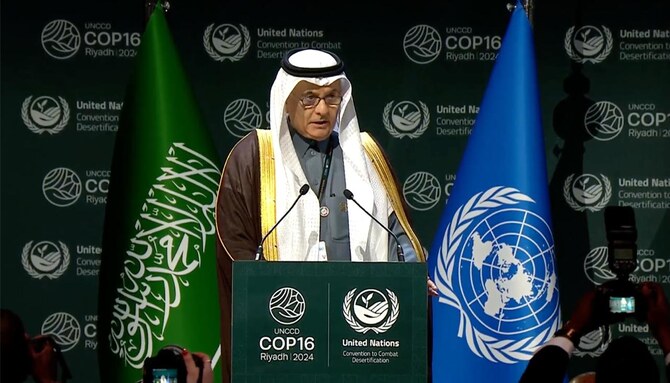
Abdulrahman Al-Fadli, the Kingdom’s minister of environment and COP16 president. Screenshot
Short Url
Updated 02 December 2024
Follow

COP16: Saudi Arabia vows to intensify action to tackle drought, land degradation

RIYADH: Saudi Arabia’s incoming COP16 president vowed to work with the international community to tackle drought and desertification on the first day of a UN conference in Riyadh.

Abdulrahman Al-Fadli, the Kingdom’s minister of environment, used his speech at the event – being held from Dec. 2 to 13 under the theme “Our Land. Our Future” – to reflect on the challenges facing the global community.

Outgoing COP15 president, Côte d'Ivoire’s Alain-Richard Donwahi, handed over leadership of the UN Convention to Combat Desertification with a call for continued urgency, while Ibrahim Thiaw, executive secretary of the UNCCD, warned that close to 40 percent of the planet’s surface is affected by land degradation. 

Al-Fadli said he was “honoured” to have been elected president, adding: “We look forward to intensifying action under this convention to face the challenges and promote integration between various international environment organizations.” 

Reflecting on the challenges ahead, he emphasized the Kingdom’s commitment to combating desertification, adding: “The Middle East is one of the regions most impacted by land degradation, drought, and desertification. We seek to address environmental challenges in partnership with the international community.” 

The environment minister highlighted Vision 2030 as a cornerstone for the Kingdom’s green agenda, saying: “Protecting the environment and natural resources is essential for achieving sustainable development and quality of life.”

Saudi Arabia’s environmental commitment  

Al-Fadli detailed the Kingdom’s objectives, including the Saudi Green Initiative, which aims to restore 40 million hectares of degraded land and increase national reserves by 30 percent by 2030.  

He added: “We have established initiatives and programs to limit pollution, develop vegetation cover, and improve waste management and meteorological services.” 

Addressing broader approaches, Al-Fadli highlighted that Saudi Arabia has adopted the National Environment Strategy and established a fund for environmental causes, as well as five specialized centers. 

He underlined efforts in renewable energy: “We aim to ensure more than 50 percent of our energy mix comes from renewable sources by 2030, reducing carbon emissions significantly.” 

Global and local perspectives 

Mayor of Riyadh Faisal bin Abdul Aziz bin Ayyaf highlighted the interconnected nature of environmental challenges, saying: “No country or city can address these challenges alone. Through international cooperation and collective work, we can find innovative solutions to restore our land and develop our cities.” 

He added: “We coordinate initiatives to ensure Riyadh can be a model for the world.” 

Amina Mohammed, deputy secretary-general of the UN, called for urgent global action, particularly around strengthening international cooperation on land degradation, ramping up restoration work, and mobilizing finance at scale. 

“Land sustains us, and we are destroying it. Action cannot wait,” she said. 
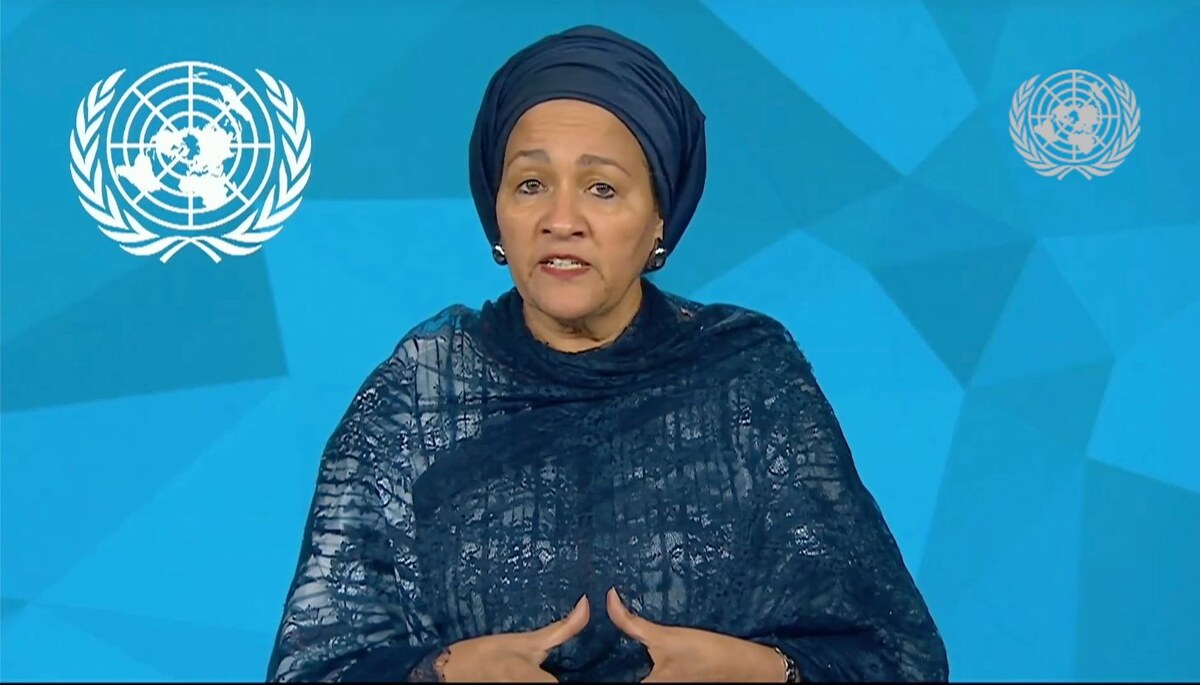


Amina Mohammed, deputy secretary-general of the UN. Screenshot

Outgoing president’s reflections 

COP15 president Donwahi praised Saudi Arabia’s capability to continue the battle against land degradation, saying there is no doubt in the Kingdom’s ability to  “elevate our shared legacy even further” as it stands at the forefront of challenges such as sandstorms and drought. 

Stressing the ongoing nature of the mission, he said: “We have remained optimistic. However, the situation remains urgent. We must go further and faster.” 

Donwahi acknowledged the progress made by previous COPs, particularly the inclusion of youth, saying: “For the first time, we have appointed a special youth envoy, a strong symbolic gesture that demonstrates our commitment to young people.” 

International collaboration 

Ibrahim Thiaw, executive secretary of the UNCCD, used his speech to warn that close to 40 percent of the planet’s surface is affected by land degradation. 

“This disease is progressing at a terrifying pace,” he added. 

Thiaw expressed his “deepest gratitude” to Saudi Arabia for its “vision in elevating the global land restoration and drought resilience agenda.” 

The conference also looked ahead to COP17 in Mongolia, with Prime Minister Luvsannamsrain Oyun-Erdene expressing his country’s readiness.


RLC Global Forum highlights role of Saudi youth in retail digital shift 

Updated 04 February 2026
Follow

RLC Global Forum highlights role of Saudi youth in retail digital shift 

RIYADH: Saudi Arabia’s young and highly digital population is reshaping how the Kingdom’s retail sector adopts new technologies and artificial intelligence, advancing faster than many global competitors, industry leaders told Arab News. 

Speaking on the sidelines of the RLC Global Forum in Riyadh, executives told Arab News that the intersection of a youthful population and strong investment in AI is driving a shift in the industry’s priorities. 

From understanding consumer behavior to leveraging the Kingdom’s growing status as a global AI leader, Saudi Arabia is becoming as a unique destination for the retail sector to thrive, learn, and evolve in the digital sphere. 

Abdullah Al-Tamimi, CEO of commercial real estate company Hamat Holding, told Arab News that the firm is keen to analyze and understand consumer behavior, with a particular focus on the younger generation as a key part of that insight. 

“Actually, it’s a big part of our day-to-day operation,” he said, adding that the company invests heavily in understanding customer needs and behavior and works to correct any missteps. 

Al-Tamimi emphasized paying close attention to small details, noting that younger consumers are especially sensitive to the overall experience and “deserve that we work around the clock in order to improve it.” 

He added that this focus “can be a competitive advantage for Saudi Arabia as well.” 

Al-Tamimi said that as the younger generation grows accustomed to new technology shaping retail customer experiences, Hamat Holding is leveraging AI to enhance them further. 

“We started a couple of initiatives improving digitalization,” he said, adding that the company sees digital tools as a way to enhance its work by automating day-to-day operations and allowing teams to focus on bigger-picture and more complex tasks. 

While the firm has expanded its use of technology, he stressed it has not replaced human workers, emphasizing the continued importance of human capital for creativity and interaction. “AI is a big part of our strategy,” Al-Tamimi added. 

Amit Keswani Manghnani, chief omnichannel and AI officer at luxury goods retailer and distributor Chalhoub Group, told Arab News that bridging a younger customer base with continuous digital development is key to advancing the Kingdom’s retail strategies. 

On Saudi Arabia’s demographics, he said: “We look at 2030 as really building products which serve especially the younger population, which is growing and very digitally savvy.” 

Manghnani underscored the unique characteristics of the Kingdom’s retail market as a tool for developing effective products and customer experiences. 

“So it’s very digitally savvy, much more than in other markets,” he said, noting that e-commerce penetration is rising not only through online purchases but also via digital catalogs that drive in-store visits. 

Manghnani said investment is focused on making products more digitally accessible and easier to use, while strengthening customer service to meet the expectations of what he described as a demanding but welcome consumer base. “Service excellence, digital — all these things together are how we are tapping into the younger population, which again is extremely savvy.” 

Manghnani reinforced Al-Tamimi’s point that the Kingdom holds a competitive advantage, citing the speed at which its retail and technology industries are aligning. 

“As a market, we’re tending to see the adoption of digital,” he said, referring to AI, data and other forms of digital interaction, adding that these tools are increasingly being combined. 

He noted that this market is moving “much quicker than the other markets.” 

The two-day RLC Global Forum brought together more than 2,000 global leaders, policymakers, and innovators from over 40 countries over the two-day event to define the next chapter of growth across retail, consumer, and lifestyle industries.