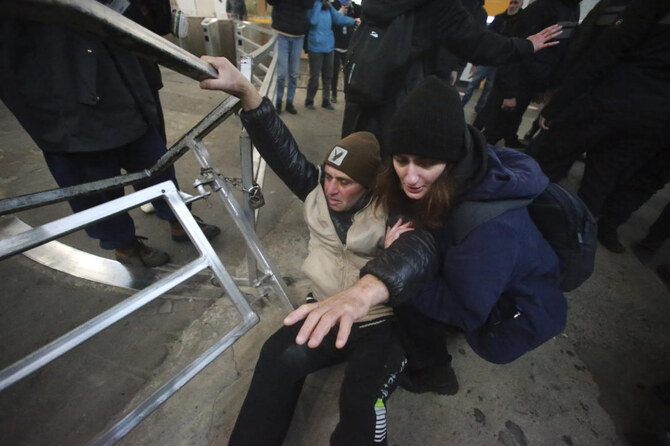
TBILISI: A third night of protests in the Georgian capital against the government’s decision to suspend negotiations to join the European Union left 44 people hospitalized, officials said Sunday.
Tens of thousands of demonstrators gathered outside the parliament Saturday night, throwing stones and setting off fireworks, while police deployed water cannons and tear gas. An effigy of the founder of the governing Georgian Dream party, Bidzina Ivanishvili — a shadowy billionaire who made his fortune in Russia — was burned in front of the legislature.
Georgia’s Interior Ministry said Sunday that 27 protesters, 16 police and one media worker were hospitalized.
Prime Minister Irakli Kobakhidze warned that “any violation of the law will be met with the full rigor of the law.”
“Neither will those politicians who hide in their offices and sacrifice members of their violent groups to severe punishment escape responsibility,” he said at a briefing Sunday.
He insisted it wasn’t true that Georgia’s European integration had been halted. “The only thing we have rejected is the shameful and offensive blackmail, which was, in fact, a significant obstacle to our country’s European integration.” The government’s announcement came hours after the European Parliament adopted a resolution criticizing last month’s general election in Georgia as neither free nor fair.
Kobakhidze also dismissed the US State Department’s statement Saturday that it was suspending its strategic partnership with Georgia. The statement condemned Georgia’s decision to halt its efforts toward EU accession.
“You can see that the outgoing administration is trying to leave the new administration with as difficult a legacy as possible. They are doing this regarding Ukraine, and now also concerning Georgia,” Kobakhidze said. “This will not have any fundamental significance. We will wait for the new administration and discuss everything with them.”
Kobakhidze also confirmed that Georgia’s ambassador to the US, David Zalkaliani, had become the latest of a number of diplomats to stand down since the protests started.
EU foreign policy chief Kaja Kallas and enlargement commissioner Marta Kos released a joint statement Sunday on the Georgian government’s decision to suspend negotiations.
“We note that this announcement marks a shift from the policies of all previous Georgian governments and the European aspirations of the vast majority of the Georgian people, as enshrined in the Constitution of Georgia,” the statement said.
It reiterated the EU’s “serious concerns about the continuous democratic backsliding of the country” and urged Georgian authorities to “respect the right to freedom of assembly and freedom of expression, and refrain from using force against peaceful protesters, politicians and media representatives.”
The ruling Georgian Dream party’s disputed victory in the Oct. 26 parliamentary election, which was widely seen as a referendum on Georgia’s aspirations to join the EU, has sparked major demonstrations and led to an opposition boycott of parliament.
The opposition has said that the vote was rigged with the help of Russia, Georgia’s former imperial master, with Moscow hoping to keep Tbilisi in its orbit.
Speaking to The Associated Press on Saturday, Georgia’s pro-Western President Salome Zourabichvili said that her country was becoming a “quasi-Russian” state and that Georgian Dream controlled the major institutions.
“We are not demanding a revolution. We are asking for new elections, but in conditions that will ensure that the will of the people will not be misrepresented or stolen again,” Zourabichvili said.
The EU granted Georgia candidate status in December 2023 on condition that it meet the bloc’s recommendations, but put its accession on hold and cut financial support earlier this year after the passage of a “foreign influence” law widely seen as a blow to democratic freedoms.


![]()

Over 40 people hospitalized in Georgia during protests over the suspension of EU talks
Short Url
https://arab.news/c6cfc
Over 40 people hospitalized in Georgia during protests over the suspension of EU talks
- Georgia’s Interior Ministry said Sunday that 27 protesters, 16 police and one media worker were hospitalized
- Prime Minister Irakli Kobakhidze warned that ‘any violation of the law will be met with the full rigor of the law’


Latest updates


© 2026 SAUDI RESEARCH & PUBLISHING COMPANY, All Rights Reserved And subject to Terms of Use Agreement.