Riyadh launches Middle East’s largest urban rail network 

1 / 4
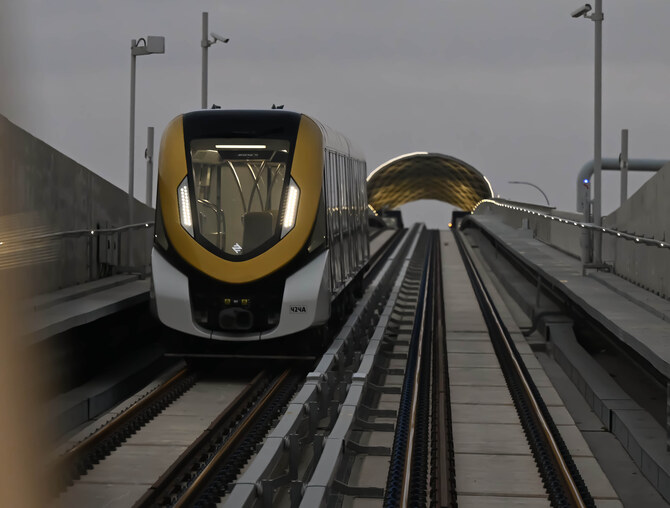
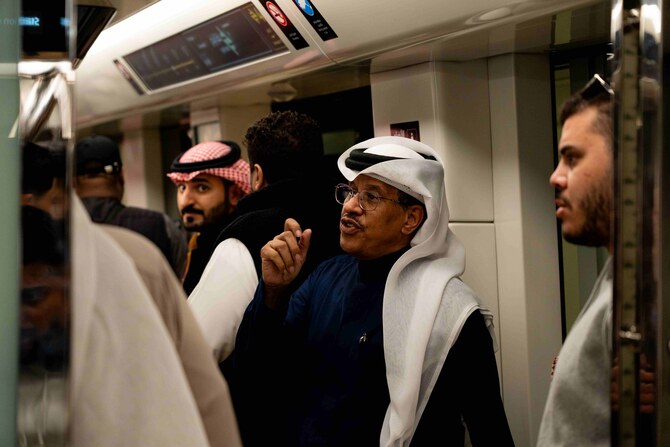
A large group of media professionals boarded a Metro departing from the KAFD station toward King Khalid International Airport as part of an introductory tour organized by the Royal Commission for Riyadh City for journalists on Friday. (AN Photo/Basheer Saleh)
2 / 4
A large group of media professionals boarded a Metro departing from the KAFD station toward King Khalid International Airport as part of an introductory tour organized by the Royal Commission for Riyadh City for journalists on Friday. (AN Photo/Basheer Saleh)
3 / 4
A large group of media professionals boarded a Metro departing from the KAFD station toward King Khalid International Airport as part of an introductory tour organized by the Royal Commission for Riyadh City for journalists on Friday. (AN Photo/Abdulrhman Bin Shalhuob)
4 / 4
A large group of media professionals boarded a Metro departing from the KAFD station toward King Khalid International Airport as part of an introductory tour organized by the Royal Commission for Riyadh City for journalists on Friday. (AN Photo/Abdulrhman Bin Shalhuob)
Short Url
Updated 30 November 2024
Follow

Riyadh launches Middle East’s largest urban rail network 

  • $22bn, energy-efficient Metro system will be a world leader, official says

RIYADH: The first three lines of the Riyadh Metro will begin operating on Sunday, forming part of the largest urban rail network in the Middle East.

Riyadh Metro, which is a key pillar of Saudi Vision 2030, is a crucial step toward reducing traffic congestion in the capital, and improving quality of life for the city’s residents.

The first phase of the Riyadh Metro starts with three lines: the Blue line, connecting Olaya Street to Al Batʼha; the Yellow line, running along King Khalid International Airport Road; and the Purple line, covering Abdul Rahman bin Awf Road and Al-Shaikh Hassan Bin Hussain Street.

The Red line, covering King Abdullah Road, and the Green line, spanning King Abdulaziz Road, are both scheduled to begin operating on Dec. 15, while the Orange line, which covers Madinah Road, starts on Jan. 5, 2025.

The Riyadh Metro was launched 12 years after the project was announced in April 2012, when the Saudi Cabinet approved the implementation of the public transport project and formed a high-level committee to oversee it. Despite the challenges faced by the project, including the global pandemic, it was ultimately completed.

Contracts for the Riyadh Metro project were awarded in 2013 to three global consortiums, with a total value of about $22.5 billion (SR84.4 billion).

The project features several sustainable characteristics that promote eco-friendly transportation options. The metro system will employ energy-efficient trains and stations, as well as technologies such as regenerative braking to reduce energy consumption.

Additionally, some stations will be equipped with thousands of solar panels, and each metro station will rely on electricity sourced from renewable energy.

Maher Sheira, supervisor of digital infrastructure for the King Abdulaziz Public Transport Project in Riyadh, told Arab News: “Our target is to reduce traffic within the city by up to 30 percent. This goal is supported by the metro’s capacity to transport up to 3.6 million passengers daily, which is a challenging target, especially when compared to other cities that have struggled to transition car users to public transportation.”

Achieving this goal depends on several factors, including the city’s infrastructure, integration of various transport modes, and the overall complementarity of these services, he said.

“This project is one of the key initiatives that could help make these goals a reality.”

Sheira said that the launch of the metro and improvement of public transportation will not only alleviate traffic congestion, but also also play a crucial role in reducing carbon emissions.

“We all know that shifting from daily car use to public transportation can have a significant environmental impact,” he said.

“In a small study we conducted, we found that if 100,000 passengers switch from cars to public transport, it could save over 3 million trees annually. This number has the potential to grow even further.”

He said both the metro and the bus systems are integral parts of the King Abdulaziz Public Transport Program.

These systems are seamlessly integrated, ensuring a smooth and reliable experience for passengers. Once a passenger exits a metro station and boards a bus, they will use the same ticket and enjoy the same high level of service.

“To ensure quality, the design of both networks was focused on delivering first-class standards, with an emphasis on maintaining top-tier service throughout the entire journey,” Sheira added.

“The quality of service is evident throughout the system. You can see it at the stations, on the trains, and certainly on the buses and at the bus stops. We are committed to maintaining this high standard of quality and will continue to do so.”

Numerous factors have been taken into account to ensure the success and efficiency of the vast network.

“Our goal is to keep Riyadh at the forefront of global cities in terms of public transportation. This is our objective, and with determination, we are confident that we will achieve it, Inshallah,” he said.

------------------

Inspiring story

The inspiring story of the Riyadh Metro began in 2009, led by a visionary king with determination and ambition for the future; the story’s hero is King Salman. 

The document was submitted by King Salman to develop the public transportation system in Riyadh:

My Lord, Custodian of the Two Holy Mosques, King Abdullah bin Abdulaziz — May Allah preserve you. 

I am honored to inform Your Royal Highness that the city of Riyadh, which is witnessing significant population growth, urban expansion, and substantial economic prosperity, has started to experience severe traffic congestion on its main streets due to the ongoing rise in traffic.

Accordingly, the High Commission for the Development of Riyadh has developed a comprehensive and long-term plan to enhance the city’s public transportation system.

First: Establishing the backbone of the public transportation system through manufacturing an electric train.

Second: Implementing a bus network that covers all areas of Riyadh, with its services integrated with the electric train system. The network covers 708 kilometers and is also integrated with the local network within residential neighborhoods. 

The High Commission has fully prepared the engineering designs, technical specifications, and tender documents for this phase, paving the way for its implementation. 

Therefore, I kindly request Your Highness’s approval of this matter. May Allah preserve you, guide your steps, and grant you success. Peace and blessings be upon you. 

Chairman of the High Commission for the Development of Riyadh

Salman bin Abdulaziz

20/10/2009


Balad Beast brings global beats to historic streets

Updated 31 January 2026
Follow

Balad Beast brings global beats to historic streets

  • ‘MDLBEAST put us on the international map,’ say Saudi electronic duo Dish Dash

JEDDAH: The music festival Balad Beast concluded its fourth edition this weekend, having transformed Jeddah’s UNESCO World Heritage district of Al-Balad into an open-air celebration of music, culture and creativity that attracted thousands of music lovers over two nights.

The festival, organized by Saudi music platform MDLBEAST, featured more than 70 local, regional and international artists across four stages, offering audiences a diverse journey through electronic, hip-hop and global sounds.

French Haitian singer-songwriter Naïka performed on the second night of Balad Beast. (Supplied)

Speaking to Arab News, MDLBEAST chief creative officer Ahmad Al-Ammary, also known as DJ Baloo, described Balad Beast as a “cultural takeover” adding that finding the right spaces for dance floors was a challenge, “but Balad is constantly evolving and we work with that change.”

Addressing the challenges of working in a heritage area, he said: “Balad is sensitive and condensed, so logistics can be complex. In our first year, heavy rain flooded one of the planned squares and we had to relocate the Souq Stage to a much smaller space, but it worked and it has remained there ever since.

HIGHLIGHT

Reggae superstar Shaggy noted that the reality of playing live in Saudi Arabia often surprises those who arrive with preconceptions.

“Yes, the alleys are narrow and the district is old, but they’re full of ideas, patterns, colors and visuals. Everything flows here,” he continued. “As a festival, it’s hard to define Balad, because it gives so much of itself creatively. It’s incredibly generous with its ideas and details, and inspiration comes from everywhere.”

Balad Beast featured more than 70 local, regional and international artists across four stages, offering audiences a diverse journey through electronic, hip-hop and global sounds. (Supplied)

Balad Beast featured performances from international artists including US rapper Playboi Carti, making his first appearance in Saudi Arabia; US rapper Destroy Lonely; Swedish DJ and producer Alesso; and Bosnian-German DJ Solomun on the opening night. The following night saw French-Haitian singer-songwriter Naïka, reggae superstar Shaggy, Dutch DJ Franky Rizardo, British DJ Pawsa, and US rapper Tyga, and more take the stage, while Saudi and regional artists including Cosmicat, TUL8TE, Zeina, Vinyl Mode, Moayed, Dish Dash, Musab, Varoo and HiFi appeared across the festival, offering audiences a mix of global and local talent.

Saudi electronic duo Dish Dash reflected on the festival organizer’s impact for local artists.

As a festival, it’s hard to define Balad, because it gives so much of itself creatively. It’s incredibly generous with its ideas and details, and inspiration comes from everywhere.

Ahmad Al-Ammary, MDLBEAST chief creative officer

“MDLBEAST put us on the international map,” the brothers told Arab News. “It helped us get recognized by festivals, promoters and event organizers abroad. When we travel, people don’t expect this level of talent coming from Saudi Arabia, especially considering we didn’t have this scene before.”

Shaggy, who performed a hit-filled set during the festival, told Arab News: “I’ve been blessed with some incredible songs, and I see music as a gift and a tool for service. When I go on stage, I’m there to entertain people, to make them smile and feel good, but that service also supports many livelihoods from the people working at this festival to those who work with me. These songs have become part of people’s lives, and I don’t take that lightly.”

Balad Beast featured more than 70 local, regional and international artists across four stages, offering audiences a diverse journey through electronic, hip-hop and global sounds. (Supplied)

Shaggy also noted that the reality of playing live in Saudi Arabia often surprises those who arrive with preconceptions.

“I’ve performed in Saudi Arabia more than once, and while there are certain rules that are different, it’s not an issue for me. My focus is always on delivering the hits and giving the audience a great time,” he said.

“There’s a big misconception. People have more freedom than (outsiders) think. Everyone has been extremely nice.”

Asked what advice he would offer to aspiring artists, Shaggy said: “Understand that what you’re given is a gift and a form of service. Stay humble, do the work, and remember why you’re doing it.”

As Al-Ammary noted, there are many such aspiring artists now making a name for themselves in the Kingdom.

“Talent is emerging everywhere, at different levels,” he said. “The scene is still in a mysterious and surprising phase. There’s a rawness to it.”