

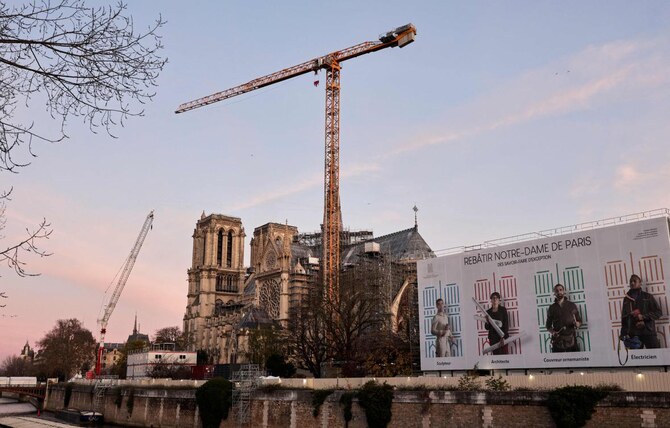

PARIS: France is to offer the world a first look inside the restored Notre Dame cathedral in Paris on Friday, over five years after the fire that ravaged the interior of the heritage landmark and toppled its spire.
Eight days ahead of the December 7 reopening of the cathedral, President Emmanuel Macron will conduct an inspection, broadcast live on television, which will provide the first official insight into how the 850-year-old edifice now looks inside.
Notre Dame will welcome back visitors and worshippers over the December 7-8 weekend after a sometimes challenging restoration to return to its former glory the great Paris cathedral badly damaged by the April 19, 2019 fire.
Macron at the time set the ambitious goal to rebuild Notre Dame within five years and make it “even more beautiful” than before, a target that the French authorities say has been met.
Some 250 companies and hundreds of experts were mobilized for a restoration costing hundreds of millions of euros in what was dubbed the “building site of the century.”
All 2,000 people who contributed to the work have been invited to Friday’s event, of whom at least 1,300 are expected to attend.
“This final site visit is an opportunity to thank them in particular — from wood craftsmen to those of metal and stone, from scaffolders to roofers, from bell makers to art restorers, from gilders to masons and sculptors, from carpenters to organ builders, from architects, archaeologists, engineers and planners to logistical or administrative functions,” stated Macron ahead of the visit.
Accompanied by his wife Brigitte, Macron is expected from 0930 GMT to inspect the key areas of the cathedral including the nave, choir and chapel and discuss the restoration in person with the workers.
The restoration cost a total of nearly 700 million euros (more than $750 million at today’s rate).
It was financed from the 846 million euros in donations that poured in from 150 countries in an unprecedented surge of solidarity.
The 19th-century gothic spire has now been resurrected with an exact copy of the original, the stained windows have regained their color, the walls shining after fire stains cleaned and a restored organ ready to thunder out again.
Unseen to visitors is a new mechanism to protect against any future fires, a discreet system of pipes ready to release millions of water droplets in case of a new disaster.
Notre Dame, which welcomed 12 million visitors in 2017, expects to receive an even higher figure of “14 to 15 million” after the reopening, according to the church authorities.
French ministers have also floated the idea of charging tourists an entrance fee to the site but the Paris diocese has said free admission was an important principle to maintain.
Archbishop of Paris Laurent Ulrich told AFP last month that Macron will on Saturday, December 7 give an address inside Notre Dame to mark the reopening.
It is extremely unusual for a political leader to be allowed to address the faithful inside a Catholic religious building. France is by its constitution a secular country with a strict division between church and state.
World leaders are expected to join but the guest list has yet to be unveiled.
The next day, Sunday December 8, will see the first mass and consecration of the new altar, he added.
Macron in December said he had invited Pope Francis to the reopening of the cathedral but the head of the Catholic church announced in September, to the surprise of some observers, that he would not be coming.
Instead, the pontiff is on the subsequent weekend making a landmark visit to the French island of Corsica.
The French Catholic church has in recent years been rocked by a succession of sexual abuse allegations against clerics, including most recently the monk known as Abbe Pierre who became a household name for his aid to the destitute.
Over five years on, the investigation into what caused the fire is ongoing, with initial findings backing an accidental cause such as a short circuit, a welder’s torch or a cigarette.


