Trump selects longtime adviser Keith Kellogg as special envoy for Ukraine and Russia

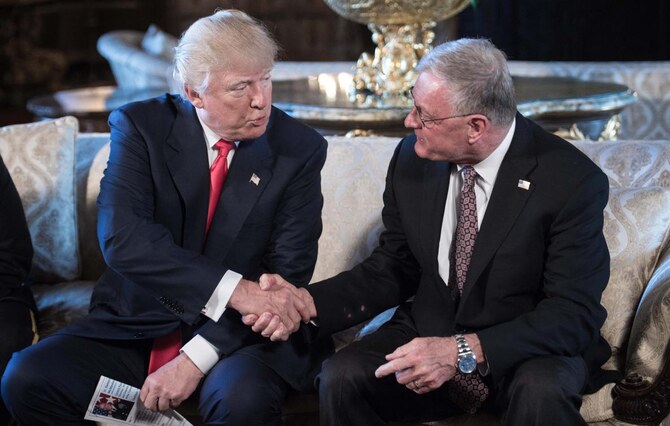
Donald Trump and Keith Kellogg, Mar-a-Lago, Palm Beach, Florida, Feb. 20, 2017. (AFP)
Short Url
Updated 27 November 2024
Follow

Trump selects longtime adviser Keith Kellogg as special envoy for Ukraine and Russia

  • As special envoy for Ukraine and Russia, Kellogg will have to navigate an increasingly untenable war between the two nations
  • Trump has criticized the billions that the Biden administration has poured into Ukraine

WEST PALM BEACH, Florida: President-elect Donald Trump said Wednesday that he has chosen Keith Kellogg, a highly decorated retired three-star general, to serve as his special envoy for Ukraine and Russia.
Kellogg, who is one of the architects of a staunchly conservative policy book that lays out an “America First” national security agenda for the incoming administration, will come into the role as Russia’s invasion of Ukraine enters its third year in February.
Trump made the announcement on his Truth Social account, and said “He was with me right from the beginning! Together, we will secure PEACE THROUGH STRENGTH, and Make America, and the World, SAFE AGAIN!”
Kellogg, a retired Army lieutenant general who has long been Trump’s top adviser on defense issues, served as national security adviser to Vice President Mike Pence, was chief of staff of the National Security Council and then stepped in as an acting security adviser for Trump after Michael Flynn resigned.
As special envoy for Ukraine and Russia, Kellogg will have to navigate an increasingly untenable war between the two nations.
The Biden administration has begun urging Ukraine to quickly increase the size of its military by drafting more troops and revamping its mobilization laws to allow for the conscription of troops as young as 18.
The White House has pushed more than $56 billion in security assistance to Ukraine since the start of Russia’s February 2022 invasion and expects to send billions more to Kyiv before Biden leaves office in less than months.
Trump has criticized the billions that the Biden administration has poured into Ukraine. Washington has recently stepped up weapons shipments and has forgiven billions in loans provided to Kyiv. The incoming Republican president has said he could end the war in 24 hours, comments that appear to suggest he would press Ukraine to surrender territory that Russia now occupies.
As a co-chairman of the American First Policy Institute’s Center for American Security, Kellogg wrote several of the chapters in the group’s policy book. The book, like the Heritage Foundation’s “Project 2025,” is a move to lay out a Trump national security agenda and avoid the mistakes of 2016 when he entered the White House largely unprepared.
Kellogg in April wrote that “bringing the Russia-Ukraine war to a close will require strong, America First leadership to deliver a peace deal and immediately end the hostilities between the two warring parties.”
Kellogg was a character in multiple Trump investigations dating to his first term. He was among the administration officials who listened in on the July 2019 call between Trump and Volodymyr Zelensky in which Trump prodded his Ukrainian counterpart to pursue investigations into the Bidens.
The call, which Kellogg would later say did not raise any concerns on his end, was at the center of the first of two House impeachment cases against Trump, who was acquitted by the Senate both times.
On Jan. 6, 2021, hours before pro-Trump rioters stormed the US Capitol, Kellogg, who was then Pence’s national security adviser, listened in on a heated call in which Trump told his vice president to object or delay the certification in Congress of President Joe Biden ‘s victory.
He later told House investigators that he recalled Trump saying to Pence words to the effect of: “You’re not tough enough to make the call.”


Two high-speed trains derail in Spain, police sources say 21 people killed

Updated 4 min 43 sec ago
Follow

Two high-speed trains derail in Spain, police sources say 21 people killed

  • The accident happened near Adamuz, in Cordoba province. So far, 21 people ​have been confirmed dead by police

MADRID: A high-speed train derailed and smashed into another oncoming train in southern Spain on Sunday, pushing the second train off the tracks in a collision that police sources confirmed to Reuters had killed at least 21 people.
The accident happened near Adamuz, in Cordoba province. So far, 21 people ​have been confirmed dead by police, with state broadcaster Television Espanola adding that 100 people had been injured, 25 seriously. The driver of one of the trains, which was traveling from Madrid to Huelva, was among those who died, the TV station added.
“The Iryo 6189 Malaga — (to Madrid) train has derailed from the track at Adamuz, crashing onto the adjacent track. The (Madrid) to Huelva train which was traveling on the adjacent track has also derailed,” said Adif, which runs the rail network, in a social media post.
Adif said the accident happened at 6:40 p.m. (1740 GMT), about 10 minutes after the Iryo train left Cordoba heading toward Madrid.
Iryo is a private rail operator, majority-owned by Italian state-controlled railway group Ferrovie dello Stato. The train involved was a Freccia 1000 train which was traveling between ‌Malaga and Madrid, ‌a spokesperson for Ferrovie dello Stato said.
The company said in a statement that it ‌deeply ⁠regretted what ​had happened ‌and had activated all emergency protocols to work closely with the relevant authorities to manage the situation.
The second train was operated by Renfe, which also did not respond to a request for comment.
Adif has suspended all rail services between Madrid and Andalusia.

HORRIFIC SCENE
The Iryo train had more than 300 passengers on board, while the Renfe train had around 100.
Paco Carmona, Cordoba fire chief, told TVE the first train heading to Madrid from Malaga had been evacuated.
The other train’s carriages were badly damaged, he said, with twisted metal and seats. “There are still people trapped. We don’t know how many people have died and the operation is concentrating on getting people out of areas which are very narrow,” he ⁠said. “We have to remove the bodies to reach anyone who is still alive. It is proving to be a complicated task.”
Transport Minister Oscar Puente said he was following events ‌from rail operator Adif’s headquarters in Madrid.
“The latest information is very serious,” ‍he posted on X. “The impact was terrible, causing the first two ‍carriages of the Renfe train to be thrown off the track. The number of victims cannot be confirmed at this time. ‍The most important thing now is to help the victims.”
The mayor of Adamuz, Rafael Moreno, told El Pais newspaper that he had been among the first to arrive at the scene of the accident alongside the local police and saw what he believed to be a badly lacerated body several meters from the accident site.
“The scene is horrific,” he said. “I don’t think they were on the same track, but it’s not clear. Now ​the mayors and residents of the area are focused on helping the passengers.”

CALLS FOR MEDICS
Images on local television showed a reception center set up for passengers in the town of Adamuz, population 5,000, with locals coming ⁠and going with food and blankets amid nighttime temperatures of around 42 degrees Fahrenheit (6 degrees Celsius).
A woman named Carmen posted on X that she had been on board the Iryo train to Madrid. “Ten minutes after departing (from Cordoba) the train started to shake a lot, and it derailed from coach 6 behind us. The lights went out.”
Footage posted by another Iryo train passenger, also on X, showed an Iryo staffer in a fluorescent jacket instructing passengers to remain in their seats in the darkened carriages, and those with first aid training to keep watch over fellow passengers. He also urged people to maintain mobile phone batteries to be able to use their torches when they disembarked.
Salvador Jimenez, a journalist for RTVE who was on board the Iryo train, shared images showing the nose of the rear carriage of the train lying on its side, with evacuated passengers sitting on the side of the carriage facing upwards.
Jimenez told TVE by phone from beside the stricken trains that passengers had used emergency hammers to smash the windows and climb out, and they had seen two people taken ‌out of the overturned carriages on stretchers.
“There’s a certain uncertainty about when we’ll get to Madrid, where we’ll spend the night, we’ve had no message from the train company yet,” he said. “It’s very cold but here we are.”