

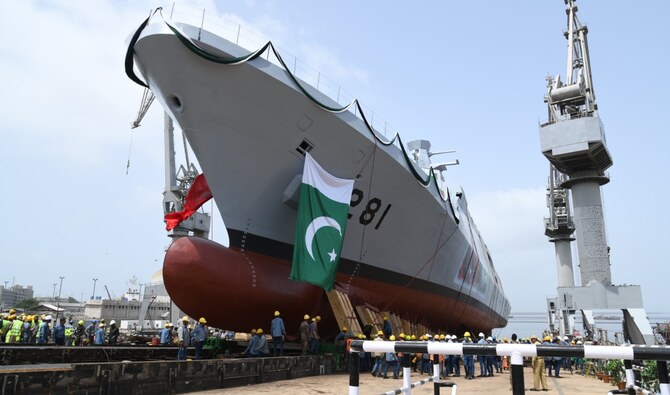

KARACHI: Pakistani Naval Chief Admiral Naveed Ashraf said this week growing regional threats due to the conflict in the Middle East had necessitated a “robust, adaptive, and technologically advanced” navy and pushed Islamabad to reevaluate its maritime security needs.
Pakistan has recently inducted PNS Babur and PNS Hunain, two state-of-the-art warships, into its fleet as part of a broader effort to enhance its maritime security and operational readiness.
In an interview with the Naval News website, Admiral Ashraf explained the effects on naval technologies of a changing regional geopolitical environment due to the “ongoing Israel-Gaza conflict with its butterfly effect in Yemen and Iran.”
“The already volatile maritime security environment coupled with a diverse range of traditional and non-traditional maritime threats necessitates a robust, adaptive, and technologically advanced Navy with well-trained HR,” he said.
“Therefore, since assuming command as Chief of the Naval Staff, the most pressing challenge was to boost combat readiness through optimal utilization of resources and completion of ongoing Projects under financial constraints in order to boost the Pakistan Navy’s prowess in the increasingly complex maritime security environment in the region.”
Admiral Ashraf said Pakistan was in the midst of complex geo-political and geo-economic competition prevailing in the region and its maritime security was intertwined with the maritime environment in the Indian Ocean, which was rapidly transforming.
“In our immediate neighborhood, long-drawn instability in Afghanistan simmers and continues to impinge upon regional security. On our eastern side, India is disturbing regional peace by blatantly provoking its neighbors,” the officer said.
“On our Western flank, Iran’s standoff with the US and Israel may manifest into a precarious situation for the shipping plying along the international Sea Lines of Communication (SLOCs).”
The ongoing Israel-Hamas conflict, with a spillover in the maritime arena after missile strikes by Houthis on merchant traffic and counter strikes on the Yemen mainland by the US-led West, had created conditions for enhanced ERF presence in the region, Ashraf said, referring to Engine Reliability Fix (ERF), a Naval Aviation Enterprise initiative that aims to improve the lifespan of engines on various aviation platforms.
“Access to shore-based missiles and remotely operated vehicles to the warring groups is a serious threat to SLOCs transiting the Red Sea and the Gulf of Aden,” he added.
In the non-traditional domain, maritime terrorism, piracy, drug trafficking, gun running and human smuggling were other challenges, Admiral Ashraf said, describing Pakistan’s regional maritime security as an “ominous hybrid mix of traditional and non-traditional threats.”
“Operationally, we believe in hybrid approach that combines manned and unmanned systems for naval operations,” he added.
“This strategy enables us to leverage the strengths of both types of platforms, optimizing operational flexibility and effectiveness. By integrating unmanned technologies with traditional manned systems, what I have observed is that operational gaps have been duly addressed, especially with regards to surveillance while substantially cutting repair/ maintenance and operating costs.”


