BEIRUT: Last week Israel launched its deadliest strikes on Iran-backed groups in Syria, killing more than 100 fighters in the latest escalation since two months of full-blown Israel-Hezbollah war spilled over.
What are the reasons for this escalation, and what exactly is Israel targeting in Lebanon’s neighbor Syria?
Israel intensified its strikes against Syria from September 26, days after launching an intense bombing campaign mainly targeting Hezbollah strongholds in Lebanon.
Since then, the Syrian Observatory for Human Rights war monitor has recorded at least 86 Israeli attacks, with 199 Iran-backed fighters, Syrian soldiers and 39 civilians killed.
On November 20, Israeli strikes on the city of Palmyra killed 106 Tehran-backed fighters, with one raid targeting a meeting of commanders.
It was the deadliest Israeli attack on Iran-backed groups since Syria’s war erupted in 2011, said the Britain-based Observatory which has a network of sources inside the country.
The casualties included 73 pro-Iran Syrian fighters, 11 of whom worked for Hezbollah which also lost four Lebanese members. The remaining 29 casualties were mostly from Iraq’s Al-Nujaba group.
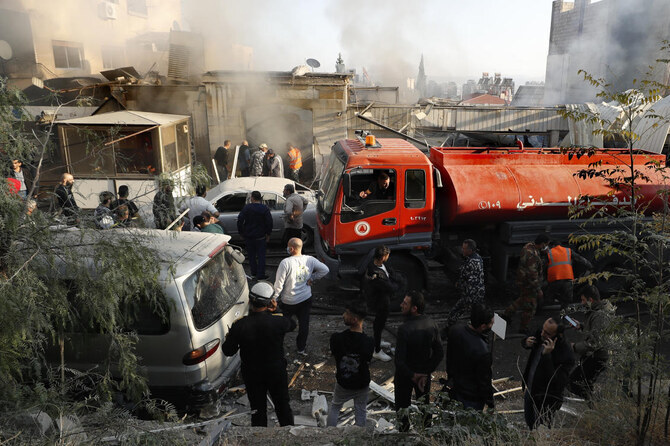
On Monday, Israel struck again, this time at a crossing on the Syria-Lebanon border, the latest in a wave of attacks targeting such routes since September.
Observatory head Rami Abdel Rahman said Israel has mainly hit border crossings, Damascus apartments, and the positions of Iran-backed groups, including Hezbollah weapons and ammunition depots.
“Syria today has become a de facto part of Israel’s battlefield,” he said.
On November 19, Syrian Foreign Minister Bassam Sabbagh visited ally Tehran and condemned “more than 130” Israeli attacks on his country since the Gaza war started in October 2023.
These included an April 1 attack on an Iranian diplomatic building in Damascus that killed seven Islamic Republic Guard Corps members including two generals, triggering Iran’s first ever attack on Israel.
Since 2011, Israel has carried out hundreds of strikes in Syria, mainly targeting the army and Iran-backed groups.
Israel rarely comments on such strikes, but has repeatedly said it will not allow Iran to expand its presence there.
Israel’s military said Monday’s strikes targeted “smuggling routes to transfer weapons to” Hezbollah, and follow other operations against “Syrian regime smuggling routes” in recent weeks.
For Century Foundation analyst Sam Heller, “the deterrent balance that had existed between Hezbollah and Israel has broken down” since the Lebanon war.
“Israel is now bombing Lebanon at will, and additionally hitting what are purportedly Hezbollah and Iran-linked targets in Syria without fear of real reprisal” by the group.
“This all seems like an attempt by Israel to sustainably weaken Hezbollah,” as it pounds its “logistical lines via Syria and pushes for a resolution to the war that will prevent Hezbollah from resupplying and rebuilding,” Heller added.
Renad Mansour of Chatham House said Israel’s Syria strikes “targeted the financial and military supply chains that fuel the axis of resistance” — Iran-backed armed groups that include Hezbollah and Palestinian, Yemeni and Iraqi militants.
On Sunday, UN special envoy for Syria Geir Pedersen said it was “extremely critical” to end the Lebanon and Gaza fighting to avoid dragging Syria into a regional war.
Escalating Israeli attacks have added to the country’s woes after 13 years of conflict and successive economic crises compounded by Western sanctions.
Damascus has not responded to Israel’s attacks and has tried to distance itself from the Gaza and Lebanon wars.
“Any counterattack against Israel would invite massive retaliation against Syria’s leadership or essential infrastructure,” Heller said.
A source close to Hezbollah said “Syria’s role is not to attack Israel, but rather to serve... as a supply line from Iran and Iraq to Hezbollah.”
Tehran and Baghdad fear that Israeli strikes, which have already hit Yemen’s Houthi militants, could hit their territory even if a ceasefire is agreed, the source said, requesting anonymity to discuss sensitive matters.
Last week, Israel called on the UN Security Council to pressure Iraq into halting attacks launched by Iran-backed groups from its soil.
Tehran-backed Iraqi factions have claimed near-daily drone attacks on Israel in solidarity with allies Hamas and Hezbollah. Most of the attacks were intercepted.
The Baghdad government, which is dominated by pro-Iran parties, has accused Israel of trying to legitimize attacking Iraq, saying it was already taking measures to prevent attacks on Israel launched from its territory.
For more than a year, “Iraq has managed to stay relatively insulated from this wider regional war,” Mansour told AFP, adding that Iran and the United States also pushed for this.
But “in this time of transition between US President (Joe) Biden and (Donald) Trump, the Iraqi government is concerned that (Israeli Prime Minister Benjamin) Netanyahu has even more of a free hand to go after all the axis of resistance,” he said.

Why has Israel increased its attacks on Syria?
Short Url
https://arab.news/82fa2
Why has Israel increased its attacks on Syria?
- The Syrian Observatory for Human Rights war monitor has recorded at least 86 Israeli attacks, with 199 Iran-backed fighters, Syrian soldiers and 39 civilians killed
- Observatory head Rami Abdel Rahman said Israel has mainly hit border crossings, Damascus apartments, and the positions of Iran-backed groups
Civilians and aid operations bare brunt of drone strikes in Sudan’s Kordofan
- At least 77 people killed and dozens injured in various attacks in Kordofan, mostly by the paramilitary Rapid Support Forces
- Residents say RSF drone strikes are taking place almost daily around the two key cities of Kadugli and Dilling
CAIRO: A surge in drone strikes in the Sudanese region of Kordofan has taken a growing toll on civilians and hampered aid operations, analysts and humanitarian workers said Wednesday, as the war in Sudan nears the three-year mark.
At least 77 people were killed and dozens injured in various attacks, mostly by the paramilitary Rapid Support Forces, in densely populated areas, according to Sudan Doctors Network, a group that tracks violence through the war. Many of the victims were civilians.
The conflict between the RSF and the Sudanese military erupted into a full-blown war in April 2023. So far, at least 40,000 people have been killed and 12 million displaced, according to the World Health Organization. Aid groups say the true toll could be many times higher, as the fighting in vast and remote areas impedes access.
The military increased its use of drones and airstrikes in Kordofan over the past year as the conflict shifted westward, making the region “a primary theater of operations,” said Jalale Getachew Birru, senior analyst for East Africa at the nonprofit Armed Conflict Location & Event Data, ACLED.
Two weeks ago, the military said it broke the RSF siege of Kadugli, the capital of South Kordofan province, and the neighboring town of Dilling after more than two years.
However, Birru said the sieges were not fully broken. “These cities are still encircled, and the fight for the control of these cities and the wider region is ongoing,” he told The Associated Press.
Daily drone strikes
Walid Mohamed, a resident of Kadugli, told the AP that breaking the siege allowed more goods and medicines to enter the city, reopening the corridor with Dilling and driving down food prices after a dire humanitarian situation unfolded there. However, he said RSF drone strikes have since occurred almost daily, mainly targeting hospitals, markets and homes.
Omran Ahmed, a resident of Dilling, also said drone strikes had increased, “spreading fear and terror among residents as they see more civilians become victims.”
UN High Commissioner for Human Rights Volker Türk on Wednesday sounded the alarm that drone strikes killed more than 50 civilians over two days this week.
“These latest killings are yet another reminder of the devastating consequences on civilians of the escalating use of drone warfare in Sudan,” said Türk, condemning the attacks on civilian sites including markets, health facilities and schools.
UN spokesperson Stéphane Dujarric said there was evidence that both sides had used drones against civilians in this week’s attacks.
“These civilians have been at one time or another in government-controlled areas and areas controlled by the RSF, which would make us believe that both sides are using them,” he said.
Two military officials, who spoke on condition of anonymity because they weren’t authorized to brief the media, told the AP this week that the army doesn’t target civilian infrastructure.
A UN convoy reached Dilling and Kadugli with aid for more than 130,000 people, the first major delivery in three months, United Nations agencies said Wednesday. However, aid workers are concerned about escalating violence.
Mathilde Vu, an advocacy manager with the Norwegian Refugee Council told the AP there’s “huge concern” about the “unacceptable” escalation in Kordofan and that it could “shatter lives and obstruct any hope to reverse the famine/ starvation” in the region.
“It’s very indiscriminate. Between Kordofan, Darfur and the east (Sennar), it’s now every other day we receive messages like ‘drone attack here, hit a civilian infrastructure, killed people,’” Vu said.
Kordofan battlefront shifts
Much of the recent fighting in Sudan has been centered in Kordofan, where the army wants to create a route into the neighboring region of Darfur, Kholood Khair, founding director of Confluence Advisory, a think tank, told the AP.
El-Fasher city, the capital of North Darfur, was the army’s last stronghold in the region but fell to the RSF in October. Its recapture could allow the army to restore important supply and logistic lines between Kordofan and Darfur.
Meanwhile, the RSF wants to create a route out of Kordofan, back to the center of the country and the capital, Khartoum, Khair said.
Both the military and the RSF have used drones, especially in North Kordofan. Civilians have been hard-hit.
Last year, 163 air and drone strikes across the country targeted civilians, killing 1,032 people, according to ACLED data. The army reportedly carried out 83 strikes that caused 568 deaths, while the RSF conducted 66 strikes that killed 288 people.
Both sides have stepped up their use of drones in Kordofan over the past few weeks, according to Federico Donelli, associate professor of international relations at the University of Trieste.
Donelli said several factors are driving the increase, including the army’s acquisition of new weapons and drones manufactured and supplied by foreign actors.
“This has enabled the army to rely more heavily on precision strikes, mirroring tactics that the Rapid Support Forces have been using for some time,” he said,
Both sides may be struggling to maintain troop strength, he said. “Consequently, drones are favored over deploying armed units on the ground, particularly in contested areas such as Kordofan.”
Khair, from Confluence Advisory, said the fighting in Kordofan could shift in the upcoming period, with the army potentially seeking to push into Darfur, particularly toward el-Fasher, where war crimes have been reported.
“We expect to see the bombing campaigns not only continue but increase in frequency and volume,” she said.
At least 77 people were killed and dozens injured in various attacks, mostly by the paramilitary Rapid Support Forces, in densely populated areas, according to Sudan Doctors Network, a group that tracks violence through the war. Many of the victims were civilians.
The conflict between the RSF and the Sudanese military erupted into a full-blown war in April 2023. So far, at least 40,000 people have been killed and 12 million displaced, according to the World Health Organization. Aid groups say the true toll could be many times higher, as the fighting in vast and remote areas impedes access.
The military increased its use of drones and airstrikes in Kordofan over the past year as the conflict shifted westward, making the region “a primary theater of operations,” said Jalale Getachew Birru, senior analyst for East Africa at the nonprofit Armed Conflict Location & Event Data, ACLED.
Two weeks ago, the military said it broke the RSF siege of Kadugli, the capital of South Kordofan province, and the neighboring town of Dilling after more than two years.
However, Birru said the sieges were not fully broken. “These cities are still encircled, and the fight for the control of these cities and the wider region is ongoing,” he told The Associated Press.
Daily drone strikes
Walid Mohamed, a resident of Kadugli, told the AP that breaking the siege allowed more goods and medicines to enter the city, reopening the corridor with Dilling and driving down food prices after a dire humanitarian situation unfolded there. However, he said RSF drone strikes have since occurred almost daily, mainly targeting hospitals, markets and homes.
Omran Ahmed, a resident of Dilling, also said drone strikes had increased, “spreading fear and terror among residents as they see more civilians become victims.”
UN High Commissioner for Human Rights Volker Türk on Wednesday sounded the alarm that drone strikes killed more than 50 civilians over two days this week.
“These latest killings are yet another reminder of the devastating consequences on civilians of the escalating use of drone warfare in Sudan,” said Türk, condemning the attacks on civilian sites including markets, health facilities and schools.
UN spokesperson Stéphane Dujarric said there was evidence that both sides had used drones against civilians in this week’s attacks.
“These civilians have been at one time or another in government-controlled areas and areas controlled by the RSF, which would make us believe that both sides are using them,” he said.
Two military officials, who spoke on condition of anonymity because they weren’t authorized to brief the media, told the AP this week that the army doesn’t target civilian infrastructure.
A UN convoy reached Dilling and Kadugli with aid for more than 130,000 people, the first major delivery in three months, United Nations agencies said Wednesday. However, aid workers are concerned about escalating violence.
Mathilde Vu, an advocacy manager with the Norwegian Refugee Council told the AP there’s “huge concern” about the “unacceptable” escalation in Kordofan and that it could “shatter lives and obstruct any hope to reverse the famine/ starvation” in the region.
“It’s very indiscriminate. Between Kordofan, Darfur and the east (Sennar), it’s now every other day we receive messages like ‘drone attack here, hit a civilian infrastructure, killed people,’” Vu said.
Kordofan battlefront shifts
Much of the recent fighting in Sudan has been centered in Kordofan, where the army wants to create a route into the neighboring region of Darfur, Kholood Khair, founding director of Confluence Advisory, a think tank, told the AP.
El-Fasher city, the capital of North Darfur, was the army’s last stronghold in the region but fell to the RSF in October. Its recapture could allow the army to restore important supply and logistic lines between Kordofan and Darfur.
Meanwhile, the RSF wants to create a route out of Kordofan, back to the center of the country and the capital, Khartoum, Khair said.
Both the military and the RSF have used drones, especially in North Kordofan. Civilians have been hard-hit.
Last year, 163 air and drone strikes across the country targeted civilians, killing 1,032 people, according to ACLED data. The army reportedly carried out 83 strikes that caused 568 deaths, while the RSF conducted 66 strikes that killed 288 people.
Both sides have stepped up their use of drones in Kordofan over the past few weeks, according to Federico Donelli, associate professor of international relations at the University of Trieste.
Donelli said several factors are driving the increase, including the army’s acquisition of new weapons and drones manufactured and supplied by foreign actors.
“This has enabled the army to rely more heavily on precision strikes, mirroring tactics that the Rapid Support Forces have been using for some time,” he said,
Both sides may be struggling to maintain troop strength, he said. “Consequently, drones are favored over deploying armed units on the ground, particularly in contested areas such as Kordofan.”
Khair, from Confluence Advisory, said the fighting in Kordofan could shift in the upcoming period, with the army potentially seeking to push into Darfur, particularly toward el-Fasher, where war crimes have been reported.
“We expect to see the bombing campaigns not only continue but increase in frequency and volume,” she said.
© 2026 SAUDI RESEARCH & PUBLISHING COMPANY, All Rights Reserved And subject to Terms of Use Agreement.