

Civilians and aid operations bear brunt of drone strikes in Sudan’s Kordofan

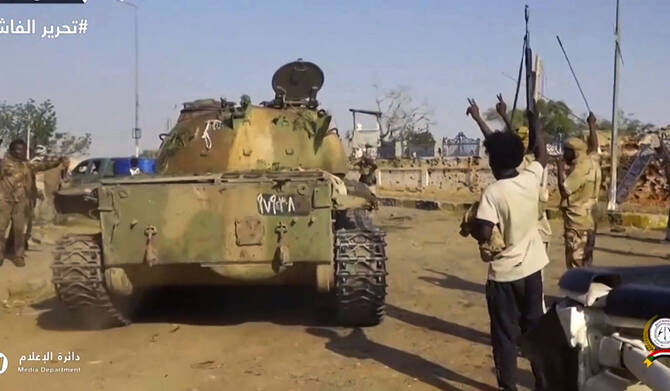
RSF fighters celebrating in the streets of El-Fasher in Sudan's Darfur. (AFP/File)
Short Url
Updated 18 February 2026
Follow

Civilians and aid operations bear brunt of drone strikes in Sudan’s Kordofan

  • At least 77 people killed and dozens injured in various attacks in Kordofan, mostly by the paramilitary Rapid Support Forces
  • Residents say RSF drone strikes are taking place almost daily around the two key cities of Kadugli and Dilling

CAIRO: A surge in drone strikes in the Sudanese region of Kordofan has taken a growing toll on civilians and hampered aid operations, analysts and humanitarian workers said Wednesday, as the war in Sudan nears the three-year mark.
At least 77 people were killed and dozens injured in various attacks, mostly by the paramilitary Rapid Support Forces, in densely populated areas, according to Sudan Doctors Network, a group that tracks violence through the war. Many of the victims were civilians.
The conflict between the RSF and the Sudanese military erupted into a full-blown war in April 2023. So far, at least 40,000 people have been killed and 12 million displaced, according to the World Health Organization. Aid groups say the true toll could be many times higher, as the fighting in vast and remote areas impedes access.
The military increased its use of drones and airstrikes in Kordofan over the past year as the conflict shifted westward, making the region “a primary theater of operations,” said Jalale Getachew Birru, senior analyst for East Africa at the nonprofit Armed Conflict Location & Event Data, ACLED.
Two weeks ago, the military said it broke the RSF siege of Kadugli, the capital of South Kordofan province, and the neighboring town of Dilling after more than two years.
However, Birru said the sieges were not fully broken. “These cities are still encircled, and the fight for the control of these cities and the wider region is ongoing,” he told The Associated Press.

Daily drone strikes

Walid Mohamed, a resident of Kadugli, told the AP that breaking the siege allowed more goods and medicines to enter the city, reopening the corridor with Dilling and driving down food prices after a dire humanitarian situation unfolded there. However, he said RSF drone strikes have since occurred almost daily, mainly targeting hospitals, markets and homes.
Omran Ahmed, a resident of Dilling, also said drone strikes had increased, “spreading fear and terror among residents as they see more civilians become victims.”
UN High Commissioner for Human Rights Volker Türk on Wednesday sounded the alarm that drone strikes killed more than 50 civilians over two days this week.
“These latest killings are yet another reminder of the devastating consequences on civilians of the escalating use of drone warfare in Sudan,” said Türk, condemning the attacks on civilian sites including markets, health facilities and schools.
UN spokesperson Stéphane Dujarric said there was evidence that both sides had used drones against civilians in this week’s attacks.
“These civilians have been at one time or another in government-controlled areas and areas controlled by the RSF, which would make us believe that both sides are using them,” he said.
Two military officials, who spoke on condition of anonymity because they weren’t authorized to brief the media, told the AP this week that the army doesn’t target civilian infrastructure.
A UN convoy reached Dilling and Kadugli with aid for more than 130,000 people, the first major delivery in three months, United Nations agencies said Wednesday. However, aid workers are concerned about escalating violence.
Mathilde Vu, an advocacy manager with the Norwegian Refugee Council told the AP there’s “huge concern” about the “unacceptable” escalation in Kordofan and that it could “shatter lives and obstruct any hope to reverse the famine/ starvation” in the region.
“It’s very indiscriminate. Between Kordofan, Darfur and the east (Sennar), it’s now every other day we receive messages like ‘drone attack here, hit a civilian infrastructure, killed people,’” Vu said.

Kordofan battlefront shifts

Much of the recent fighting in Sudan has been centered in Kordofan, where the army wants to create a route into the neighboring region of Darfur, Kholood Khair, founding director of Confluence Advisory, a think tank, told the AP.
El-Fasher city, the capital of North Darfur, was the army’s last stronghold in the region but fell to the RSF in October. Its recapture could allow the army to restore important supply and logistic lines between Kordofan and Darfur.
Meanwhile, the RSF wants to create a route out of Kordofan, back to the center of the country and the capital, Khartoum, Khair said.
Both the military and the RSF have used drones, especially in North Kordofan. Civilians have been hard-hit.
Last year, 163 air and drone strikes across the country targeted civilians, killing 1,032 people, according to ACLED data. The army reportedly carried out 83 strikes that caused 568 deaths, while the RSF conducted 66 strikes that killed 288 people.
Both sides have stepped up their use of drones in Kordofan over the past few weeks, according to Federico Donelli, associate professor of international relations at the University of Trieste.
Donelli said several factors are driving the increase, including the army’s acquisition of new weapons and drones manufactured and supplied by foreign actors.
“This has enabled the army to rely more heavily on precision strikes, mirroring tactics that the Rapid Support Forces have been using for some time,” he said,
Both sides may be struggling to maintain troop strength, he said. “Consequently, drones are favored over deploying armed units on the ground, particularly in contested areas such as Kordofan.”
Khair, from Confluence Advisory, said the fighting in Kordofan could shift in the upcoming period, with the army potentially seeking to push into Darfur, particularly toward el-Fasher, where war crimes have been reported.
“We expect to see the bombing campaigns not only continue but increase in frequency and volume,” she said.


UN Security Council urged to put pressure on UAE to stop arming Sudanese paramilitary

Updated 8 sec ago
Follow

UN Security Council urged to put pressure on UAE to stop arming Sudanese paramilitary

  • Activist accuses Rapid Support Forces and its allies of widespread conflict-related sexual violence during war, calls for action against faction’s powerful international backers
  • Plea comes amid growing warnings of genocide in Sudan, ‘unchecked external interference’ that is allowing atrocities to continue, and the risk of further regional destabilization

NEW YORK CITY: The UN Security Council faced calls on Thursday to put pressure on the UAE to stop arming the Rapid Support Forces, one of the warring military factions in Sudan, amid warnings that atrocities bearing “the hallmarks of genocide” were spreading and the situation in the country risks causing further regional destabilization.

Sudanese activist Hala Alkarib said that “unchecked external interference” was allowing atrocities to continue. She cited the documentation by a UN panel of experts and international nongovernmental organizations of weapons and military equipment being shipped into Darfur, “including by the United Arab Emirates, in violation of this Council’s arms embargo.”

She told council members: “You can stop the violence by pressuring the RSF’s powerful backers with economic, political and criminal consequences.”

The council also heard warnings from Alkarib and senior UN officials that after more than 1,000 days of war, civilians face renewed risks of mass atrocities in Darfur and Kordofan.

Earlier on Thursday, the International Independent Fact-Finding Mission for Sudan issued a report that described atrocities committed by the RSF in and around El-Fasher in late October last year as “indicators of a genocidal path.”

Alkarib, regional director of the Strategic Initiative for Women in the Horn of Africa, told the Security Council that she had lost family members and her home in the conflict between the RSF and the Sudanese Armed Forces, which began in April 2023.

“To be here a third time, only to report that the situation is even worse, is an indictment not just of the warring parties but of this council’s inability to stop the bloodshed,” she said.

“Over 1,000 days since the start of the war, despite repeated warnings, this council has failed to act. Every red line — siege, forced displacement, man-made famine, genocide, mass rape — has been crossed.”

She warned that the kinds of atrocities seen in El-Geneina and El-Fasher now risk being repeated in Greater Kordofan and Blue Nile, where drone attacks by all sides are killing civilians and destroying hospitals, schools and markets.

“Unless you act now, you will have more blood on your hands,” Alkarib said.

Her organization has documented more than 1,294 cases of conflict-related sexual violence against women and girls since the war began, she said, “perpetrated primarily by the RSF and their allies.”

She accused RSF forces in Darfur of deliberately targeting women and girls from the Fur, Masalit, Berti, Zaghawa and Tunjur communities on the basis of ethnicity.

“As the UN Fact-Finding Mission confirmed in a report today, this is part of a strategy of genocide aimed at eradicating native African communities,” Alkarib said.

Sexual violence, arbitrary detention and enforced disappearances in RSF-controlled areas remain severely underdocumented due to access restrictions, communications blackouts and retaliation, she added.

Thousands of women and children have been detained in villages including Garny, Tura and Tabit in North Darfur, she said, and hospitals and schools have been turned into detention centers. Forced marriages, including child marriages, to RSF soldiers are frequently linked to abductions and enforced disappearances.

Alkarib called for an immediate end to hostilities, the release of civilians held by the warring parties, “particularly women held by the RSF in conditions amounting to sexual slavery,” and the deployment of a mission with a clear mandate to protect civilians across Sudan in collaboration with the African Union.

She also urged the Security Council to expand the arms embargo to the whole of Sudan; impose targeted sanctions on violators; demand safe and sustained humanitarian access; condemn attacks on aid convoys, including a recent strike on a World Food Programme convoy in North Kordofan; support Sudanese women-led organizations; and back efforts to ensure accountability, including the work of the International Criminal Court.

“None of this will stop without immediate action from you, the international community,” Alkarib added.

The UN’s political affairs chief, Rosemary DiCarlo, said: “Sudan reached a horrific milestone: 1,000 days of a brutal war that has nearly destroyed the third-largest country in Africa. 1,000 days of total impunity for the perpetrators of a long list of atrocities and war crimes.”

She warned that “the risk of regionalization of the conflict is a matter of urgent concern,” citing in particular the movement of armed groups across the border between Sudan and South Sudan “in both directions,” and reports that weapons continue to transit through neighboring states.

“The horrific events in El-Fasher in October 2025 were preventable,” DiCarlo said. During the time the city was under siege, more than a year, the UN’s Human Rights Office “repeatedly sounded the alarm about the risk of mass atrocities. But the warnings were not heeded.”

The UN high commissioner for human rights, Volker Turk, had also alerted the international community to the possibility of similar crimes in Kordofan, where civilians are once again at risk of “summary executions, sexual violence, arbitrary detention and family separation,” she added.

“During the final offensive of the RSF on El-Fasher, reports indicate that sexual violence against women and girls was widespread,” DiCarlo said. “The time to act to prevent a repeat of atrocities elsewhere in the country is now.”

She welcomed progress in an initiative to secure a humanitarian truce, led by Egypt, Saudi Arabia, the UAE and the US.

“These efforts offer a critical opportunity for immediate and much-needed deescalation and could pave the way for a sustainable cessation of hostilities,” she said. “We call on both parties to the conflict to engage with this initiative in good faith and without preconditions.”

But she stressed that unity among Sudan’s partners was essential.

“This entails ensuring that the flow of weapons to the warring parties is cut off,” DiCarlo said. “The war has gone on this long and been this deadly in large part because of the support the parties have received from abroad.”

Speaking on behalf of UN humanitarian chief Tom Fletcher, Edem Wosornu, the director of the crisis response division at the Office for the Coordination of Humanitarian Affairs, said violence continues to spread “relentlessly.”

“Nearly three years have passed since this war began — humanitarian needs have deepened and countless civilian lives have been shattered,” she added.

Since the start of this year, she said, conditions in much of Kordofan and Darfur have deteriorated and drone attacks across the three states in Kordofan have escalated, resulting in civilian casualties and displacement. More than 1 million people are now displaced in the region.

In North Kordofan, fighting around the state capital, El-Obeid, was restricting the delivery of humanitarian and commercial supplies, Wosornu said. In South Kordofan, there has been intensified fighting and aerial attacks in and around Kadugli and Dilling, where an assessment by the Integrated Food Security Phase Classification indicates famine conditions may be prevalent.

Despite recent announcements that sieges had been broken and convoys could move between El-Obeid to Kadugli and Dilling, “humanitarian access along these key supply lines remains unpredictable,” Wosornu added.

In December, rates of acute malnutrition in Um Baru and Kernoi in North Darfur exceeded the threshold for famine, she said, and more than 1,000 newly displaced people recently arrived in Tawila, joining 600,000 who were already living there “in dire conditions.”

She continued: “For over 12 million women and girls, this is a crisis within a crisis. Violence against women and girls in Sudan has reached catastrophic levels. Sexual violence against women and girls has reached horrific levels. Documented cases have nearly tripled – yet this is but a fraction of the real scale.”

Wosornu also warned that 4.2 million children and pregnant and breastfeeding women face acute malnutrition.

She urged the council to work together “in pursuit of an immediate stop to the fighting, to stem the flow of weapons into Sudan, and to press for the lasting, inclusive peace that is so desperately needed.”

The UK is chairing the Security Council this month, with British Foreign Minister Yvette Cooper serving as president of the council for February.