Militia detains 300 migrants in the desert in Libya’s effort to contain sea crossings

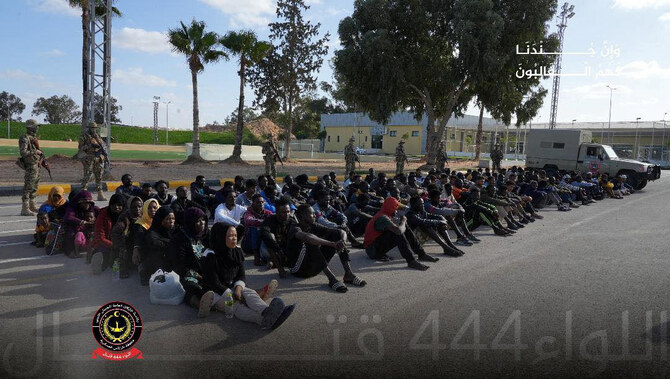
Libyan Army 444th Combat Brigade Soldiers stand next to detained migrants in Tripoli in this photo released on Nov. 25, 2024. (Reuters)
Short Url
Updated 26 November 2024
Follow

Militia detains 300 migrants in the desert in Libya’s effort to contain sea crossings

  • The group in a post on Facebook condemned smuggling and human trafficking and said its patrols would continue efforts to block smuggling routes
  • The apprehensions come as Libya remains a primary point of departure for men, women and children from the Middle East and Africa aiming to reach Europe

TRIPOLI: Libyan military officials said Monday they apprehended hundreds of migrants traversing the country’s vast desert hoping to ultimately cross the Mediterranean Sea in pursuit of a better life in Europe.
The 444 Brigade, a powerful militia group that operates under the auspices of the Libyan army, said in a statement that its patrolling commanders detained more than 300 migrants and referred them to authorities.
The group in a post on Facebook condemned smuggling and human trafficking and said its patrols would continue efforts to block smuggling routes. It posted satellite images of the desert and pictures of what appeared to be migrants sitting in rows in front of armed and masked militants.
The apprehensions come as Libya remains a primary point of departure for men, women and children from the Middle East and Africa aiming to reach Europe. Many are escaping war or poverty and many employ smugglers to help them negotiate treacherous deserts and sea routes. Roughly 38,000 people have arrived in Italy and Malta from Libya this year, according to UNHCR, the United Nations Refugee Agency.
The overcrowded boats used by migrants and smugglers are known to routinely capsize and a key priority for European leaders has been to encourage North African countries to prevent migrants from reaching the sea. But unlike in Morocco and Tunisia — where tens of thousands of migrants also attempt to pass through en route to the southern shores of Europe — fighting between rival governments in Libya has added additional challenges to migration management partnerships.
Migrant apprehensions are rarely reported in Libya, though the country’s state news service LANA reported more than 2,000 arrests in July.
The oil-rich country plunged into turmoil after a NATO-backed uprising toppled longtime dictator Muammar Qaddafi. Since then, the country has been divided between dueling governments in the east and west, each backed by militias and foreign powers. Human traffickers have for years benefited from the political chaos.
United Nations High Commissioner for Human Rights Volker Türk in July said migrants in the country had been subjected to torture, forced labor and starvation while being detained.


MSF says conditions for Gaza medics ‘as hard as it’s ever been’ despite truce

Updated 4 sec ago
Follow

MSF says conditions for Gaza medics ‘as hard as it’s ever been’ despite truce

DOHA: Conditions for medics and patients in Gaza are as severe as ever despite a nearly two-month truce in the territory, the president of medical charity Doctors Without Borders (MSF) said in an AFP interview.
Israel and Palestinian militant group Hamas agreed in October to a US-backed truce deal for Gaza which stipulated an influx of aid to the territory devastated by two years of war and in the grip of a humanitarian crisis.
“It’s as hard as it’s ever been,” Javid Abdelmoneim said of conditions for medical staff operating in Gaza’s hospitals, speaking on the sidelines of the annual Doha Forum on diplomacy on Sunday.
“While we’re able to continue doing operations, deliveries, wound care, you’re using protocols or materials and drugs that are inferior, that are not the standard. So you’ve got substandard care being delivered,” he explained.
Abdelmoneim, who worked as a doctor in Gaza in 2024, said the ongoing truce was only a “ceasefire of sorts” with “still several to dozens of Palestinians being killed every day by Israel.”
Despite the truce, 376 Palestinians have been killed in Gaza, according to local health authorities, as well as three Israeli soldiers.
“We’re seeing the injured patients in the emergency rooms in which we work throughout the strip,” he added.
Aid agencies are pushing for more access for humanitarian convoys to enter Gaza while Israel has resisted calls to allow aid through the Rafah crossing from Egypt.
Aid ‘weaponized’
The MSF president said that since the truce began, aid “hasn’t come in to the level that’s necessary.”
“There isn’t a substantial change and it is being weaponized... So as far as we’re concerned that is an ongoing feature of the genocide. It’s being used as a chip and that’s something that should not happen with humanitarian aid,” Abdelmoneim said.
In 2024, MSF said its medical teams had witnessed evidence on the ground in Gaza and concluded that genocide was taking place.
Israel’s foreign ministry rejected the report saying at the time that it was “fabricated.”
Abdelmoneim said both the lack of supplies and the destruction of hospitals in the Palestinian territory — still not offset by the provision so far of field hospitals — meant care remained inadequate.
“Those two things together mean increased infection rates, increased stays and greater risk of complications. So it is a substandard level of care that you’re able to deliver,” he said.
The MSF president also sounded the alarm over the safety of medical staff in Sudan where at the end of October the paramilitary Rapid Support Forces (RSF) seized the North Darfur capital of El-Fasher, the army’s last stronghold in the western region.
The paramilitaries’ final advance after a bitter 18-month siege was followed by reports of widespread atrocities.
“One feature that has been consistent, no matter where you are in Sudan, no matter who controls the territory, are attacks on health care and blockages to supply movements and provision of health care,” Abdelmoneim said.
’Freedom, protection access’
The World Health Organization said at the end of October that it had received reports that more than 460 patients and their companions had been shot dead at a maternity hospital in El-Fasher during its capture by the RSF and of six health workers being abducted.
On Thursday, an RSF drone attack on the army-held town of Kalogi in Sudan’s South Kordofan state hit a children’s nursery and a hospital, killing dozens of civilians including children, a local official told AFP.
“Both sides need to allow humanitarian and medical workers freedom, protection and access to the population, and that includes supplies,” said Abdelmoneim, who also worked as a doctor in Omdurman in Sudan in February.
The MSF president said the charity’s medical teams receiving displaced people in Sudan and neighboring Chad were encountering “harrowing tales of sexual violence, tales of ethnically targeted violence, extortion” as well of “evidence that really does point to famine-like conditions.”
In Tawila, a town now sheltering more than 650,000 people fleeing El-Fasher and nearby Zamzam camp, also under RSF control, Abdelmoneim said the MSF had been told by survivors “that family members are detained and never seen again.”
“So our question is, what has happened to that population?” he said.
The medical charity was backing calls by the UN Human Rights Council for an enquiry into the reported violations.
“We would encourage all member states to support that, an independent investigation inside El-Fasher,” Abdelmoneim said.