

Wheel-jam strike paralyzes Balochistan highways amid protest over kidnapped schoolboy

Demonstrators are protesting over the kidnapping of an 11-year-old schoolboy in Quetta, Pakistan, on November 25, 2024. (AN photo)
Short Url
Updated 25 November 2024
Follow

Wheel-jam strike paralyzes Balochistan highways amid protest over kidnapped schoolboy

  • 11-year-old Muhammad Musawir Khan was kidnapped by armed men in Quetta on Nov. 15
  • Government says law enforcement agencies are working for the kidnapped boy’s recovery

QUETTA: A wheel-jam strike paralyzed highways in Pakistan’s southwestern Balochistan province on Monday as protests over the kidnapping of an 11-year-old schoolboy entered their 11th consecutive day in Quetta.
Muhammad Musawir Khan, a third-grade student, was kidnapped from a school van by unknown armed men while on his way to school on November 15.
The family has not received any ransom call from the kidnappers in all these days since his abduction. They have also categorically said they will not pay a single penny to the kidnappers.
“Today, all national highways connecting Balochistan with the rest of the country are closed against the kidnapping of my son,” Raz Muhammad, the boy’s father, told Arab News. “We will continue our protest until he safely returns home.”
Muhammad urged Prime Minister Shahbaz Sharif and Army Chief General Asim Munir to consider Khan as their own child and play a role in his recovery.
Other family members echoed the sentiment, saying it was the state’s responsibility to ensure the boy’s recovery and improve the general environment of insecurity.
“We have been sitting here for the last 11 days to seek protection for all children like Muhammad Musawir Khan from these kidnappers,” Hajji Malang, the boy’s uncle, told Arab News. “Whoever kidnapped our child, we will not bargain with them for his release.”
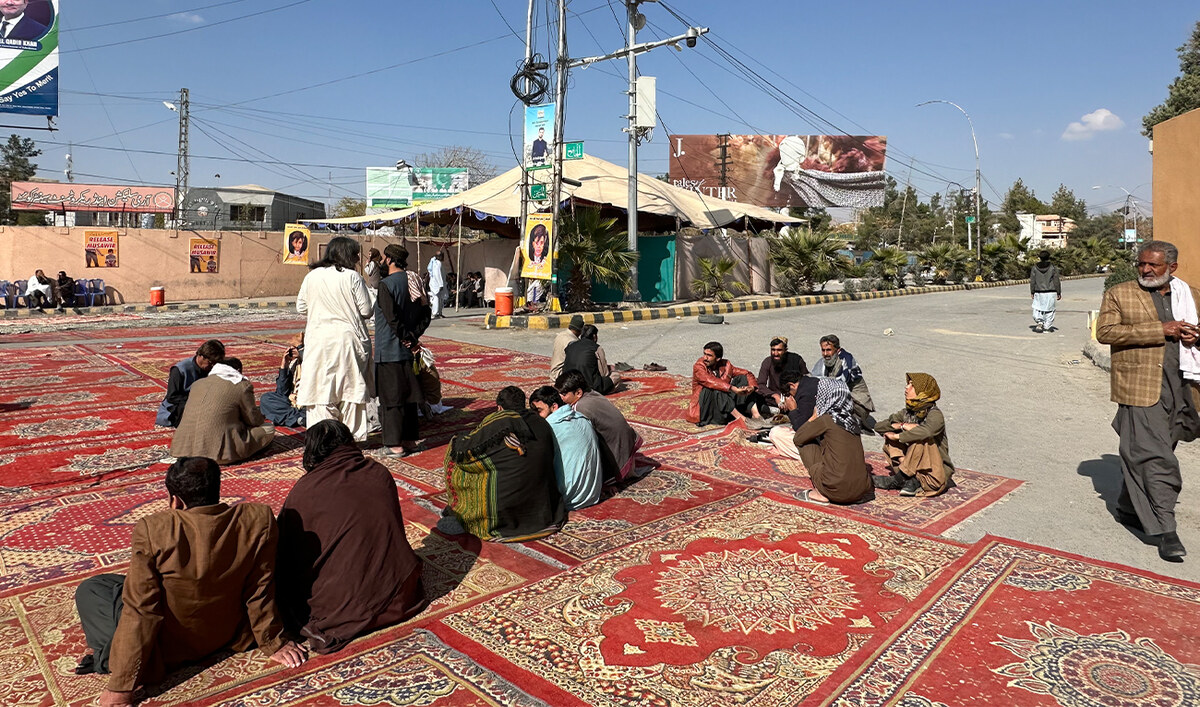


Demonstrators are protesting over the kidnapping of an 11-year-old schoolboy in Quetta, Pakistan, on November 25, 2024. (AN photo)

The kidnapped boy belongs to a prominent tribal family involved in the gold trading business in Balochistan for decades. According to the family, he was abducted from Patel Bagh, a busy neighborhood in Quetta.
Political and religious parties, traders, transporters, lawyers and civil society members have all been visiting the protest camp to express solidarity with the family and demand the immediate and safe recovery of the boy.
Speaking to the media outside the provincial assembly, Chief Minister Mir Sarfraz Bugti said he thought of the kidnapped child like his own son.
“We are utilizing our full capacity and the government is making serious efforts to ensure his safe recovery,” he said.
Commissioner of Quetta Division Hamza Shafqaat shared the same update while speaking to Arab News.
“The government, along with all law enforcement agencies, is working diligently for the recovery of Muhammad Musawir Khan,” he said.
“We have shared our report on the progress in the recovery of the kidnapped boy to with the Balochistan High Court, chief minister and the provincial assembly, and they have all expressed satisfaction that the investigation is heading in the right direction,” he added.
However, Shafqaat declined to divulge details of the ongoing investigation.
Malik Muhammad Sadiq Kakar, senior member of Pashtoonkhwa Milli Awami Party, said that highways in Balochistan’s Quetta, Mastung, Khuzdar, Killa Abdullah, Chaman, Zhob, Killa Saifullah and Loralai districts were closed to protest the kidnapping of the child.
“We are sitting with the family of the kidnapped boy to express solidarity because we want peace in Balochistan,” he told Arab News.
Pakistan’s restive Balochistan province, which shares borders with Afghanistan and Iran, has been the site of a low-level insurgency by separatist militants for over two decades.
Other extremist factions, including Tehreek-e-Taliban Pakistan and Daesh’s Khorasan chapter, also have a presence in the region and frequently attack security forces and civilians.
Last week, Pakistan approved a “comprehensive military operation” in the province, targeting ethnic Baloch separatist groups attacking security forces and Chinese nationals working on the multibillion-dollar China-Pakistan Economic Corridor (CPEC).

Pakistan to open today televised bidding for privatization of loss-making flag carrier PIA

Updated 10 sec ago
Follow

Pakistan to open today televised bidding for privatization of loss-making flag carrier PIA

  • Pakistan plans to privatize 75 percent of the carrier, while retaining its name and branding
  • Three contenders remain in race to buy the airline after Fauji Fertilizer Company’s withdrawal

ISLAMABAD: Pakistan is set to hold a live broadcast bidding process today, Tuesday, for the privatization of the Pakistan International Airlines (PIA), officials said, with three consortiums contending to buy the loss-making national flag carrier.

The government prequalified four investor groups in July, but Fauji Fertilizer Company, part of a military-backed conglomerate, withdrew from the process recently.

The remaining contenders include two consortiums led by Lucky Cement and Arif Habib Corporation, and a private airline Airblue.

Pakistan aims to privatize 75 percent of the carrier, while retaining its name and branding, according to PM Shehbaz Sharif’s office. The decision marks Islamabad’s most aggressive push in decades to reform the debt-ridden airline, which has accumulated more than $2.8 billion in losses.

Speaking to Arab News, Muhammad Ali, adviser to the prime minister on privatization, said the exit of Fauji Fertilizer Company from the bidding process does not preclude future collaboration.

“We don’t know if Fauji [Fertilizer Company] will partner or not with the winning bidder. However, they have withdrawn from the race,” he said.

The sealed bids will be submitted by the bidders at 10:30am on Tuesday.

“Reference price for PIACL’s (Pakistan International Airlines Corporation Limited) bidding will only be approved by the Privatization Commission Board and the Cabinet Committee on Privatization after bids have been received,” the government said in a statement on Monday.

“The bids will be opened in a ceremony starting at 3:30pm [on Tuesday] in the presence of the bidders. The bids and the reference prices will be announced and the bidding will be concluded as per agreed terms.”

PIA’s sale is a central to Islamabad’s economic reform agenda under a $7 billion bailout agreed last year with the International Monetary Fund (IMF). Officials say the airline’s privatization is essential to halt recurring losses, revive international routes and ease pressure on the budget.

This is Pakistan’s third attempt at PIA privatization, following a failed 2024 auction that received only one bid of $35 million that was far below the government’s nearly $300 million asking price, according to Privatization Commission records. Islamabad is targeting $302 million in privatization proceeds this year.

“Privatization of PIA will avoid burden on exchequer, expand airline’s fleet, improve service quality, create employment opportunities, and help Pakistan’s aviation, tourism and GDP (gross domestic product) to grow,” Ali said.

Once considered among Asia’s leading airlines, PIA has accumulated more than $2.8 billion in losses. The airline has struggled with chronic mismanagement, political interference, overstaffing, mounting debt and operational issues that led to a 2020 ban on flights to the European Union, United Kingdom and the United States (US) after a pilot licensing scandal, further shrinking PIA revenues.

Pakistan’s Finance Adviser Khurram Schehzad said PIA used to be the region’s “best airline” in the 70s and 80s, adding that Pakistani diaspora in various countries wants their own airline to flourish again.

“Airlines help turnaround the economy, promote growth, investment and economic activity through multiple ways,” he said, noting, “We are a country of 250 million people, with a huge diaspora.”

Former finance minister Miftah Ismail believed the airline’s privatization would benefit consumers and taxpayers even if it did not materially move the macroeconomic needle.

“PIA’s privatization will have a positive impact on the aviation industry,” he told Arab News. “There will be greater competition and hopefully better service for consumers. It will also save the money people of Pakistan have to pay every year for PIA to keep going.”

Ismail noted the government had already transferred around Rs800 billion ($2.85 billion) of PIA’s liabilities onto the public balance sheet ahead of the sale.

“So, PIA has lost 800 billion rupees of people’s money. That money is gone forever and the consumers will have to pay, but at least further losses will be cut,” he said.

To a question, he said the process of privatization was “transparent” this time around but cautioned that broader privatization momentum remains limited only to state assets like power companies, oil exploration groups and gas distribution companies.

Islamabad has launched a five-year privatization plan covering 24 state entities between 2024 and 2029, including the Roosevelt Hotel in New York, three banks, power distribution companies, and the Postal Life Insurance Company, according to the Privatization Commission.

Aviation industry veterans say structural constraints under state ownership doomed repeated turnaround plans for PIA.

Speaking to Arab News, former PIA chief executive officer Musharraf Rasool Cyan pointed to “pervasive interference” and “rigid” public-sector rules for the failure of PIA.

“Due to interference by institutions like the judiciary and even parliament, the management cannot take market-aligned decisions,” he said, citing non-performance-based contracts, slow procurement rules, union pressures and corruption.

Cyan said PIA failed to adapt as competition intensified from the 1990s, lagged in network optimization and technology, and suffered from weak accountability.

“The work culture became more political than professional,” he said, adding the airline now needs equity injections and a fleet renewal.