

Pakistan says protests cost $684 million daily as Imran Khan’s supporters march on Islamabad

A police officer walks past a wire laid across a road to prevent an anti-government rally by supporters of the former Pakistani Prime Minister Imran Khan's party Pakistan Tehreek-e-Insaf (PTI) in Islamabad, Pakistan, on November 25, 2024. (REUTERS)
Short Url
Updated 25 November 2024
Follow

Pakistan says protests cost $684 million daily as Imran Khan’s supporters march on Islamabad

  • Finance Ministry’s estimates exclude losses from IT, telecom sectors and provincial economies
  • Imran Khan has called for protests demanding his release, with demonstrations also held abroad

ISLAMABAD: Pakistan’s Ministry of Finance has prepared a report estimating economic losses of Rs190 billion ($684 million) per day due to political protests, Federal Finance Minister Muhammad Aurangzeb said on Sunday, as supporters of jailed former prime minister Imran Khan march toward Islamabad to demand his release.
The protest, led by Khan’s Pakistan Tehreek-e-Insaf (PTI) party, has effectively cut off the federal capital from other cities, with authorities using shipping containers to seal all entry and exit points and announcing the closure of all educational institutions in Islamabad.


A view of a convoy by supporters of the former Pakistani Prime Minister Imran Khan’s party Pakistan Tehreek-e-Insaf (PTI), as they head toward Islamabad, during an anti-government rally in Peshawar, Pakistan, on November 24, 2024. (REUTERS)

The disruption has also impacted small businesses, with slow Internet and telecom services further compounding the economic losses.
“Protests result in a daily loss of Rs190 billion,” the finance minister said in a statement circulated by his office, warning of repercussions for the national economy.
According to the ministry’s report, the GDP suffers a daily loss of Rs144 billion, accounting for the largest share of the economic impact. Additionally, a decline in exports results in a daily loss of Rs26 billion, while disruptions in foreign direct investment contribute Rs3 billion to the daily losses.
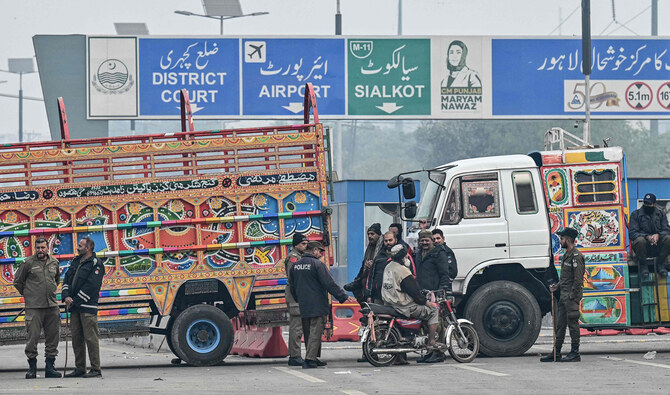


Police personnel stand guard at a closed road before a protest by supporters of former Prime Minister Imran Khan's Pakistan Tehreek-e-Insaf (PTI) party for Khan's release in Lahore on November 24, 2024. (AFP)

Losses in the IT and telecom sectors are significant but separate from these figures.
“The federal government’s daily loss is Rs190 billion, while provincial losses are even higher,” Aurangzeb noted, without providing detailed provincial breakdowns.
Khan, who has been incarcerated for over a year on charges he claims are politically motivated, has urged his followers to rally both in Pakistan and abroad.
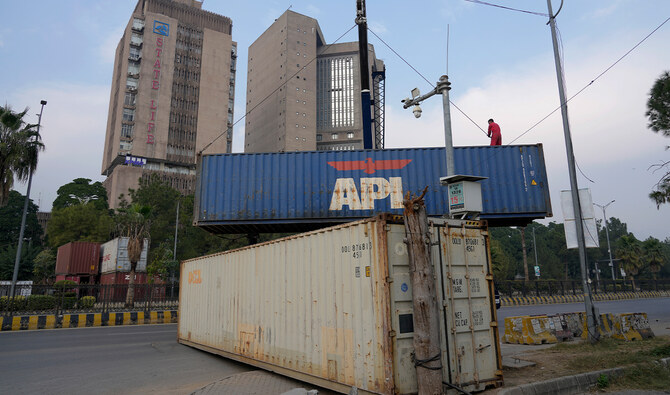


A worker places shipping containers to close a road ahead of a planned rally by supporters of imprisoned former Prime Minister Imran Khan’s Pakistan Tehreek-e-Insaf party, in Islamabad, Pakistan, on November 23, 2024. (AP)

PTI supporters in countries such as the United Kingdom, France, Sweden, Spain and Japan have also organized demonstrations, calling for the former prime minister’s release.
As tensions persist, the government remains firm in its resolve to maintain public order, with Finance Minister Aurangzeb stressing that the ongoing unrest is severely undermining the country’s economic recovery efforts.


Supporters of Pakistan Tehreek-e-Insaf (PTI) party and former Pakistan's Prime Minister Imran Khan shout slogans as they take part in a protest rally for the release of their leader Khan, in Peshawar on November 24, 2024. (AN Photo)


Pakistan’s JF-17 fighter jet draws ‘strong interest’ at Riyadh defense exhibition

Updated 13 sec ago
Follow

Pakistan’s JF-17 fighter jet draws ‘strong interest’ at Riyadh defense exhibition

  • Jets showcased as Pakistan seeks to expand defense exports
  • Interest in JF-17 has heightened after May 2025 conflict with India 

ISLAMABAD: Pakistan’s JF-17 Thunder fighter jet has drawn “strong interest” at the World Defense Exhibition in Riyadh, Pakistan’s state broadcaster said on Sunday, as Islamabad promotes the aircraft to international buyers at one of the region’s largest defense industry events.

The exhibition brings together defense officials, manufacturers and military delegations from dozens of countries, offering a platform for arms exporters to showcase equipment and pursue new contracts amid heightened global and regional security concerns.

Saudi Arabia has sought to position Riyadh as a regional hub for defense and aerospace exhibitions, using such events to foster partnerships and attract international manufacturers as part of broader diversification efforts. 

Last year Islamabad signed a mutual defense pact with Riyadh and is reportedly discussing another defense agreement involving Saudi Arabia and Turkiye, although details have not been made public.

“At the World Defense Exhibition in Riyadh, the Pakistan Air Force’s JF-17 Thunder has attracted strong interest from visitors and defense experts, standing out among fighter jets displayed by the US, Saudi Arabia and other countries,” state broadcaster Pakistan Television reported.

Islamabad is attending the exhibition in the backdrop of talks with at least 13 countries, six to eight of which are in an advanced stage, for deals involving JF-17 jets made jointly with China as well as training aircraft, drones, and weapons systems, according to recent media reports. 

Interest in the JF-17 jets has been bolstered by its operational visibility following the Pakistan-India military confrontation in May 2025, which Pakistani officials and defense analysts have cited as reinforcing the aircraft’s combat credibility.

Islamabad has increasingly positioned the JF-17 as a cost-effective multirole combat aircraft for countries seeking alternatives to high-end Western fighter jets. The aircraft is already in service with several foreign air forces and remains central to Islamabad’s defense export strategy.

Countries engaged in talks include Sudan, Saudi Arabia, Indonesia, Morocco, Ethiopia, and Nigeria as well as the government in eastern Libya led by Khalifa Haftar. Discussions on JF-17s and other weapons with Bangladesh and Iraq have been publicly acknowledged by Pakistan’s military, although more details have not been made public.

Almost all the potential buyers are Muslim-majority nations, like Pakistan. Many are from the predominantly Muslim Middle East, where Pakistan has historically been a security provider.