UK announces £108 million to support Pakistani businesses tackle climate change

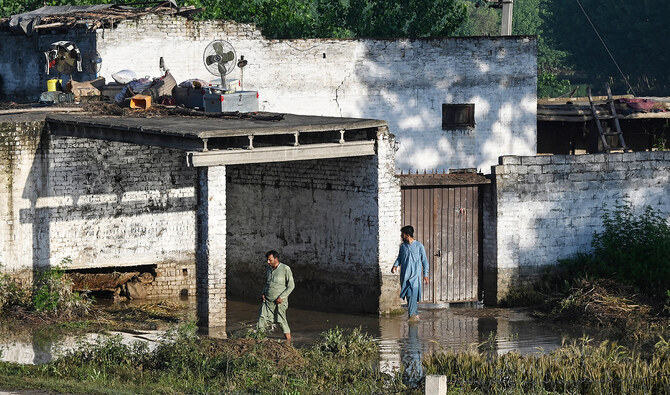
Residents wade through the flooded waters outside their homes following heavy rains in Charsadda district of Khyber Pakhtunkhwa province on April 17, 2024. (AFP/File)
Short Url
Updated 23 November 2024
Follow

UK announces £108 million to support Pakistani businesses tackle climate change

  • Funds will help businesses develop climate technologies, support Pakistan’s private sector
  • UK government says program will support the creation of over 100,000 Pakistani jobs

ISLAMABAD: The United Kingdom (UK) government this week announced £108 million in funds to support Pakistani businesses adapt to climate challenges, saying that it would help them develop technologies and meet significant investments required to tackle climate threats.
The announcement was made at the culmination of the two-day visit by British Parliamentary Under-Secretary of State for the Middle East, Afghanistan and Pakistan Hamish Falconer to Islamabad on Friday.
The British government said the funding will support a first-of-its-kind investment facility to deliver climate technologies and private sector support in Pakistan. The program will be delivered in partnership with the International Finance Corporation.
“The UK and Pakistan are committed to tackling tomorrow’s threats today,” Falconer was quoted as saying by the British government on Friday. 
“That’s why we’re investing in the expertise needed and supporting local businesses, alongside the Government of Pakistan, to get ahead of the challenges that climate change poses to the Pakistani people and the world.”
According to the Global Climate Risk Index, Pakistan is among the countries most at risk from climate change. The 2022 floods, which experts linked to global warming, impacted over 33 million people, resulted in more than 1,700 deaths and caused an estimated $33 billion in damages.
Pakistan’s economic struggles and high debt burden put a strain on its resources and impinged its ability to respond to the disaster.
Pakistan has also been grappling with increasingly unpredictable weather patterns, including droughts, heatwaves, and heavy rainfall. This year, the country experienced its heaviest April rainfall since 1961, with 59.3 millimeters recorded. Additionally, several regions faced severe heatwaves in May and June.
“The program will leverage the £108m the UK puts in to mobilize 5-6 times that amount of investment from the private sector and will support the creation of over 100,000 Pakistani jobs,” the British government said on its official website. 
Pakistan and the UK enjoy strong military, economic and educational ties, with the latter hosting a large Pakistani diaspora.
Recent high-level visits by military leaders from both countries have signalled a deepening of defense ties and cooperation. The strong relationship is built on a shared history and the significant presence of a Pakistani diaspora in the country.


Islamabad says surge in aircraft orders after India standoff could end IMF reliance

Updated 06 January 2026
Follow

Islamabad says surge in aircraft orders after India standoff could end IMF reliance

  • Pakistani jets came into the limelight after Islamabad claimed to have shot down six Indian aircraft during a standoff in May last year
  • Many countries have since stepped up engagement with Pakistan, while others have proposed learning from PAF’s multi-domain capabilities

ISLAMABAD: Defense Minister Khawaja Asif on Tuesday said Pakistan has witnessed a surge in aircraft orders after a four-day military standoff with India last year and, if materialized, they could end the country’s reliance on the International Monetary Fund (IMF).

The statement came hours after a high-level Bangladeshi defense delegation met Pakistan’s Air Chief Marshal Zaheer Ahmed Baber Sidhu to discuss a potential sale of JF-17 Thunder aircraft, a multi-role fighter jointly developed by China and Pakistan that has become the backbone of the Pakistan Air Force (PAF) over the past decade.

Fighter jets used by Pakistan came into the limelight after Islamabad claimed to have shot down six Indian aircraft, including French-made Rafale jets, during the military conflict with India in May last year. India acknowledged losses in the aerial combat but did not specify a number.

Many countries have since stepped up defense engagement with Pakistan, while delegations from multiple other nations have proposed learning from Pakistan Air Force’s multi-domain air warfare capabilities that successfully advanced Chinese military technology performs against Western hardware.

“Right now, the number of orders we are receiving after reaching this point is significant because our aircraft have been tested,” Defense Minister Asif told a Pakistan’s Geo News channel.

“We are receiving those orders, and it is possible that after six months we may not even need the IMF.”

Pakistan markets the Chinese co-developed JF-17 as a lower-cost multi-role fighter and has positioned itself as a supplier able to offer aircraft, training and maintenance outside Western supply chains.

“I am saying this to you with full confidence,” Asif continued. “If, after six months, all these orders materialize, we will not need the IMF.”

Pakistan has repeatedly turned to the IMF for financial assistance to stabilize its economy. These loans come with strict conditions including fiscal reforms, subsidy cuts and measures to increase revenue that Pakistan must implement to secure disbursements.

In Sept. 2024, the IMF approved a $7 billion bailout for Pakistan under its Extended Fund Facility (EFF) program and a separate $1.4 billion loan under its climate resilience fund in May 2025, aimed at strengthening the country’s economic and climate resilience.

Pakistan has long been striving to expand defense exports by leveraging its decades of counter-insurgency experience and a domestic industry that produces aircraft, armored vehicles, munitions and other equipment.

The South Asian country reached a deal worth over $4 billion to sell military equipment to the Libyan National Army, Reuters report last month, citing Pakistani officials. The deal, one of Pakistan’s largest-ever weapons sales, included the sale of 16 JF-17 fighter jets and 12 Super Mushak trainer aircraft for basic pilot training.