ISLAMABAD: Pakistan’s Interior Minister Mohsin Naqvi on Friday vowed to implement the Islamabad High Court’s (IHC) order, refusing to allow former prime minister Imran Khan’s Pakistan Tehreek-e-Insaf (PTI) party to stage the Nov. 24 protest in the federal capital demanding his release.
The PTI has announced a “long march” to Islamabad, primarily to pressurize the government to end Khan’s imprisoned that has lasted for over a year on what his party contends are politically motivated charges. The protest also aims to raise PTI’s voice against alleged rigging in the February 8 general elections while calling for measures to ensure judicial independence, which the party says has been undermined by the 26th constitutional amendment.
Only a day earlier, the IHC directed the government to form a committee to engage in talks with the PTI, emphasizing the need to avoid disruptions during the three-day visit of Belarusian President Aleksandr Lukashenko to discuss bilateral economic cooperation. The court expressed hope that the PTI would allow “meaningful communication” with the administration while acknowledging that the maintenance of law and order would be the government’s priority if there was no breakthrough between the two sides.
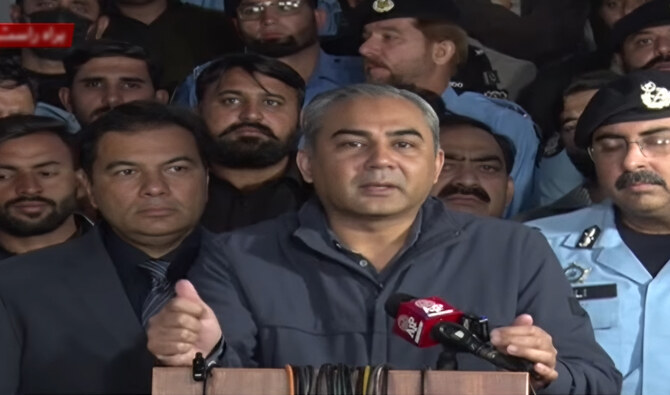
Addressing the media in Islamabad alongside the capital city’s chief commissioner and police chief, the interior minister highlighted that no rally, march or protest would be allowed in the federal capital owing to the Belarusian president’s visit to the country, as per the IHC order.
“No one will be allowed to stage a rally or protest in Islamabad in compliance with the high court order,” Naqvi said. “After the IHC order, we will implement it 100 percent at any cost. We are bound by the law to implement it.”
Regarding the IHC directions to hold talks with the PTI party leadership, the minister said he would speak to Prime Minister Shehbaz Sharif in the evening to constitute a committee “but definitely if they stage a protest, this [negotiation] will get difficult.”
Islamabad’s district magistrate has already imposed a two-month ban on the gathering of more than five people in the capital using Section 144 of the Criminal Procedure Code (CrPC), which allows the government to prohibit various forms of political assembly, gatherings, sit-ins, rallies, demonstrations and other activities for a specified period.
In response to a question about whether the government was in touch with Adiala Jail, where ex-premier Khan is currently incarcerated, Naqvi said he has no contact with anyone there.
The interior minister also highlighted that the capital city’s administration did not receive any application from the PTI to stage a protest.
He made it clear that people violating the court orders would be responsible if there was any loss of life during the Nov. 24 protest.
Naqvi also said that he agreed with the residents of Islamabad that shops, roads, businesses and mobile signals should not be shut down but noted there was no other way of dealing with such protests.
“If they want to come and protest [in Islamabad], I’ll be the one who will say that no talks should take place,” he concluded. “If they want to hold talks, they should do it in a proper manner. This is no way that on one side they protest and on the other call for talks.”
Earlier this week, Pakistan’s interior ministry had authorized the deployment of paramilitary Punjab Rangers and Frontier Corps troops in Islamabad to maintain law and order.
Pakistan’s parliament also passed a law earlier this year to regulate public gatherings in Islamabad, specifying timings for rallies and designating specific areas. The law prescribes three-year jail terms for participants in illegal assemblies and 10-year imprisonment for repeat offenders.


![]()

Pakistan government doubles down on preventing Imran Khan’s Nov. 24 protest
Short Url
https://arab.news/c56g4
Pakistan government doubles down on preventing Imran Khan’s Nov. 24 protest
- Interior Minister Mohsin Naqvi warns no talks if Khan’s PTI proceeds with the protest
- Ex-premier’s party plans a ‘long march’ to Islamabad, seeking his release from prison
Latest updates


© 2026 SAUDI RESEARCH & PUBLISHING COMPANY, All Rights Reserved And subject to Terms of Use Agreement.