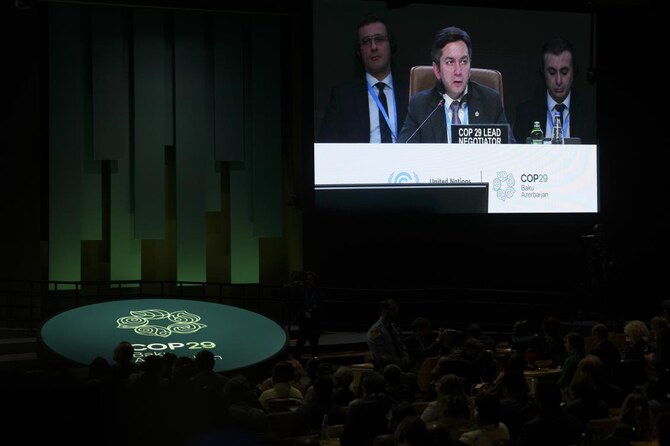
COP29 host urges collaboration as deal negotiations enter final stage

Yalchin Rafiyev, Azerbaijan’s COP29 lead negotiator, speaks during a plenary session at the COP29 UN Climate Summit in Baku, Azerbaijan. Economists say developing countries need at least $1 trillion annually in climate finance by the end of the decade, but wealthy nations have so far been resisting. (AP)
Short Url
Updated 22 November 2024
Follow

COP29 host urges collaboration as deal negotiations enter final stage

  • Sweeping plan that would see rich nations pledge to hand over hundreds of billions of dollars to help poorer countries grapple with the worsening impacts of global warming

BAKU: COP29 climate summit host Azerbaijan urged participating countries to bridge their differences and come up with a finance deal on Friday, as negotiations at the two-week conference entered their final hours.
World governments represented at the meeting in the Caspian Sea city of Baku are tasked with agreeing a sweeping plan that would see rich nations pledge to hand over hundreds of billions of dollars to help poorer countries grapple with the worsening impacts of global warming.
Economists have said developing countries need at least $1 trillion annually by the end of the decade, but wealthy nations have so far been resisting. Negotiations have also been clouded by uncertainty over the role of the United States, the world’s top historic greenhouse gas emitter, ahead of climate skeptic President-elect Donald Trump’s return to the White House.
“We encourage parties to continue to collaborate within and across groups with the aim of proposing bridging proposals that will help us to finalize our work here in Baku,” the COP29 presidency said in a note to delegates on Friday morning.
It said a new draft deal would be released at midday in Baku, in the hopes of a deal by the end of the day.
Past COPs have traditionally run over time.
Division and discontent over the negotiations have already spilled into the open, after a fresh deal draft was released by the presidency on Thursday that offered two vastly different options that left no-one happy.
Although the 10-page document was slimmed to less than half the size of the previous versions issued at the summit, it avoided stating the total funds countries would aim to invest each year, leaving the space marked with an “X.”
It also reflected big divisions over issues such as whether funds should be offered as grants or loans, and the degree to which different types of non-public finance should count toward the final annual goal.
“I hope they find the sweet spot with this next iteration,” said Li Shuo, director of the China Climate Hub at the Asia Society, a veteran observer of COP summits. “Anything other than that may require rescheduling flights.”
UN Secretary-General Antonio Guterres returned to Baku from a G20 meeting in Brazil on Thursday, calling for a major push to get a deal and warning that “failure is not an option.”


Australian bushfires raze homes in two states; firefighter dies

Updated 2 sec ago
Follow

Australian bushfires raze homes in two states; firefighter dies

  • Sixteen homes lost on Central Coast region in New South Wales
  • Tasmania 700-hectare blaze destroys 19 homes at Dolphin Sands
SYDNEY/WELLINGTON: An Australian firefighter was killed overnight after he was struck by a tree while trying to control a bushfire that had destroyed homes and burnt large swathes of bushland north of Sydney, authorities said on Monday.
Emergency crews rushed to bushland near the rural town of Bulahdelah, 200 kilometers north of Sydney, after reports that a tree had fallen on a man. The 59-year-old suffered a cardiac arrest and died at the scene, officials said.
Prime Minister Anthony Albanese said the “terrible news is a somber reminder” of the dangers faced by emergency services personnel as they work to protect homes and families.
“We honor that bravery, every day,” Albanese said in a statement.
A fast-moving fire over the weekend destroyed 16 homes in New South Wales state’s Central Coast region, home to about 350,000 people and a commuter region just north of Sydney.
Resident Rouchelle Doust, from the hard-hit town of Koolewong, said she and her husband tried to save their home as flames advanced.
“He’s up there in his bare feet trying to put it out, and he’s trying and trying, and I’m screaming at him to come down,” Doust told the Australian Broadcasting Corp.
“Everything’s in it: his grandmother’s stuff, his mother’s stuff, all my stuff — everything, it’s all gone, the whole lot.”
Conditions eased overnight, allowing officials to downgrade fire danger alerts, though the weather bureau warned some inland towns in the state could hit more than 40 degrees Celsius (104 Fahrenheit) on Tuesday, raising fire dangers.
More than 50 bushfires were burning across New South Wales as of Monday.
On the island state of Tasmania, a 700-hectare blaze at Dolphin Sands, about 150km northeast of the state capital of Hobart, destroyed 19 homes and damaged 40. The fire has been contained, but residents have been warned not to return as conditions remain dangerous, officials said.
Authorities have warned of a high-risk bushfire season during Australia’s summer months from December to February, with increased chances of extreme heat across large parts of the country following several relatively quiet years.
New Zealand national park fire
In neighboring New Zealand, five helicopters and multiple crews were working to put out a fire near the country’s oldest national park, a month after a wildfire burnt through 2,589 hectares of alpine bush there.
Police said they had closed a road near the state highway and advised motorists to avoid the area and expect delays, after the blaze near Tongariro National Park, a popular hiking spot, spread to 110 hectares by Monday afternoon.