


DUBAI: Saudi calligrapher and arts instructor Abdulaziz Al-Rashedi’s first love was the pen. His fascination with writing began in elementary school in the Eighties in his hometown of Madinah.
Al-Rashedi talks about holding a pen in the same way a musician might discuss holding their instrument. In the eyes of the calligrapher, writing is an artistic act, like a dance, that has its own kind of magic.
“What I loved about the pen was the way the ink was flowing out of it,” he tells Arab News. “The pen led me to my love of writing Arabic calligraphy.”
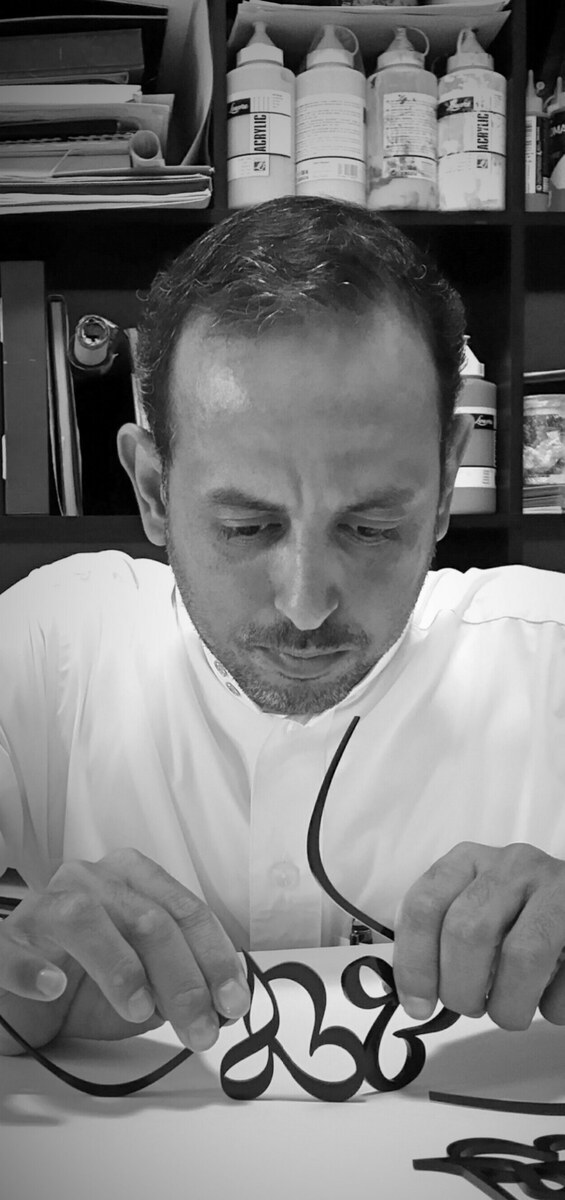
Al-Rashedi talks about holding a pen in the same way a musician might discuss holding their instrument. (Supplied)
But there were challenges imposed by the conservative social environment of the Kingdom in the Eighties and Nineties.
“People didn’t regard art as something important. During that time, people thought that art couldn’t generate money. For them, it was a waste of time,” he says. “In such a depressing environment, I was suffering from people’s lack of interest. They were saying that the writing would distract me from my studies. But actually, it encouraged me to study.”
Not everyone disregarded his interest in pursuing calligraphy, however. Al-Rashedi’s late father was always a supporter.

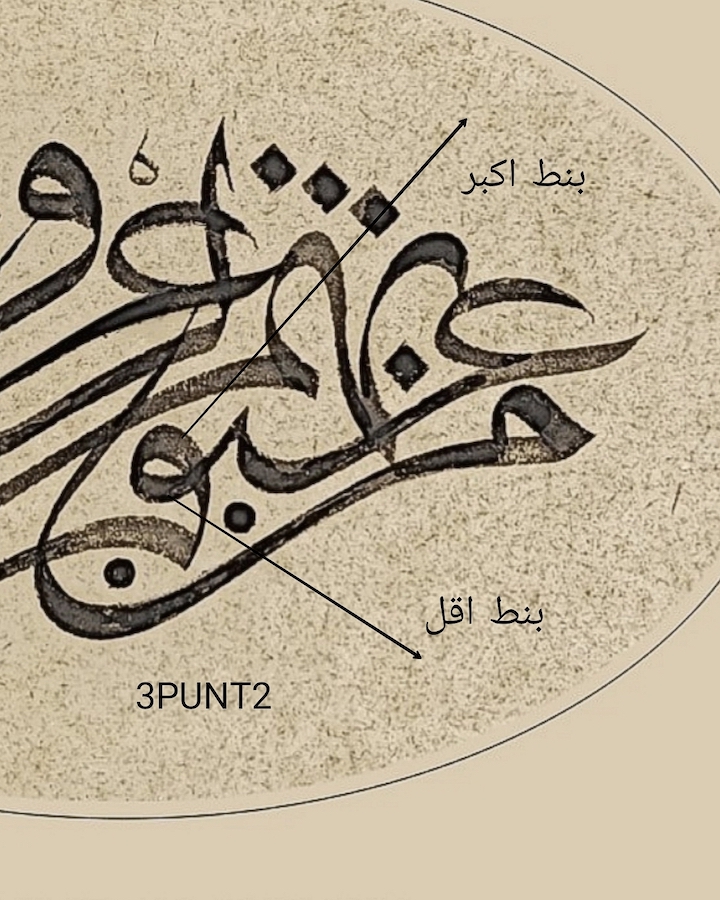
3punt 2. (Supplied)
“He was a believer in writing, and conserving it,” Al-Rashedi says. “He thought I was doing something important with my life, even though others thought it wasn’t important. They likened it to making scribbles. I was literally making art on my own. None of my friends shared this interest with me and there were no calligraphy institutes to encourage this talent. The situation was very difficult.”
But in 1993, Al-Rashedi learned there was, in fact, a master Saudi calligrapher living in Madinah: Ahmad Dia. He kindly agreed to teach Al-Rashedi the basics of Arabic calligraphy. And, perhaps just as importantly, to do so in his home, which Al-Rashedi compares to a school and a museum, as well as a meeting place for calligraphers.
“I was young, but he treated me like a man,” the artist recalls. “For us calligraphers, he was like a spiritual father figure, who planted a seed of determination in us. He always encouraged us and never told us off if our writing wasn’t on point.”
3punt 4. (Supplied)
Al-Rashedi remained in contact with his tutor until Dia’s death in 2022 during the COVID pandemic. “When he died, it felt as if the light went off,” Al-Rashedi says.
Al-Rashedi also trained himself by copying the work of another important figure: Hashem Al-Baghdadi, the influential Iraqi calligrapher and educator who published books on the rules of Arabic calligraphy. Al-Rashedi describes the pre-social media era as a “truly dark period” when there were no opportunities to host exhibitions or share his work with others.
“People weren’t communicating with each other. It was a period that lacked (opportunity) and even good materials, such as pens and paper,” he recalls.
But with the advent of social media, most notably Facebook, and the opening of a few art galleries, including Jeddah’s Athr Gallery in 2009, things improved drastically. Today, Al-Rashedi is able to share his work on Instagram and other platforms, displaying the skills he has honed over three decades of practice.
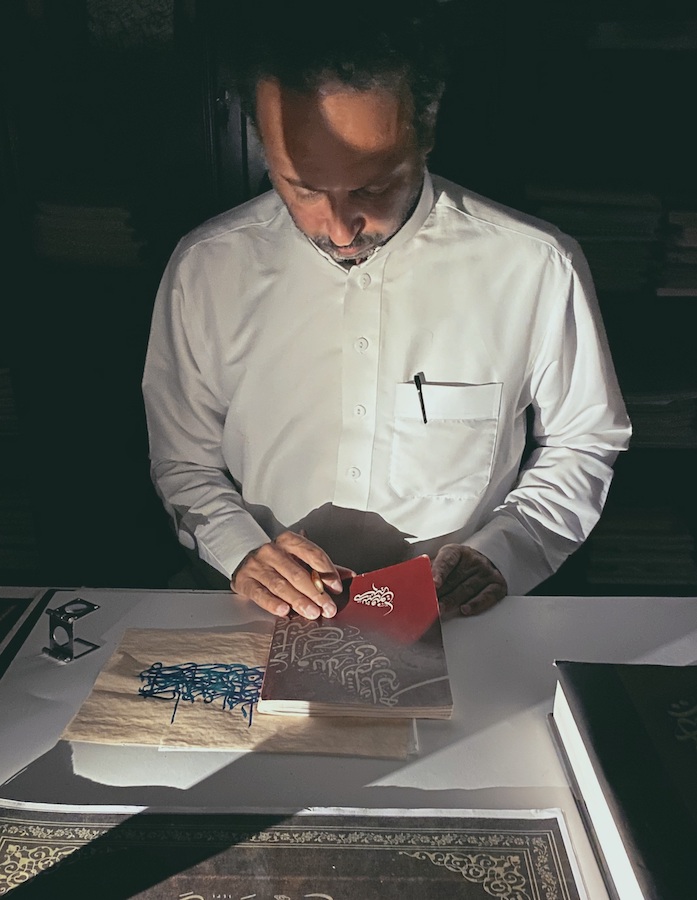
His fascination with writing began in elementary school in the Eighties in his hometown of Madinah. (Supplied)
Arabic calligraphy is an internationally respected art form that has existed for thousands of years, exercised in Islamic texts and found on monuments around the world. So, what is its long-lasting secret?
“I often ask myself why the curves of Arabic calligraphy have bewitched people for so long, and I believe it inevitably has something to do with its holiness,” he says. “Allah has been an inspiration for calligraphers and their innovation of writing. I feel there is a holy light within the letters of Arabic calligraphy.”
But Al-Rashedi also believes that, for many years, calligraphy has been stuck in a rut, untouched by modern innovation or creativity.
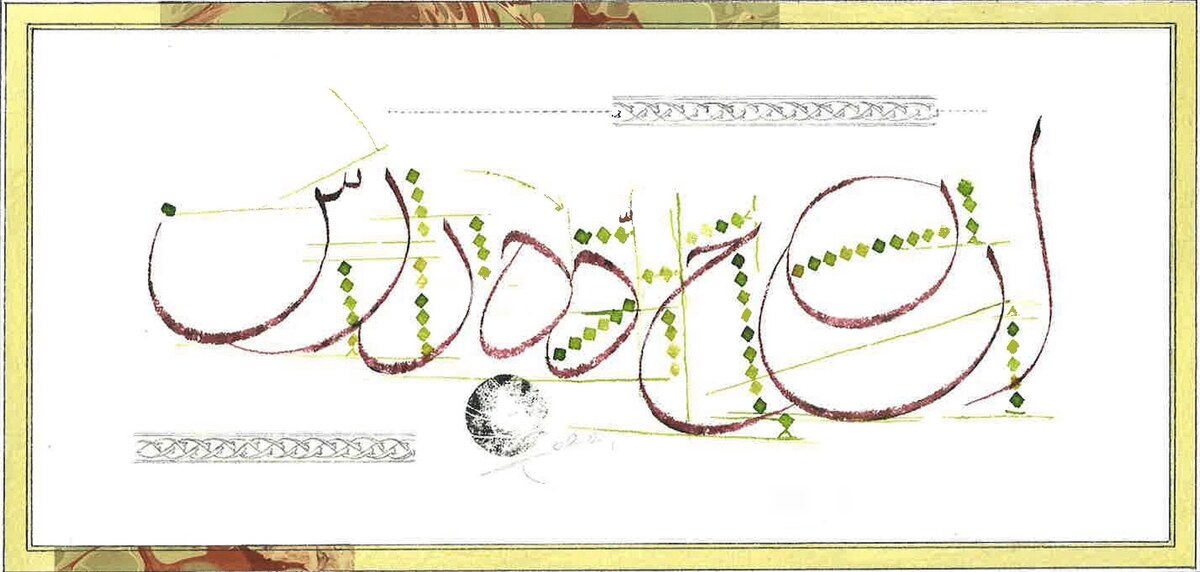
3punt 6. (Supplied)
“Many calligraphers have literally said that Arabic calligraphy has reached its end and no one could add anything new to it,” he says. “Such an idea is incorrect.”
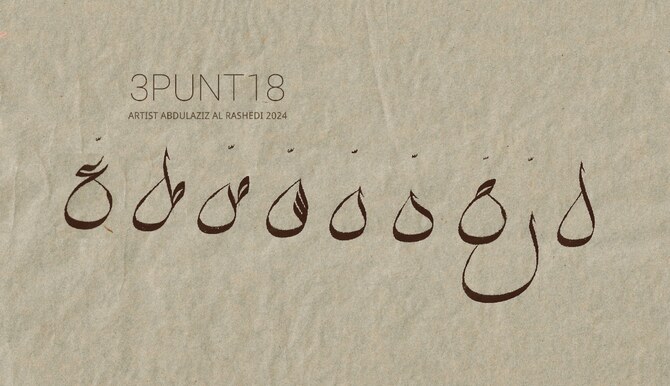
Indeed, Al-Rashedi has invented his own form of Arabic calligraphy, which he calls “3punt.” (He says the name refers to the size of the letters, which are written using three different pens.)
“It depends on the idea of lessening the thickness of the letter. Usually, one pen is used in Arabic calligraphy. But I discovered that the original bulkiness of Arabic scripture and the usage of just one pen prevents Arabic calligraphy from having new forms of writing being added to its system.”
Based on a strict set of rules, Al-Rashedi’s 3punt calligraphy contains 55 “subtypes of writing,” he says. It has its own lightness and elegance, with carefully choreographed flowing lines of slender Arabic script.
Ultimately, Al-Rashedi believes that Arabic calligraphy is about connections.
“If we look at Latin or Chinese scripture, on letters like ‘n,’ ‘e,’ or ‘r,’ they are based on separate components. But with Arabic calligraphy, you can connect six or seven letters in one go,” he says. “Without a doubt, Arabic writing — as an art form — is superior to other types of writing.”


