

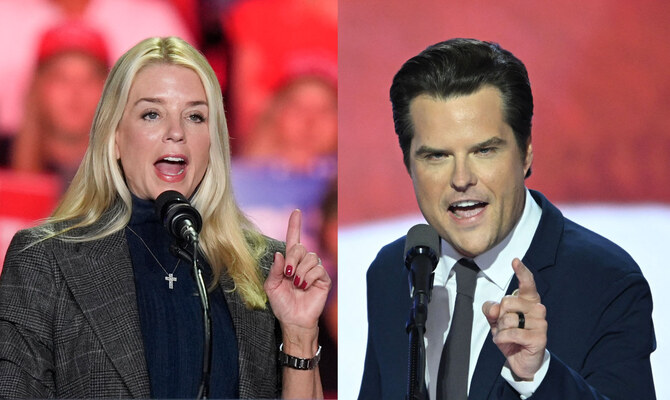
Trump chooses Pam Bondi for attorney general pick after Gaetz withdraws amid fallout over sex trafficking probe

Former Florida Attorney General Pam Bondi, left, and former US Representative Matt Gaetz. (AP/AFP)
Short Url
Updated 22 November 2024
Follow

Trump chooses Pam Bondi for attorney general pick after Gaetz withdraws amid fallout over sex trafficking probe

  • "It is clear that my confirmation was unfairly becoming a distraction to the critical work of the Trump/Vance Transition,” Gaetz said
  • Bondi is a longtime Trump ally and was one of his lawyers during his first impeachment trial when he was accused of abusing his power

WASHINGTON: President-elect Donald Trump on Thursday named Pam Bondi, the former attorney general of Florida, to be US attorney general just hours after his other choice, Matt Gaetz, withdrew his name from consideration.
Bondi is a longtime Trump ally and was one of his lawyers during his first impeachment trial, when he was accused — but not convicted — of abusing his power as he tried to condition US military assistance to Ukraine on that country investigating then-former Vice President Joe Biden.
Bondi was among a group of Republicans who showed up to support Trump at his hush money criminal trial in New York that ended in May with a conviction on 34 felony counts. She’s been a chair at the America First Policy Institute, a think tank set up by former Trump administration staffers.
“For too long, the partisan Department of Justice has been weaponized against me and other Republicans — Not anymore,” Trump said in a social media post. “Pam will refocus the DOJ to its intended purpose of fighting Crime, and Making America Safe Again.”
Trump’s son Donald Trump Jr. told Fox Business on Sunday that the transition team had backups in mind for his controversial nominees should they fail to get confirmed. The swift selection of Bondi came about six hours after Gaetz withdrew.
Gaetz stepped aside amid continued fallout over a federal sex trafficking investigation that cast doubt on his ability to be confirmed as the nation’s chief federal law enforcement officer.


That announcement capped a turbulent eight-day period in which Trump sought to capitalize on his decisive election win to force Senate Republicans to accept provocative selections like Gaetz, who had been investigated by the Justice Department before being tapped last week to lead it. The decision could heighten scrutiny on other controversial Trump nominees, including Pentagon pick Pete Hegseth, who faces sexual assault allegations that he denies.
“While the momentum was strong, it is clear that my confirmation was unfairly becoming a distraction to the critical work of the Trump/Vance Transition,” Gaetz, a Florida Republican who one day earlier met with senators in an effort to win their support, said in a statement.
“There is no time to waste on a needlessly protracted Washington scuffle, thus I’ll be withdrawing my name from consideration to serve as Attorney General. Trump’s DOJ must be in place and ready on Day 1,” he added. Hours later, Gaetz posted on social media that he looks “forward to continuing the fight to save our country,” adding, “Just maybe from a different post.”
Trump, in a social media post, said: “I greatly appreciate the recent efforts of Matt Gaetz in seeking approval to be Attorney General. He was doing very well but, at the same time, did not want to be a distraction for the Administration, for which he has much respect. Matt has a wonderful future, and I look forward to watching all of the great things he will do!”
Last week, Trump named personal lawyers Todd Blanche, Emil Bove and D. John Sauer to senior roles in the department. Another possible attorney general contender, Matt Whitaker, was announced Wednesday as the US ambassador to NATO.
Bondi, too, is a longtime loyalist. She has been a vocal critic of the criminal cases against Trump as well as Jack Smith, the special counsel who charged Trump in two federal cases. In one radio appearance, she blasted Smith and other prosecutors who have charged Trump as “horrible” people she said were trying to make names for themselves by “going after Donald Trump and weaponizing our legal system.”
If confirmed by the Republican-led Senate, Bondi would instantly become one of the most closely watched members of Trump’s Cabinet given the Republican’s threat to pursue retribution against perceived adversaries and concern among Democrats that he will look to bend the Justice Department to his will. A recent Supreme Court opinion not only conferred broad immunity on former presidents but also affirmed a president’s exclusive authority over the Justice Department’s investigative functions.
Bondi would inherit a Justice Department expected to pivot sharply on civil rights, corporate enforcement and the prosecutions of hundreds of Trump supporters charged in the Jan. 6, 2021, riot at the US Capitol — defendants whom Trump has pledged to pardon.
It’s unlikely that Bondi would be confirmed in time to overlap with Smith, who brought two federal indictments against Trump that are both expected to wind down before the incoming president takes office. Special counsels are expected to produce reports on their work that historically are made public, but it remains unclear when such a document might be released.
In 2013, while serving as Florida attorney general, Bondi publicly apologized for asking that the execution of a man convicted of murder be delayed because it conflicted with a campaign fundraiser.
Bondi said she was wrong and sorry for requesting then-Gov. Rick Scott push back the execution of Marshall Lee Gore by three weeks.
Before she ran for state attorney general in 2010, Bondi worked for the Hillsborough County state attorney.


Thailand heads to polls with voters demanding ‘real change’

Updated 4 sec ago
Follow

Thailand heads to polls with voters demanding ‘real change’

  • Millennials, Generation Z make up around 46.5 percent of Thailand’s eligible voters
  • Voters will also decide on whether to rewrite current military-backed constitution

BANGKOK: Thai voters will head to the polls on Sunday after cycling through three prime ministers in less than three years, with the three-way contest of major parties set to decide the leader of the Southeast Asian nation over the next four years.

For the first time in the country’s history, nearly 53 million eligible voters in the kingdom of 71 million people will choose 500 lawmakers and also decide whether to rewrite the constitution.

The snap election was called in December by Anutin Charnvirakul, Thailand’s third premier since the 2023 election, who dissolved the House of Representatives to preempt a looming no-confidence vote.

More than 5,000 candidates from 57 parties are registered to take part in the polls, which will directly elect 400 lawmakers based on constituencies, while 100 others will be chosen from “party list” nominees, who gain seats according to each party’s proportional share of the vote.

Together, they will constitute the 500 members of the House of Representatives who will select the prime minister.

“This election is a gamble on the future of Thailand. Over the past decade, I have never seen the country move backward as much as it has,” Lawan Sarovat, a 60-year-old resident of Bangkok, told Arab News.

Thailand has been struggling with prolonged political uncertainty and a series of challenges, including an economy stuck at about 2 percent growth for the past five years and a border conflict with Cambodia last year that killed more than 100 people and cost at least $436 million.

“We want to see change. We had hoped that the previous election would bring about real change, but that did not happen. This time, people must try to make their voices heard in every possible way,” Sarovat said.

Main contenders

Sunday’s vote pits incumbent Prime Minister Charnvirakul’s Bhumjaithai party, which is backed by Thailand’s royalist conservative establishment, with the progressive youth-led People’s Party and Pheu Thai, a once-dominant party associated with now-jailed former premier Thaksin Shinawatra.

A nationwide survey by the National Institute of Development Administration put People’s Party leader Natthaphong Ruengpanyawut in first place for prime minister at over 29 percent, followed by Anutin at more than 22 percent.

The People’s Party was also a leading choice in terms of party preference, chosen by more than 33.5 percent of the January survey’s 2,500 respondents, while Bhumjaithai and Pheu Thai came second and third with about 22.7 percent and 16.9 percent, respectively.

The People’s Party is the successor to the group that won the last election — Move Forward — but was blocked from power, despite winning the greatest number of seats in the House of Representatives with the support of 14 million Thais.

It was eventually dissolved by the Constitutional Court over its proposals to revise the country’s strict royal insult laws.

“Elections in Thailand are not simply about citizens voting to choose a government. They are surrounded by multiple factors,” Thai senator Tewarit Maneechai told Arab News.

Even after securing popular support, Thai political parties must gain acceptance from a network of independent bodies established under the current constitution, including the Senate, the Constitutional Court, and the National Anti-Corruption Commission.

These institutions, Maneechai said, continue to function as mechanisms of the old power structure that has dominated Thailand’s political direction since the 2014 military coup.

Under this system, even an elected government can be removed from office at any time. Maneechai pointed to the case of Paetongtarn Shinawatra, ex-premier from the Pheu Thai Party, who was removed from office in August 2025 following a ruling by the Constitutional Court — a decision that raised public concerns over the expanding authority of independent agencies.

“There are surrounding factors that determine whether a government can actually be formed. Political parties that are able to govern are those that operate within the rules designed by the group that came to power through the coup,” Maneechai said.

Constitutional referendum

On Sunday, voters will also decide if a new constitution should replace a military-backed 2017 charter.

The ballot will simply ask voters if they “approve that there should be a new constitution,” with options of “Yes,” “No,” or “No opinion.”

The referendum needs more than 17 million votes in favor to become “a mandate that the entire country must heed,” Maneechai said.

“The referendum matters because even if a party wins the election, its ability to remain in power ultimately depends on independent mechanisms under the current constitution, which have the authority to remove a prime minister and destabilize a government.”

Though a majority “Yes” would kickstart a multi-stage drafting process, it will require two more referendums before a new charter could be adopted.

Change vs. status quo

Jamza Jongkham is among many Thai voters hoping that the election will lead to a constitutional reform.

“Right now, Thai politics is operating under rules controlled by an authoritarian camp that dominates the entire system, overriding political parties elected by the people,” he told Arab News.

The 27-year-old said what happened to the Move Forward party in 2023 was “fundamentally unfair,” and despite anger at how powerful politicians misuse power, he still has hopes in the younger generation.

Together, millennials and Generation Z make up around 46.5 percent of Thailand’s eligible voters.

“I still believe that people’s voices matter. If we choose to remain silent and do not exercise our right to vote, I believe Thailand will only become worse. There are still many people who want to see this country move in a better direction,” he said.

“If we can change the system so that everyone can participate in politics on an equal footing, I believe Thailand would become a far more just society.”

Puangthong Pawakapan, a political scientist at Chulalongkorn University, said Sunday’s vote is unlikely to serve as a decisive turning point in Thai politics, but rather reflect “an increasingly intense political struggle” between the public and entrenched power structures.

“This election has divided both those in power and the public into two clear sides — those who want change and those who want to preserve the status quo,” she told Arab News.

“Today, the public clearly sees that Thailand’s political and economic problems are rooted in an old power structure that is extremely difficult to change.”