BEIRUT: Israeli strikes killed 79 pro-Iran fighters, including from Iraq and Lebanon, in the Syrian city of Palmyra, a monitor said Thursday, updating the toll for the raids a day earlier.
The toll was “the highest due to Israeli raids on pro-Iran groups in Syria since the start of the conflict” in the country in 2011, said Rami Abdel Rahman, head of the Syrian Observatory for Human Rights.
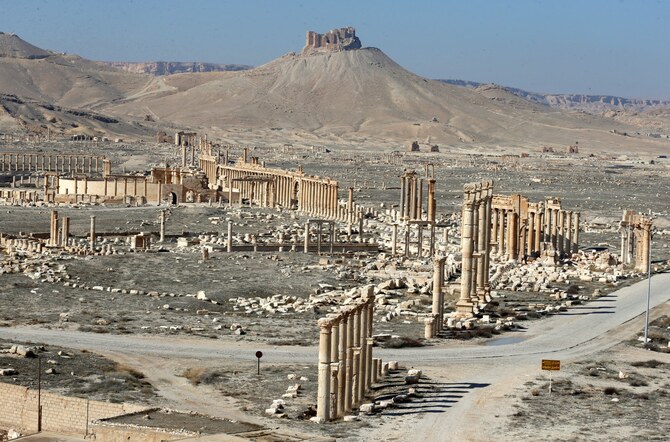
The Britain-based Observatory said Wednesday’s strikes targeted three sites in Palmyra — a modern city adjacent to renowned Greco-Roman ruins — including one that hit a meeting of pro-Iranian groups with leaders from Iraq’s Al-Nujaba group and Lebanon’s Hezbollah.
The death toll has risen to “79 pro-Iran fighters,” 53 of them Syrians, 22 foreign nationals “mostly from the Iraqi Al-Nujaba movement,” in addition to “four from Hezbollah,” said the Observatory, updating an earlier toll of 71 dead.
Syria’s defense ministry said Wednesday the Israeli strikes on the city in central Syria killed 36 people and wounded more than 50 others.
Also Wednesday, Syria’s foreign ministry condemned “in the strongest terms the brutal Israeli aggression against the city of Palmyra, which reflects the continuing crimes of Zionism against the countries of the region and their peoples.”
Since civil war erupted in 2011, Israel has carried out hundreds of strikes in Syria, mainly targeting the army and Iran-backed groups.
The Israeli military has intensified its strikes on targets in Syria since almost a year of hostilities with Iran-backed Hezbollah in neighboring Lebanon escalated into all-out war in late September.
Israel rarely comments on individual strikes in Syria but has repeatedly said it will not allow Iran to expand its presence in the country.
Palmyra, a UNESCO World Heritage Site, was taken over and pillaged by Daesh militants at the height of the Syrian civil war.
The director general of antiquities and museums in Syria, Nazir Awad, told AFP the city’s temples “did not suffer any direct damage” during the latest strikes.
“We need to conduct a survey on the ground to confirm these observations,” he added.

Israel strikes on Syria’s Palmyra kill 79 pro-Iran fighters: new toll from monitor
Short Url
https://arab.news/cxq89
Israel strikes on Syria’s Palmyra kill 79 pro-Iran fighters: new toll from monitor
- The death toll has risen to “79 pro-Iran fighters,” 53 of them Syrians, 22 foreign nationals “mostly from the Iraqi Al-Nujaba movement,” in addition to “four from Hezbollah“
- Israel rarely comments on individual strikes in Syria but has repeatedly said it will not allow Iran to expand its presence in the country
Hamas says technocratic committee key to consolidating Gaza truce
- A senior Hamas official on Thursday welcomed the formation of a technocratic committee to govern post-war Gaza, saying it would help consolidate the ceasefire and prevent a return to fighting
GAZA: A senior Hamas official on Thursday welcomed the formation of a technocratic committee to govern post-war Gaza, saying it would help consolidate the ceasefire and prevent a return to fighting.
Egypt, a mediator in indirect ceasefire talks between Israel and Hamas, announced the formation of a 15-member Palestinian technocratic committee that would operate under the overall supervision of a so-called “Board of Peace,” to be chaired by US President Donald Trump.
“The formation of the committee is a step in the right direction,” said Bassem Naim, a senior leader in the Palestinian Islamist movement.
“This is crucial for consolidating the ceasefire, preventing a return to war, addressing the catastrophic humanitarian crisis and preparing for comprehensive reconstruction,” he said.
Hamas has exercised total control over public life in Gaza since 2007.
It has repeatedly said it does not seek a role in any future governing authority in Gaza and would limit its involvement to monitoring governance.
Naim said Hamas was ready to hand over administration of the Gaza Strip to the national transitional committee and to facilitate its work.
“The ball is now in the court of the mediators, the American guarantor and the international community to empower the committee,” he said.
He urged them to counter what he described as Israeli Prime Minister Benjamin Netanyahu’s attempts to “stall or obstruct” the next stages of the ceasefire.
Since the ceasefire took effect on October 10, Gaza has been split by a so-called “Yellow Line,” marking the boundary between territory controlled by Hamas and areas under Israeli military authority.
Washington’s top envoy, Steve Witkoff, said on Wednesday the ceasefire had moved into its second stage.
Key elements of the second stage include the gradual withdrawal of Israeli forces from Gaza, the demilitarization of the territory including the disarmament of Hamas, and steps to address the humanitarian crisis through accelerated aid deliveries and reconstruction.
The US-proposed Board of Peace is expected to be led on the ground by Bulgarian diplomat and politician Nickolay Mladenov, who has recently held talks with Israeli and Palestinian officials.
Mladenov previously served as the United Nations envoy for the Middle East peace process from early 2015 until the end of 2020.
Media reports say Trump is expected to announce the members of the Board of Peace in the coming days, with the body set to include around 15 world leaders.
Egypt, a mediator in indirect ceasefire talks between Israel and Hamas, announced the formation of a 15-member Palestinian technocratic committee that would operate under the overall supervision of a so-called “Board of Peace,” to be chaired by US President Donald Trump.
“The formation of the committee is a step in the right direction,” said Bassem Naim, a senior leader in the Palestinian Islamist movement.
“This is crucial for consolidating the ceasefire, preventing a return to war, addressing the catastrophic humanitarian crisis and preparing for comprehensive reconstruction,” he said.
Hamas has exercised total control over public life in Gaza since 2007.
It has repeatedly said it does not seek a role in any future governing authority in Gaza and would limit its involvement to monitoring governance.
Naim said Hamas was ready to hand over administration of the Gaza Strip to the national transitional committee and to facilitate its work.
“The ball is now in the court of the mediators, the American guarantor and the international community to empower the committee,” he said.
He urged them to counter what he described as Israeli Prime Minister Benjamin Netanyahu’s attempts to “stall or obstruct” the next stages of the ceasefire.
Since the ceasefire took effect on October 10, Gaza has been split by a so-called “Yellow Line,” marking the boundary between territory controlled by Hamas and areas under Israeli military authority.
Washington’s top envoy, Steve Witkoff, said on Wednesday the ceasefire had moved into its second stage.
Key elements of the second stage include the gradual withdrawal of Israeli forces from Gaza, the demilitarization of the territory including the disarmament of Hamas, and steps to address the humanitarian crisis through accelerated aid deliveries and reconstruction.
The US-proposed Board of Peace is expected to be led on the ground by Bulgarian diplomat and politician Nickolay Mladenov, who has recently held talks with Israeli and Palestinian officials.
Mladenov previously served as the United Nations envoy for the Middle East peace process from early 2015 until the end of 2020.
Media reports say Trump is expected to announce the members of the Board of Peace in the coming days, with the body set to include around 15 world leaders.
© 2026 SAUDI RESEARCH & PUBLISHING COMPANY, All Rights Reserved And subject to Terms of Use Agreement.


