Indonesia to make halal certification mandatory from October 

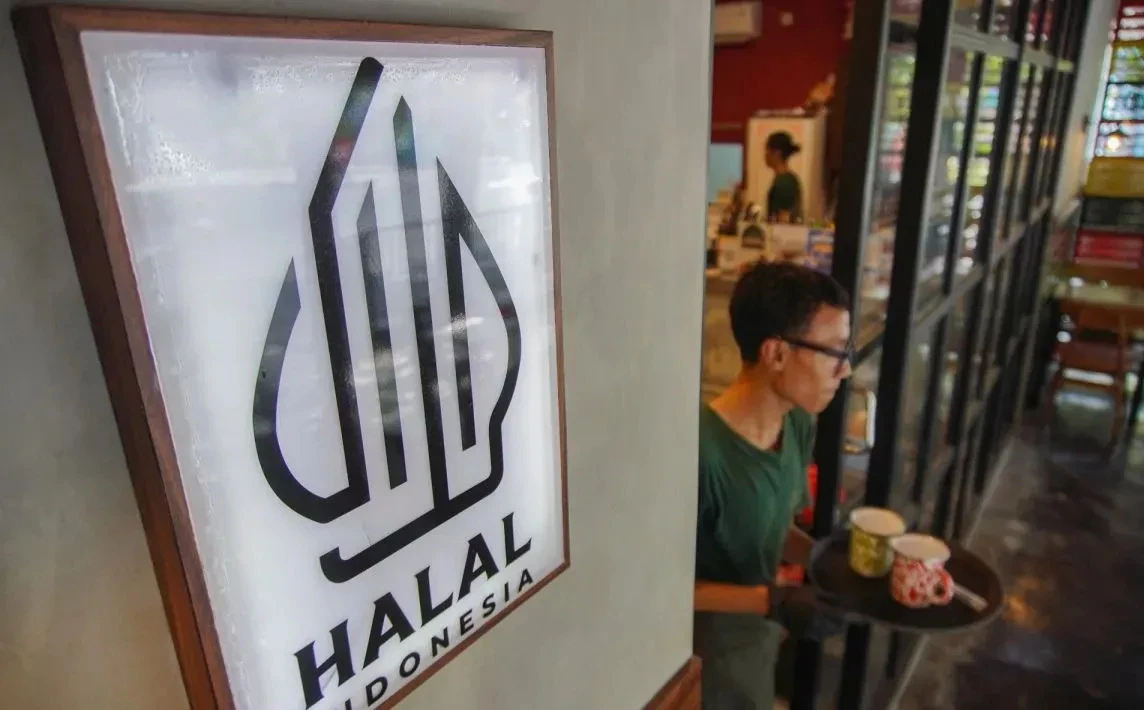
A worker walks out of a halal-certified cafe in Lumajang, East Java on Oct. 19, 2025. (Antara)
Short Url
Updated 15 January 2026
Follow

Indonesia to make halal certification mandatory from October 

  • Indonesia’s halal certifying body has issued certification for 9.6 million products 
  • Southeast Asia’s biggest economy is seeking to become a global halal hub 

JAKARTA: Indonesia will enforce mandatory certification for all halal products from October 2026, the country's certifying body said, to increase its competitiveness in the global market. 

Indonesia, the world’s largest Muslim-majority nation and Southeast Asia’s biggest economy, is seeking to strengthen its role in the growing global market for halal products, which was worth about $2.43 trillion in 2023, according to the latest State of the Global Islamic Economy Report. 

Most consumer goods and restaurants in Indonesia, including imported products, are required to have halal labeling by Oct. 17. 

The regulation applies to all types of businesses, including small and medium companies, and covers food and beverage products, herbal medicines and health supplements, cosmetics, and a range of other everyday items. 

“Halal certification should be positioned as a competitive advantage, a pillar of consumer protection, and a driver of inclusive and sustainable economic growth,” Ahmad Haikal, chief of the halal certifying body BPJPH, said in a statement this week. 

“Halal is customer satisfaction. Halal represents product hygiene, health, safety and quality. As such, today halal is seen as a market requirement, not just a mere regulation.” 

The first phase of Indonesia’s halal certification requirement was enforced in October 2024 and initially applied only to big businesses, including major global food producers such as Unilever and Nestle. 

Under the law adopted in 2014, the compulsory halal certification will be expanded to include more types of drugs in the coming years, while products or restaurants without halal certification are required to declare they do not comply with Islamic law. 

Islamic law prohibits consumption of pork or intoxicants such as alcohol, while meat can only be eaten if the animals were slaughtered by prescribed methods. 

There are 9.6 million halal-certified products across Indonesia as of October last year, according to data from BPJPH. 

The halal certifying body has been working with its foreign counterparts, including in Russia, the US and China, to boost exports of Indonesian products and strengthen the global halal ecosystem, Haikal said. 

“The ultimate objective is to make Indonesian halal products more competitive in the global market and position Indonesia as the world’s halal hub.” 


Sri Lanka hospital releases 22 rescued Iranian sailors

Updated 08 March 2026
Follow

Sri Lanka hospital releases 22 rescued Iranian sailors

  • Sri Lankan authorities said the survivors from the Dena were being handled according to international humanitarian law

COLOMBO: Sri Lanka discharged from hospital 22 Iranian sailors who were plucked from life rafts after their warship was sunk by a US submarine, officials said Sunday.
The sailors were treated at Karapitiya Hospital in the southern port city of Galle since Wednesday after the IRIS Dena was torpedoed just outside Sri Lanka’s territorial waters.
“Another 10 are still undergoing treatment,” a medical officer at the hospital told AFP.
He said the bodies of 84 Iranians retrieved from the Indian Ocean were also at the hospital.
Those discharged from hospital overnight had been taken to a beach resort in the same district.
Sri Lankan authorities said the survivors from the Dena were being handled according to international humanitarian law, and the government had contacted the International Committee of the Red Cross for assistance.
The island is also providing safe haven for another 219 Iranian sailors from a second ship, the IRIS Bushehr, that was allowed to berth a day after the Dena was sunk.
Sailors from the Bushehr have been moved to a Sri Lanka Navy camp at Welisara, just north of the capital Colombo, and their ship taken over by Sri Lanka’s navy.
Sri Lanka announced it was taking the Bushehr to the north-eastern port of Trincomalee, but an engine failure and other technical and administrative issues had delayed the movement, a navy spokesman said.
Sri Lanka has denied claims that it was under pressure from Washington not to allow the Iranians to return home, and said Colombo will be guided solely by international law and its own domestic legislation.
A US State Department spokesperson said the disposition of the Bushehr crew and Iranian sailors rescued at sea was up to Sri Lanka.
“The United States, of course, respects and recognizes Sri Lanka’s sovereignty in the handling of this situation,” the spokesperson told AFP in Washington.
India, meanwhile, said Saturday that it had allowed a third Iranian warship, the IRIS Lavan, to dock in one of its ports on “humane” grounds after it too reported engine problems.
The three ships were part of a multi-national fleet review held by India before the war in the Middle East started last week.
“I think it was the humane thing to do, and I think we were guided by that principle,” Indian Foreign Minister Subrahmanyam Jaishankar said on Saturday.
The Lavan docked in the south-west Indian port of Kochi on Wednesday.
“A lot of the people on board were young cadets. They have disembarked and are in a nearby facility,” Jaishankar said.