

15 Syrian army troops killed in Daesh attack on military bus near Palmyra

1 / 2
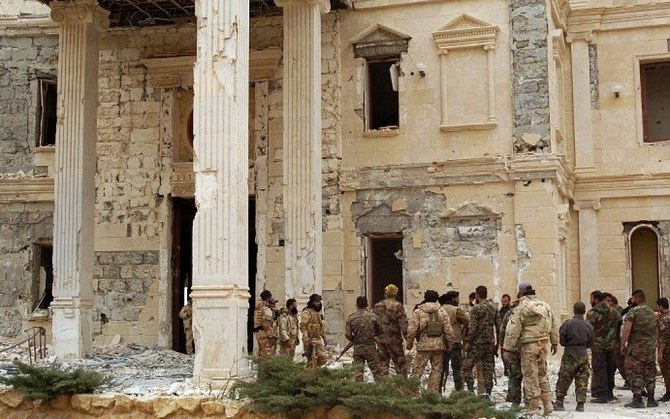
Syrian troops stand next to a mansion belonging to the Qatari royal family in the ancient city of Palmyra, Syria, Mar. 24, 2016. (AFP)
2 / 2
Syrian soldiers gather around a Syrian national flag in Palmyra, Syria, March 27, 2016. (AP Photo)
Short Url
Updated 06 March 2022
Follow

15 Syrian army troops killed in Daesh attack on military bus near Palmyra

  • Daesh cells “attacked a military bus” in the Palmyra desert, “killing 15 soldiers and wounding 18 others,” the British-based Syrian Observatory for Human Rights said
  • The majestic ancient city of Palmyra, a World Heritage site, became the scene of public executions, where Daesh also blew up ancient monuments and looted other treasures

BEIRUT: Fifteen soldiers died Sunday in an Daesh group attack on an army bus in the central Syrian desert, a war monitor said, as state media reported a “terrorist attack.”

Despite the fall of Daesh’s “caliphate” in 2019, the group continues to launch deadly attacks from hideouts in the Syrian desert, which extends from the outskirts of the capital Damascus to the Iraqi border.

Daesh cells “attacked a military bus” in the Palmyra desert, “killing 15 soldiers and wounding 18 others,” the British-based Syrian Observatory for Human Rights said.

State news agency SANA had reported 13 dead “including officers” and 18 wounded in a “terrorist attack” on a military bus on Sunday afternoon.

The Observatory, which relies on a network of sources across the country, said the death toll could rise as most of the soldiers were “seriously wounded.”

Deash did not immediately claim responsibility for the attack.

Sunday’s violence came after three regime soldiers died Friday east of Palmyra when the vehicle they were traveling in came under attack, the Observatory added.

So far this year 61 pro-regime soldiers and Iran-affiliated militiamen had been killed in Daesh attacks in the desert of Syria, it said.

About half a million people have been killed and millions have been displaced since the Syrian conflict erupted in 2011, after nationwide protests against the government were met with a brutal crackdown.

It escalated into a devastating war that drew in regional and international powers.

Daesh leader Abu Ibrahim Al-Hashimi Al-Qurashi blew himself up in early February during a raid by US forces on his house in Syria’s northwest region of Idlib, Syria’s last major opposition bastion.

Qurashi had taken over with Daesh weakened by years of assaults by US-backed local forces and the loss of its self-proclaimed “caliphate” in Syria and northern Iraq.

Daesh ruled with brutality over the “caliphate” which it had proclaimed in 2014.

The majestic ancient city of Palmyra, a World Heritage site, became the scene of public executions, where Daesh also blew up ancient monuments and looted other treasures.

In January Daesh fighters launched their biggest assault in years, attacking a prison in the Kurdish-controlled northeast Syrian city of Hasakah, aiming to free fellow extremists.

Almost a week of intense fighting left more than 370 dead, according to the Observatory.

Earlier in January, nine Syrian soldiers and allied fighters were killed in an attack on a military convoy in Syria’s east, while in November last year, the Observatory said another eastern Syria attack left a general and four soldiers dead.

Two bombs planted on an army bus in central Damascus killed 14 people in October last year, SANA had reported.

That was the deadliest attack in the capital since a bombing claimed by Daesh targeted the Justice Palace in March 2017, killing at least 30 people.


Arab League chief ‘deeply concerned’ over Yemen tensions

Updated 5 sec ago
Follow

Arab League chief ‘deeply concerned’ over Yemen tensions

  • Secretary-General Ahmed Aboul Gheit calls for solidarity among Yemen’s supporters, condemns southern separatist’s military operations

LONDON: The head of the Arab League on Tuesday said he is deeply concerned over escalating tensions in Yemen and called for solidarity among countries supporting Yemen’s internationally recognized government.

His comments came after the military coalition that backs Yemen’s Presidential Leadership Council carried out a “limited airstrike” targeting weapons and military vehicles it said were destined for southern separatist forces.

The shipments arrived in the Yemeni port of Mukalla on board two vessels from Fujairah in the UAE.

Saudi Arabia, a key member of the military coalition, criticized the UAE over its support for the separatists, known as the Southern Transitional Council.

The Kingdom said that any threat to its national security was a red line and that the UAE should follow the Yemeni government’s request to remove its forces from the country within 24 hours.

The UAE later announced it would withdraw its remaining counter-terrorism units from Yemen.

Arab League Secretary-General Ahmed Aboul Gheit expressed deep concern over the “serious and rapidly unfolding developments in Yemen.”

He called for solidarity among all countries supporting the Yemeni government and to exercise restraint.

He also condemned any military action aimed at “forcibly entrenching a secessionist reality on the ground, in a manner that threatens Yemen’s territorial unity.”

The STC, which wants a separate state in southern Yemen, seized large areas of territory in Hadramout and Al-Mahara provinces in recent weeks.

The STC is meant to be part of a coalition with the Yemeni government opposed to Houthi militants that control the north of the country.

Aboul Gheit said the southern Yemen issue must be addressed through dialogue.

The measures taken by Saudi Arabia and the military coalition were “vital to ensuring peace, security, and the unity of the Yemeni people under their internationally recognized leadership,” said Muslim World League Secretary-General Dr. Mohammed bin Abdulkarim Al-Issa.

“Supporting illegitimate practices only deepens internal divisions and serves those who do not have Yemen’s best interests at heart,” he said.