

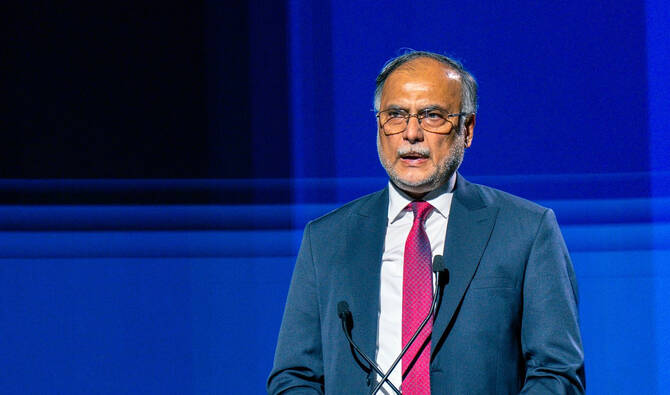

KARACHI: Pakistan must double its exports to $60 billion within four years or risk returning to the International Monetary Fund, Planning Minister Ahsan Iqbal said on Thursday, underscoring the scale of the challenge facing the country as it seeks to break its long-standing dependence on external bailouts.
The comments come as the government pushes ahead with URAAN Pakistan (Flying Pakistan), Prime Minister Shehbaz Sharif’s flagship economic transformation plan aimed at reviving growth, improving competitiveness and strengthening external finances in an economy still vulnerable to balance-of-payments pressures.
As part of the push, Sharif has set up a high-level committee led by Deputy Prime Minister Ishaq Dar to drive implementation of the plan and propose measures to accelerate export growth.
“The only way Pakistan could avoid IMF bailouts is to raise exports to $60 billion in four years and to $100 billion over the next decade,” Iqbal told Arab News, warning that failure to sharply expand overseas sales would leave Islamabad with few alternatives.
“[The plan] includes a proposal to declare an export emergency to double export earnings to $60 billion,” he added on the mandate of the newly established economic panel, saying faster tax refunds for export-oriented sectors and the removal of structural bottlenecks would be central to the effort.
Pakistan has struggled for years to expand exports, which rose about five percent last year to $32.1 billion but have weakened in the current fiscal year. Exports fell more than 20 percent to $2.32 billion in December, according to Pakistan Bureau of Statistics data.
Overall shipments declined nine percent to $15.2 billion during July-December FY26, while imports rose 11 percent to $34.4 billion, widening the trade deficit by 35 percent to $19.2 billion, PBS figures show.
“If exports are not increased, we will have to go to our friendly countries for help or go back to the IMF,” Iqbal warned, referring to Pakistan’s long history with the IMF, which has approved 25 loan arrangements for the country since 1950.
Pakistan last secured a $7 billion IMF program in 2024 to stabilize its economy.
“UNREALISTIC TARGET”
Pakistan has recently lifted its foreign exchange reserves to around $16 billion, but continues to rely on financial support from partners such as China, Saudi Arabia and the United Arab Emirates.
Iqbal said his ministry had briefed Pakistan’s civil and military leadership last month on strategies to reduce dependence on IMF support, adding that the Dar-led committee is expected to submit its recommendations to the prime minister next week.
“Pakistan possesses the potential to achieve these targets,” he said.
Economists, however, are divided on whether the export goal is achievable within the proposed timeframe.
Mohammed Sohail, chief executive officer of Topline Securities, described the target as “ambitious” but said stronger growth in services exports could help narrow the gap.
“While goods exports face challenges due to higher energy charges and taxation, Pakistan should also focus aggressively on services exports which is rising at a fast pace,” Sohail told Arab News.
Pakistan’s services exports rose nine percent to $8.41 billion in FY25, and climbed 17 percent to $3.83 billion in the first five months of the current fiscal year, according to State Bank of Pakistan data.
Others were more skeptical.
“Obviously, this is an unrealistic target,” said Muhammad Saad Ali, head of research at Lucky Investments.
“You cannot double your exports that roughly stand at $30 billion today. You can’t double them in three-four years magically,” he said.
“If we had set a 10-year target, then we would have said that there is a roadmap. But 3-4 years is absolutely not possible.”


