

COP29 leaders push for faster climate action in second week

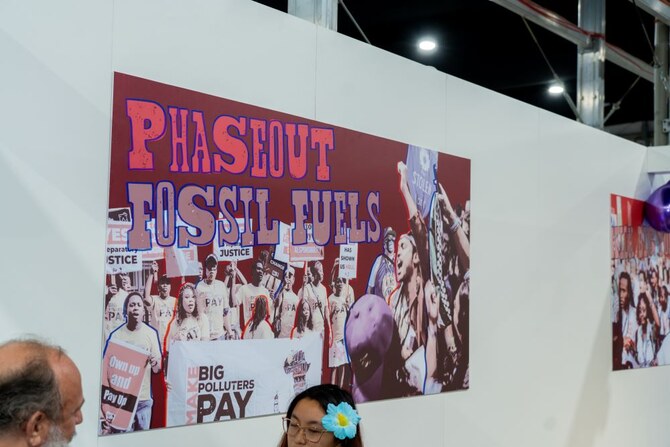
Concerns have been raised regarding the state of negotiations at COP29. (AN Photo/Abdulrahman bin Shalhoub)
Short Url
Updated 20 November 2024
Follow

COP29 leaders push for faster climate action in second week

  • Simon Stiell: Entering the second week of this COP, it is a mixed picture
  • Stiell: The bottom line is we are a long way from halving global emissions this decade

BAKU: The COP29 Presidency team gathered on Monday to discuss negotiations and some of the highlighted plans for the second week of the 29th session of the UN climate change conference.

Present at the discussions were Mukhtar Babayev, president of COP29; Yalchin Rafiyev, lead negotiator; Leyla Hasanovahe, youth climate champion for COP29; and Simon Stiell, executive secretary of the UN Framework Convention on Climate Change.

Concerns were expressed regarding the state of negotiations and whether the participating parties were moving forward at the desired speed to deliver results efficiently.

“Politicians are the power to reach a fair and ambitious dream,” Babayev said. “They must deliver on responsibilities. They must engage immediately and constructively.”

Stiell also gave his thoughts on the progress thus far.

“Entering the second week of this COP, it is a mixed picture. It has been encouraging to see the significant strides forward notably on carbon markets, making progress that previous COPs could not achieve. There is more work to do, of course, and I am certainly not complacent. There are still challenges ahead there.

“The bottom line is we are a long way from halving global emissions this decade.”

While Babayev and Stiell agreed on the amount of work still needed in order for the world to reduce the impact of climate change, Stiell said he believes collaborative efforts are necessary so that all participating countries can deliver.

“We must help countries to pick up this pace over this high week,” he said.


No peace in region without two-state solution: French envoy in Riyadh

Updated 7 sec ago
Follow

No peace in region without two-state solution: French envoy in Riyadh

  • Patrick Maisonnave affirms support for Saudi-led efforts in Yemen, emphasizes diplomacy, humanitarian aid, and long-term stability
  • Maisonnave said that there are ongoing discussions within the EU regarding designating the Houthis as a Foreign Terrorist Organization

RIYADH: As Saudi-French bilateral ties grow both politically and culturally, French Ambassador to Saudi Arabia Patrick Maisonnave sat down with Arab News to discuss the two nations’ roles at a time when the global stage is falling into deeper disarray.

The ambassador shared his thoughts on the situation in Gaza, reaffirming France’s support for a two-state solution. “I believe there is clearly no alternative to the two-state solution,” he said.

The envoy added: “In the current conditions, it may seem out of reach. But if we consider the medium and long term, there will be no coexistence, no regional stability, and no peace in that region without a two-state solution.”

Although the steps needed for international players to move from declaration to implementation were not outlined, Maisonnave asserted that a path must be taken — a strong demand he shares with the Kingdom.

When asked what his thoughts were on the EU’s level of engagement with the conflict in Yemen, the ambassador underlined that the EU and its member states remain key contributors to humanitarian efforts, continuing to provide funding and support for relief operations.

Despite ongoing diplomatic efforts, the situation in Yemen remains “serious and demanding,” he said, pointing to the scale of needs on the ground.

Maisonnave’s remarks align with broader EU policy, which has focused on increasing humanitarian aid through multi-million-euro funding packages aimed at providing food, healthcare, clean water, and sanitation to vulnerable Yemenis.

The EU has additionally expressed its support for diplomatic and political efforts to achieve a peaceful resolution to the conflict, but progress toward a comprehensive peace agreement in coordination with the UN and its regional partners has been slow.

“It is also very clear to (France) that for Saudi Arabia, this issue is one of stability and security. We fully support the efforts undertaken by Saudi Arabia to restore peace and stability in Yemen,” the envoy said.

Maisonnave also shared that there are ongoing discussions within the EU regarding designating the Houthis as a Foreign Terrorist Organization, as the US, Saudi Arabia, Canada, the UK, and New Zealand already have.

Finally, reflecting on years of strong relations between France and Saudi Arabia, amplified by recent accelerated growth, the envoy gave much credit to President Emmanuel Macron’s visit to the Kingdom in December 2024 and the strategic partnerships born from it.

“Since then, many efforts have been undertaken across a wide range of fields to deepen cooperation — economic, defense, culture, and more,” Maisonnave said.

Nearly eight years ago, in April 2018, Saudi Arabia and France signed a landmark intergovernmental agreement to cooperate on the sustainable development of the AlUla region.

This agreement launched a long-term strategic partnership, which included the creation of the French Agency for AlUla Development to support the Royal Commission of AlUla in transforming the site into a global cultural and tourism destination.

“In the coming days, we will inaugurate a major cultural exhibition by the Centre Pompidou in AlUla, which I believe will be very successful.

“Beyond AlUla, we also have many exhibitions across the Kingdom.”

Recently, the French Institute in Saudi Arabia, in collaboration with Riyadh Art, launched La Fabrique in the JAX District, a Saudi-French artistic space for creatives to collaborate, exchange ideas, and develop joint exhibitions and programs.

Designed as an open laboratory as well as a living museum, La Fabrique opened on Jan. 22 and will run until Feb. 14.