

Saudi COP29 pavilion showcases latest climate solutions

1 / 3
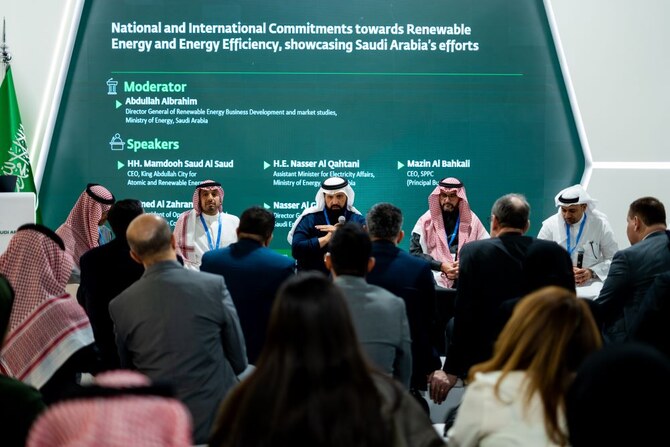
A panel discussion at the Saudi Pavilion during COP29. (AN Photo)
2 / 3
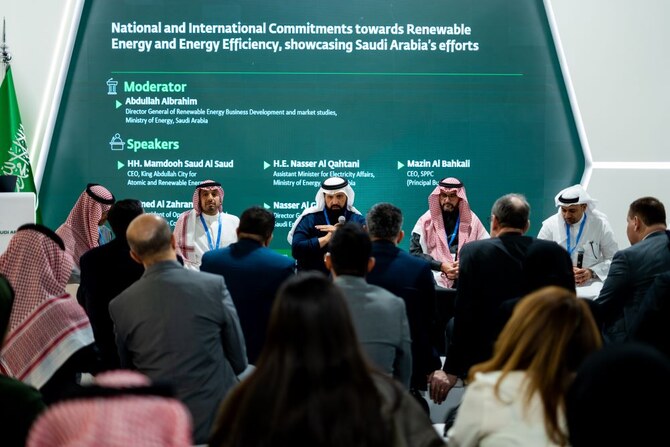
A panel discussion at the Saudi Pavilion during COP29. (AN Photo)
3 / 3
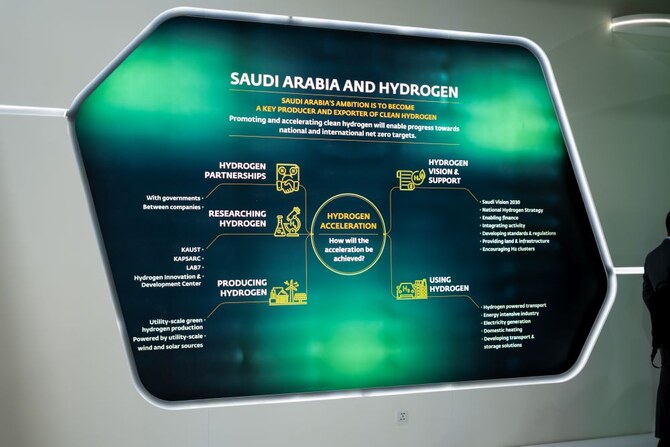
Saudi Arabia’s efforts towards decarbonization were showcased at the Saudi Pavilion during COP29. (AN Photo)
Short Url
Updated 20 November 2024
Follow

Saudi COP29 pavilion showcases latest climate solutions

  • Energy leaders, policymakers explore cutting-edge tech, offer expert insights
  • Pavilion shares Kingdom’s commitment to addressing global climate challenge 

BAKU: The Saudi pavilion has emerged as a hub for collaboration and innovation at the COP29 climate talks, reflecting the Kingdom’s robust efforts to address climate change and drive sustainable development goals.

A series of panel discussions and expert insights at the pavilion have underscored Saudi Arabia’s commitment to advancing climate solutions.

Energy leaders, policymakers, and professionals joined the sessions to exchange ideas and explore cutting-edge technologies.

Panel discussions have explored key climate initiatives, with one of the standout sessions, “The Role of International Standards in Addressing Climate Change,” delving into how global standards can be adapted to fit national circumstances.

Experts discussed the importance of aligning international frameworks to effectively support climate action across diverse regions.

Another session, “Advancing Innovative Carbon Utilization Technologies to Achieve Climate Ambitions,” focused on converting carbon dioxide into valuable products. Participants highlighted technical solutions for carbon management, including the development of carbon capture and utilization technologies, and discussed the global challenges of decarbonization.

The future of hydrogen as a clean energy source also took center stage, with the Kingdom reaffirming its commitment to achieving net-zero emissions by 2060.

Speaking to Arab News, Renad Aldebasi, a carbon specialist at the Ministry of Energy, outlined the Kingdom’s efforts under the circular carbon economy program.

“This program, built on the four Rs — reduce, reuse, recycle, and remove — guides us toward net-zero emissions by 2060. Our world-class carbon capture and sequestration hub will scale up to capture 44 million tons of CO2 annually by 2035,” Aldebasi said.

Leadership and collaboration were also on display, with the Saudi Energy Leaders Assembly playing a pivotal role, and driving discussions on policies, partnerships, and infrastructure.

The assembly further amplified Saudi Arabia’s voice in global energy dialogues.

Nasser Al-Ghamdi, CEO of the Saudi Energy Efficiency Center, highlighted the Kingdom’s advances in improving energy efficiency.

“Since 2010, we’ve achieved significant efficiency gains, including a 57 percent improvement in HVAC (heating, ventilation, and air-conditioning) systems and a 28 percent improvement in transportation fuel economy. By 2030, we aim to save the equivalent of 1 million barrels of oil daily,” he said.

Abeer Alharbi, senior project manager at the Ministry of Energy, outlined progress in renewable energy.

“Saudi Arabia’s National Renewable Energy Program aims to meet 50 percent of electricity demand through renewables by 2030. With 6.2 GW already operational, we’re setting global benchmarks, such as achieving record-low costs for solar and wind energy,” Alharbi said.

Regional and global partnerships have also been cemented at COP29.

On the sidelines of the Baku talks, Saudi Arabia signed a joint executive program with Azerbaijan, Kazakhstan, and Uzbekistan to enhance cooperation in renewable energy. The program focuses on interconnecting regional power grids, integrating renewable energy projects, and fostering joint investment opportunities. Agreements with ACWA Power further advance initiatives in battery energy storage and offshore wind power, particularly in the Caspian Sea region.

COP29 continues to provide a platform for Saudi Arabia to share its vision and initiatives, showcasing the Kingdom’s dedication to addressing one of the most pressing global challenges of our time.


Riyadh exhibition brings Saudi and Chinese contemporary art into dialogue

Updated 5 sec ago
Follow

Riyadh exhibition brings Saudi and Chinese contemporary art into dialogue

RIYADH: Saudi Arabia’s Ministry of Culture has announced that the Common Ground Festival, produced by Benchmark, will take place from Dec. 24, 2025 to Jan. 6, 2026 at Misk City, Riyadh.

The exhibition celebrates the Saudi-Chinese Cultural Year 2025 and 35 years of diplomatic relations between the two countries.

The Sigg Art Foundation presents “When the Wind Turns East,” a landmark exhibition as part of the festival, featuring works by more than 60 contemporary artists from Saudi Arabia and China.

Among the works on display are significant pieces from the Uli Sigg Collection composed of Chinese contemporary art and the Pierre Sigg Collection of Saudi contemporary art, alongside works from other important collections and directly from artists’ studios.

The Uli Sigg Collection, one of the most comprehensive assemblages of Chinese contemporary art in the world, chronicles the evolution of Chinese artistic practice from the late 20th century to the present.

Uli Sigg, former Swiss ambassador to China, began collecting in the 1980s, with much of his collection donated to Hong Kong’s M+ museum.

The Pierre Sigg Collection encompasses a large body of works, from Modern Art and Post War work to very young artists.

It also documents the dynamic evolution of Saudi artistic practice, capturing a generation of Saudi artists engaging with heritage, innovation, and contemporary identity.

Founded by Pierre Sigg, the collection represents a commitment to preserving and promoting Saudi contemporary art.

“For these two collections to contribute to this exhibition in Riyadh, at a moment celebrating Saudi-Chinese cultural exchange, feels like a natural evolution of what we have always believed: that art transcends borders and speaks a universal language,” Pierre Sigg said.

Among the 60-plus artists presented in “When the Wind Turns East,” these works from the Uli Sigg and Pierre Sigg collections exemplify the exhibition’s dialogue between Saudi and Chinese contemporary art:

From the Pierre Sigg Collection (Saudi artists): Nabila Abuljadayel — The Kiswa, Threads of Faith Crafted in Silk; Manal Al-Dowayan — The Emerging VIII, acrylic on natural linen; Lulwah Al-Homoud — The Language of Existence Series – Al Qudous, mixed media archival paper; and Rashed Al-Shashai — Brand 5, lightbox and mixed media.

From the Uli Sigg Collection (Chinese artists): Gao Weigang — Mountainside, oil on canvas; and Xue Feng — Domains, oil on canvas.

These works, alongside pieces by more than 55 other artists, span painting, textile, photography, sculpture, mixed media, and light-based installation, reflecting the extraordinary diversity of contemporary practice in both artistic communities.

“When the Wind Turns East” is the art centerpiece of the Common Ground Festival, a multidisciplinary cultural celebration exploring Saudi-Chinese exchange through visual arts, performing arts, culinary traditions, and craft demonstrations.