Pakistan, China begin joint counter-terror exercise ‘Warrior-VIII’ to bolster military ties

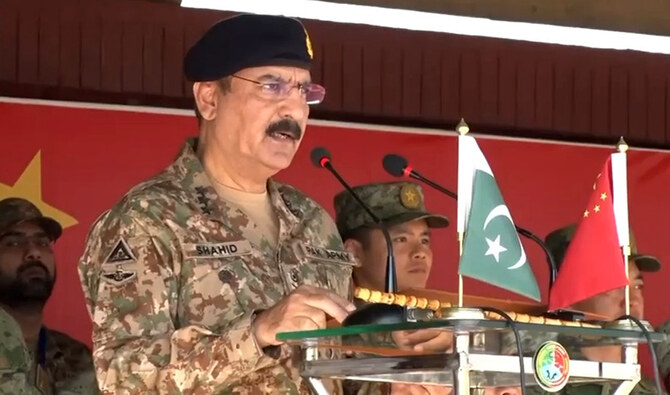
This screengrab taken from a video shared by Inter-Services Public Relations shows Rawalpindi Corps Commander Lieutenant General Shahid Imtiaz addressing the opening Ceremony of Pakistan, China joint counter-terror exercise ‘Warrior-VIII’ at National Counter Terrorism Center (NCTC), in district Nowshehra of Khyber Pakhtunkhwa province, on November 20, 2024. (ISPR)
Short Url
Updated 21 November 2024
Follow

Pakistan, China begin joint counter-terror exercise ‘Warrior-VIII’ to bolster military ties

  • Three-week long exercise aimed at refining professional skills of both armies, says Pakistan military
  • Exercise takes place amid surge in attacks in recent weeks on Chinese nationals living in Pakistan

ISLAMABAD: Pakistan and China on Wednesday kicked off their joint counter-terror exercise, “Warrior-VIII,” aimed at refining soldiers’ professional skills and bolstering military-to-military ties between the two states, Pakistan Army said. 

Pakistan and China share a robust military partnership, with the two states enjoying longstanding cooperation in defense production, technology and training. China is Pakistan’s largest defense supplier, providing advanced weaponry including fighter jets and submarines to its ally. The two nations frequently collaborate through joint military exercises, counter-terrorism efforts and regional security initiatives. 

Warrior VIII is a three-week long counter-terror exercise with the eighth edition taking place at the northwestern town of Pabbi in KP’s Nowshera district, the Inter-Services Public Relations (ISPR), the Pakistan Army’s media wing, said. 

“Opening Ceremony of Pak — China Joint Exercise Warrior-VIII between Pakistan Army and Peoples’ Liberation Army of China was conducted at National Counter Terrorism Center, Pabbi, today,” the ISPR said. 

“The exercise is aimed at refining professional skills through joint training besides harnessing the historic military-to-military relations among the iron-clad brothers.”

The exercise takes place amid a surge in attacks on Chinese nationals in Pakistan by separatist elements in Karachi and southwestern Balochistan province. Islamabad says the attacks are aimed at disrupting its ties with Beijing and destabilizing a multi-billion-dollar Chinese infrastructure project in Pakistan. 

A deadly suicide blast near the airport in the southern city of Karachi last month targeted Chinese engineers, killing two and injuring several. In March this year, a suicide bombing killed five Chinese engineers and a Pakistani driver in northwestern Pakistan as they headed to the Dasu Dam, the largest hydropower project in the country.

China has called on Pakistan to enhance security measures for its citizens in the country. Islamabad has vowed to ensure foolproof security measures for Chinese citizens in the country. 


IMF hails Pakistan privatization drive, calls PIA sale a ‘milestone’

Updated 10 January 2026
Follow

IMF hails Pakistan privatization drive, calls PIA sale a ‘milestone’

  • Fund backs sale of national airline as key step in divesting loss-making state firms
  • IMF has long urged Islamabad to reduce fiscal burden posed by state-owned entities

KARACHI: The International Monetary Fund (IMF) on Saturday welcomed Pakistan’s privatization efforts, describing the sale of the country’s national airline to a private consortium last month as a milestone that could help advance the divestment of loss-making state-owned enterprises (SOEs).

The comments follow the government’s sale of a 75 percent stake in Pakistan International Airlines (PIA) to a consortium led by the Arif Habib Group for Rs 135 billion ($486 million) after several rounds of bidding in a competitive process, marking Islamabad’s second attempt to privatize the carrier after a failed effort a year earlier.

Between the two privatization attempts, PIA resumed flight operations to several international destinations after aviation authorities in the European Union and Britain lifted restrictions nearly five years after the airline was grounded following a deadly Airbus A320 crash in Karachi in 2020 that killed 97 people.

“We welcome the authorities’ privatization efforts and the completion of the PIA privatization process, which was a commitment under the EFF,” Mahir Binici, the IMF’s resident representative in Pakistan, said in response to an Arab News query, referring to the $7 billion Extended Fund Facility.

“This privatization represents a milestone within the authorities’ reform agenda, aimed at decreasing governmental involvement in commercial sectors and attracting investments to promote economic growth in Pakistan,” he added.

The IMF has long urged Islamabad to reduce the fiscal burden posed by loss-making state firms, which have weighed public finances for years and required repeated government bailouts. Beyond PIA, the government has signaled plans to restructure or sell stakes in additional SOEs as part of broader reforms under the IMF program.

Privatization also remains politically sensitive in Pakistan, with critics warning of job losses and concerns over national assets, while supporters argue private sector management could improve efficiency and service delivery in chronically underperforming entities.

Pakistan’s Cabinet Committee on State-Owned Enterprises said on Friday that SOEs recorded a net loss of Rs 122.9 billion ($442 million) in the 2024–25 fiscal year, compared with a net loss of Rs 30.6 billion ($110 million) in the previous year.