

Pakistani privatization chief pitches sale of PIA, other state entities to Azerbaijani officials

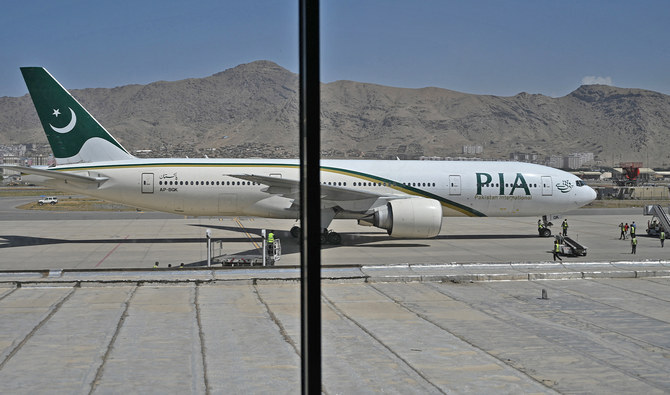
Members of ground staff stand on the tarmac beside a Pakistan International Airlines (PIA) aircraft at the airport in Kabul, Afghanistan, on September 13, 2021. (AFP/File)
Short Url
Updated 20 November 2024
Follow

Pakistani privatization chief pitches sale of PIA, other state entities to Azerbaijani officials

  • Pakistan is looking to sell debt-ridden state enterprises as envisaged under $7 billion IMF program approved in September
  • Pakistan wants to position itself as pivotal trade and transit hub connecting China and Central Asia with the rest of the world

ISLAMABAD: Pakistan’s privatization chief Abdul Aleem Khan on Wednesday met Azerbaijan’s economy minister Mikayil Jabbarov and discussed, among other issues, the sale of national carrier PIA and other loss-making state entities.

Cash-strapped Pakistan is looking to offload a 51-100 percent stake in debt-ridden PIA to raise funds and reform state-owned enterprises as envisaged under a $7 billion International Monetary Fund program approved in September. The process, however, hit a snag last month when the final bidding round attracted just one bid of Rs10 billion ($36 million) for a 60 percent stake in the national flag carrier.

PIA’s existing liabilities stand at approximately Rs250 billion ($896 million).

Pakistan is also trying to sell power distribution (discos) and other loss-making state owned companies that are a main hole in its $350 billion economy.

“Discussions with the Azerbaijani government on government-to-government and business-to-business partnerships regarding privatization in Pakistan were discussed in the meeting,” Khan’s office said in a statement after he met Jabbarov in Baku. 

“Participation in privatization of PIA, Agricultural Development Bank, discos, utility stores and other projects offered.”

According to the statement from the Pakistani side, Khan said Pakistan and Azerbaijan could make “mutual investments” in the LNG and renewable energy sectors.

“There can be huge investments in the IT sector, telecom, agriculture, energy and other sectors,” Khan said, apprising the Azerbaijani official of cooperation opportunities in Pakistan’s communication sector as well. “We have to take concrete and practical steps to increase the volume of bilateral trade.”

Khan is in Azerbaijan on a two-day visit, and will attend various meetings aimed at discussing investment opportunities and strengthening bilateral relations. 

Pakistan wants to position itself as a regional trade hub, leverage its strategic geopolitical position and enhance its role as a pivotal trade and transit hub connecting China and Central Asia with the rest of the world. In recent months, there has been a flurry of visits, investment talks and economic activity between Pakistan, China and Central Asian states, including Uzbekistan, Azerbaijan, Tajikistan and Turkmenistan.


Pakistan says military operation concluded in Balochistan, 216 militants killed 

Updated 8 sec ago
Follow

Pakistan says military operation concluded in Balochistan, 216 militants killed 

  • Separatist BLA militant group claimed responsibility for coordinated attacks across Balochistan last week 
  • Military says 36 civilians, 22 law enforcement and security forces personnel have been killed in attacks 

PESHAWAR: Pakistani forces have concluded a security operation in the southwestern Balochistan province and killed 216 militants after a series of coordinated attacks by separatist militants last week, the military’s media wing said on Thursday. 

Separatist militant group Baloch Liberation Army (BLA) claimed responsibility for a series of attacks in Balochistan last Friday and Saturday in multiple districts across the province, one of the deadliest flare-ups in the area in recent years. 

Pakistan military’s media wing, the Inter-Services Public Relations (ISPR), said security forces launched operations in Panjgur and Harnai district’s outskirts on Jan. 29 based on intelligence confirming the presence of “terrorist elements,” killing 41 militants. 

It said the military launched a broader series of intelligence-based operations in multiple areas of the province after that to dismantle “terrorist sleeper cells,” referring to it as “Operation Radd-ul-Fitna-1.”

“As a result of these well-coordinated engagements and subsequent clearance operations, 216 terrorists have been sent to hell, significantly degrading the leadership, command-and-control structures and operational capabilities of terrorist networks,” the ISPR said in a statement.

The military said 36 civilians, including women and children, were killed by militants while 22 security forces and law enforcement personnel also lost their lives. 

The ISPR said a substantial cache of foreign-origin weapons, ammunition, explosives and equipment were also recovered during the counteroffensive operations. 

“Preliminary analysis indicates systematic external facilitation and logistical support to these extremist proxies,” the statement said. 

The military said Pakistan’s armed forces remain steadfast in their resolve to combat “terrorism,” vowing that counterterror operations will continue until militants are completely eliminated. 

“Operation Radd-ul-Fitna-1 stands as a testament to Pakistan’s and particularly Balochistan’s proud peoples’ unwavering commitment to always prefer peace over violence, unity over division and development over violence,” the ISPR said. 

Pakistan’s government has accused India of being behind the militant attacks in Balochistan, charges that New Delhi has rejected as “baseless.”

Balochistan, Pakistan’s largest province by land area, has long faced a separatist insurgency that has intensified in recent years. Militants frequently target security forces, government officials, infrastructure projects, foreigners and non-local workers.

The province holds vast reserves of minerals and hydrocarbons and is central to the multibillion-dollar China-Pakistan Economic Corridor (CPEC), a flagship component of China’s Belt and Road Initiative.

Separatist groups such as the BLA accuse Islamabad of exploiting Balochistan’s natural resources while denying locals a fair share. Pakistan’s civilian and military leadership reject the claim and say they are investing in the province’s development.
