Publisher defends prize-winning French novel after Algerian victim’s claims

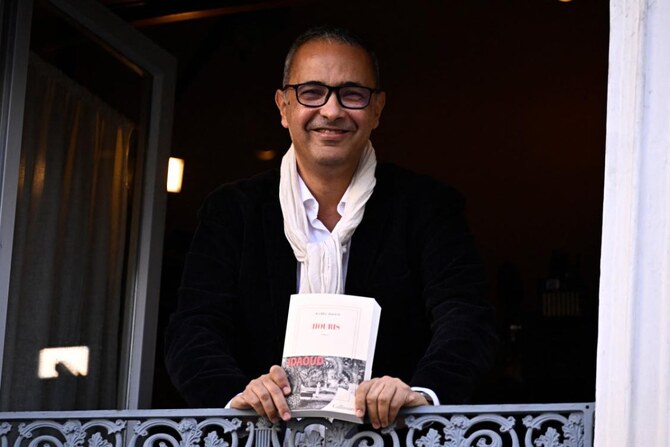
The woman, Saada Arbane, said she had told her story during a course of treatment to a psychotherapist who is now Daoud’s wife. (AFP/File)
Short Url
Updated 19 November 2024
Follow

Publisher defends prize-winning French novel after Algerian victim’s claims

  • Kamel Daoud’s novel “Houris” centered on Algeria’s civil war between the government and Islamists in the 1990s
  • Survivor of a massacre alleged on Algerian TV that the main character in the book is based on her experiences

PARIS: The publisher of the novel that won France’s top literary price has strongly defended its French-Algerian author after an Algerian survivor of a 1990s massacre in the North African country claimed the book is based on her story used without her consent.
French-Algerian writer Kamel Daoud this month won the Goncourt for his novel “Houris” centered on Algeria’s civil war between the government and Islamists in the 1990s.
The novel, banned in Algeria, tells the story of a young woman who loses her voice when an Islamist cuts her throat as she witnesses her family being massacred during the civil war.
However the survivor of a massacre during the period has alleged on Algerian TV that the main character in the book is based on her experiences.
The woman, Saada Arbane, said she had told her story during a course of treatment to a psychotherapist who is now Daoud’s wife. She accused Daoud of then using the details narrated during their therapy sessions in his book.
Publishers Gallimard however said Daoud and his wife were the victims of orchestrated attacks after the banning of the book in Algeria, adding that the publishing house had also been banned from Algeria’s main book fair earlier this month.
“Although Houris is inspired by tragic events that occurred in Algeria during the civil war of the 1990s, its plot, characters and heroine are purely fictional,” said publisher Antoine Gallimard who heads the Gallimard publishing house.
“Since the publication of his novel, Kamel Daoud has been the subject of violent defamatory campaigns orchestrated by certain media close to a regime whose nature is well known,” he added.
Arbane has alleged that she told the psychotherapist not to reveal her story but has found that there are details in the life of the main character in the book — Aube — that would only have been known to the doctor.
Speaking on television with a speech aid, she has described the book as a “violation of my intimacy” and accused the psychotherapist of going back on a promise that her story would not feature in Daoud’s work.
But Gallimard said: “It is now the turn of his wife — who in no way is a source for ‘Houris’ — to be attacked over her professional integrity.”
Daoud, who used to work as a journalist and columnist in Algeria, has stirred controversy with his analyzes of society in Algeria and elsewhere in the Arab world in French and international media.


Foreign media group slams Israel for refusing to lift Gaza press ban

Updated 07 January 2026
Follow

Foreign media group slams Israel for refusing to lift Gaza press ban

  • Foreign Press Association expresses 'profound disappointment' with Israeli government’s response to a Supreme Court appeal
  • Israel has barred foreign journalists from independently entering the devastated territory since the war started

JERUSALEM: An international media association on Tuesday criticized the Israeli government for maintaining its ban on unrestricted media access to Gaza, calling the move disappointing.
The government had told the Supreme Court in a submission late Sunday that the ban should remain in place, citing security risks in the Gaza Strip.
The submission was in response to a petition filed by the Foreign Press Association (FPA) — which represents hundreds of journalists in Israel and Palestinian territories — seeking immediate and unrestricted access for foreign journalists to the Gaza Strip.
“The Foreign Press Association expresses its profound disappointment with the Israeli government’s latest response to our appeal for full and free access to the Gaza Strip,” the association said on Tuesday.
“Instead of presenting a plan for allowing journalists into Gaza independently and letting us work alongside our brave Palestinian colleagues, the government has decided once again to lock us out” despite the ceasefire in the territory, it added.
Since the outbreak of the Gaza war in October 2023, triggered by an attack on Israel by the Palestinian militant group Hamas, the government has barred foreign journalists from independently entering the devastated territory.
Instead, Israel has allowed only a limited number of reporters to enter Gaza on a case-by-case basis, embedded with its military inside the blockaded Palestinian territory.
The FPA filed its petition in 2024, after which the court granted the government several extensions to submit its response.
Last month, however, the court set January 4 as a final deadline for the government to present a plan for allowing media access to Gaza.
In its submission, the government maintained that the ban should remain in place.
“This is for security reasons, based on the position of the defense establishment, which maintains that a security risk associated with such entry still exists,” the government submission said.
The government also said that the search for the remains of the last hostage held in Gaza was ongoing, suggesting that allowing journalists in at this stage could hinder the operation.
The remains of Ran Gvili, whose body was taken to Gaza after he was killed during Hamas’s 2023 attack, have still not been recovered despite the ceasefire.
The FPA said it planned to submit a “robust response” to the court, and expressed hope the “judges will put an end to this charade.”
“The FPA is confident that the court will provide justice in light of the continuous infringement of the fundamental principles of freedom of speech, the public’s right to know and free press,” the association added.
The Supreme Court is expected to issue a ruling on the matter, though it is unclear when a decision will be handed down.
An AFP journalist sits on the board of the FPA.