ISLAMABAD: Pakistan will need an additional $191.8 billion between 2020-2050 to transition to a low-carbon energy system and meet its international climate commitments, an Asian Development Bank (ADB) report released this month said.
The report outlines a detailed pathway to help the South Asian nation reduce greenhouse gas (GHG) emissions while maintaining sustainable economic growth. It distinguishes between low-carbon and business-as-usual (BAU) scenarios, with the former focusing on deploying renewable energy, improving energy efficiency and transitioning to cleaner fuels in sectors like power, transport and industry.
“The low-carbon scenario would require an additional investment of $191.8 billion (in 2022 prices) between 2020 and 2050 over the BAU scenario, so the investment commitment is substantial,” the report said.
“Achieving such an ambitious investment program will be challenging,” it added, emphasizing that a significant portion of the required financing would need to come from private sector investments and international financial assistance.
Pakistan, the fifth most populous country in the world, aims to become an upper-middle-income economy by 2047, its centenary year of independence. However, it also remains one of the 10 most vulnerable nations to climate change, facing challenges ranging from devastating floods to extreme heatwaves.
Under its updated Nationally Determined Contributions (NDCs) submitted in 2021, Pakistan has pledged to reduce GHG emissions by 50% by 2030, compared to 2015 levels. Of this, 15% is unconditional, while the remaining 35% is contingent upon receiving adequate international financial support.
The ADB report identifies the energy sector as central to Pakistan’s climate transition.
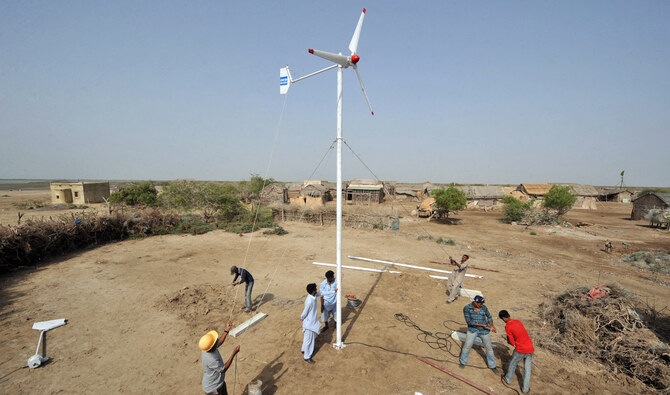
Investments in hydropower ($153 billion), nuclear power ($103 billion), wind ($62 billion) and solar energy ($51 billion) are necessary to shift away from coal and other fossil fuels. An additional $22 billion is required for modernizing transmission and distribution networks to ensure grid stability.
“The energy sector will need to evolve on a different path,” the report said, highlighting that energy-related emissions could be reduced by 23% by 2030 and 36% by 2050 under the low-carbon scenario compared to the BAU approach.
The report also noted that Pakistan’s renewable energy potential is vast, particularly in solar and wind, given the country’s high sunlight levels and favorable wind conditions. However, achieving these targets would require policy reforms, technological advancements and substantial foreign investments.
The ADB publication emphasized that the low-carbon scenario would involve a shift to cleaner fuels, including natural gas, nuclear power and renewables, as well as the electrification of transport and residential sectors.
By 2050, renewables could account for 61% of electricity generation under this scenario, compared to 17% under the BAU approach.
“Electrification and energy efficiency improvements will play a critical role in reducing demand and emissions,” the report noted, pointing to opportunities such as transitioning from coal to gas in industry and using electricity instead of gas for cooking.
To meet these goals, the report called for strengthening the investment climate, aligning incentives for private sector engagement and enhancing regulatory frameworks.


![]()

Pakistan needs additional $191.8 billion for low-carbon transition by 2050 — ADB
Short Url
https://arab.news/82ar3
Pakistan needs additional $191.8 billion for low-carbon transition by 2050 — ADB
- Pakistan, one of 10 most vulnerable nations to climate change, faces challenges such as floods and extreme heat waves
- Under its updated Nationally Determined Contributions, Pakistan has pledged to reduce GHG emissions by 50% by 2030
Latest updates


© 2026 SAUDI RESEARCH & PUBLISHING COMPANY, All Rights Reserved And subject to Terms of Use Agreement.