Philippines cleans up after sixth major storm in weeks

1 / 2
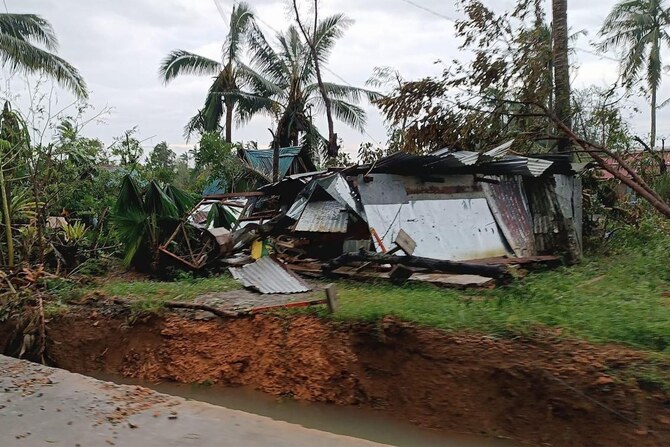
This handout photo from Marissa Cueva Alejandro taken and received on November 17, 2024 shows a damaged house during the aftermath of Super Typhoon Man-Yi in Virac, Catanduanes province. (AFP)
2 / 2
This handout photo released on November 17, 2024 through the courtesy of John Marshal Aquino Facebook page shows residents walking past destroyed houses in Panganiban town (AFP)
Short Url
Updated 22 November 2024
Follow

Philippines cleans up after sixth major storm in weeks

  • There have been no other reports so far of deaths or injuries
  • Power outages across the island province of Catanduanes could last for months

Manila: Filipinos cleared fallen trees and repaired damaged houses on Monday after the sixth major storm to batter the Philippines in a month smashed flimsy buildings, knocked out power and claimed at least one life.
The national weather service had warned of a “potentially catastrophic” impact from Man-yi, which was a super typhoon when it hit over the weekend, but President Ferdinand Marcos said Monday it “wasn’t as bad as we feared.”
Packing maximum sustained wind speeds of 185 kilometers an hour, Man-yi slammed into Catanduanes island late Saturday, and the main island of Luzon on Sunday afternoon.
It uprooted trees, brought down power lines, crushed wooden houses and triggered landslides, but did not cause serious flooding.
“Though Pepito was strong, the impact wasn’t as bad as we feared,” Marcos said, according to an official transcript of his remarks to media, using the local name for Man-yi.
One person was killed in Camarines Norte province, which Marcos said was “one casualty too many.” Police said the victim, a 79-year-old man, died after his motorbike was caught in a power line.
There have been no other reports so far of deaths or injuries.
“We will now carry on with the rescue of those (in) isolated areas and the continuing relief for those who are, who have been displaced and have no means to prepare their own meals and have no water supplies,” Marcos said.
Power outages across the island province of Catanduanes could last for months after Man-yi toppled electricity poles, provincial information officer Camille Gianan told AFP.
“Catanduanes has been heavily damaged by that typhoon — we need food packs, hygiene kits and construction materials,” Gianan said.
“Most houses with light materials were flattened while some houses made of concrete had their roofs, doors and windows destroyed.”
In the coastal town of Baler in Aurora province, clean-up operations were underway to remove felled trees and debris blocking roads and waterways.
“Most of the houses here are made of light materials so even now, before the inspection, we are expecting heavy damage on many houses in town,” disaster officer Neil Rojo told AFP.
“We’ve also received reports of roofs that went flying with the wind last night... it was the fierce wind that got us scared, not exactly the heavy rains.”
Storm weakens
Man-yi weakened significantly as it traversed the mountains of Luzon and was downgraded to a severe tropical storm as it swept over the South China Sea toward Vietnam on Monday.
More than a million people in the Philippines fled their homes ahead of the storm, which followed an unusual streak of violent weather.
Climate change is increasing the intensity of storms, leading to heavier rains, flash floods and stronger gusts.
At least 163 people in the Philippines died in the past month’s storms, which left thousands homeless and wiped out crops and livestock.
About 20 big storms and typhoons hit the Southeast Asian nation or its surrounding waters each year, killing scores of people, but it is rare for multiple such weather events to take place in a small window.
Man-yi also hit the Philippines late in the typhoon season — most cyclones develop between July and October.
This month, four storms were clustered simultaneously in the Pacific basin, which the Japan Meteorological Agency told AFP was the first time such an occurrence had been observed in November since its records began in 1951.


National security trial for Hong Kong’s Tiananmen vigil organizers to open

Updated 4 sec ago
Follow

National security trial for Hong Kong’s Tiananmen vigil organizers to open

  • Three government-vetted judges will preside over the trial, which is expected to last 75 days

HONG KONG: Two pro-democracy activists behind a group that for decades organized a vigil that commemorated people killed in Beijing’s Tiananmen Square crackdown in 1989 will stand trial on Thursday, in another landmark case brought under a China-imposed national security law that has practically crushed protests in the semiautonomous Chinese city.
Critics say their case shows that Beijing’s promise to keep the city’s Western-style civil liberties intact for 50 years when the former British colony returned to Chinese rule in 1997 has weakened over time. But the city’s government said its law enforcement actions were evidence-based and strictly in accordance with the law.
Chow Hang-tung and Lee Cheuk-yan, former leaders of the Hong Kong Alliance in Support of Patriotic Democratic Movements of China, were charged with incitement to subversion in September 2021 under the law. They are accused of inciting others to organize, plan or act through unlawful means with a view to subvert state power, and if convicted, they face a maximum penalty of 10 years in prison.
A third leader of the group, Albert Ho, is expected to plead guilty, his lawyer said previously. This might result in a sentence reduction.
Before sunrise, dozens of people were in line outside the court building to secure a seat in the public gallery under a cold-weather warning.
Tang Ngok-kwan, a former core member of the alliance, has been queuing since Monday afternoon. He said he wanted to show support for his former colleagues in detention.
“They use their freedom to exchange for a dignified defense,” he said. “It’s about being accountable to history.”
Former pro-democracy district councilor Chan Kim-kam, a former vigil-goer and also Chow’s friend, stayed awake the whole night outside the building.
“We need to witness this, regardless of the results,” she said.
Trial expected to last 75 days
Three government-vetted judges will preside over the trial, which is expected to last 75 days. Videos related to the alliance’s years of work will be part of the prosecution evidence.
Chow, also a lawyer defending herself, tried to throw out her case in November, arguing the prosecution had not specified what “unlawful means” were involved. But the judges rejected her bid.
The judges explained their decision on Wednesday, saying the prosecution made it clear that “unlawful means” meant ending the Chinese Communist Party’s rule and violating the Chinese constitution. The prosecution accused the defendants of promoting the call of “ending one-party rule” by inciting people’s hatred of and disgust over the state’s power, the judges said.
The prosecution, they said, had pointed to the defendants’ media interviews and public speeches related to the alliance to sustain the group’s operation and promote that call to others after the security law took effect in June 2020. Although the scope of the charge was relatively wide, the prosecutors had provided sufficient details for the defendants, they added.
The court will not allow the trial to become a tool of political suppression in the name of law, the judges said.
Prosecutors are expected to detail their case this week.
Urania Chiu, lecturer in law at Oxford Brookes University, said the case goes to the heart of freedom of expression.
“The prosecution case hinges on the argument that the Alliance’s general call for ‘bringing the one-party rule to an end’ constitutes subversion without more, which amounts to criminalizing an idea, a political ideal that is very far from being actualized,” she said.
Sarah Brooks, Amnesty International’s Deputy Regional Director, alleged the case was about “rewriting history and punishing those who refuse to forget the victims of the Tiananmen crackdown.”
Alliance’s disbandment a blow to civil society
The alliance was best known for organizing the only large-scale public commemoration of the 1989 crackdown in China for decades. Tens of thousands of people attended it annually until authorities banned it in 2020, citing anti-pandemic measures.
After COVID-19 restrictions were lifted, the park was occupied instead by a carnival organized by pro-Beijing groups. Those who tried to commemorate the event near the site were detained.
Before the alliance voted to disband in September 2021, police had sought details about the group, saying they had reasonable grounds to believe it was acting as a foreign agent. The alliance rejected the allegations and refused to cooperate.
Chow, Tang, another core member of the alliance were convicted in a separate case in 2023 for failing to provide authorities with information on the group and were each sentenced to 4 1/2 months in prison. But the trio overturned their convictions at the city’s top court in March 2025.
Chow, Lee and Ho have been in custody, awaiting the trial’s opening, which has been postponed twice.
Beijing said the 2020 security law was necessary for the city’s stability following the 2019 protests, which sent hundreds of thousands of people onto the streets.
The same law has convicted dozens of other leading pro-democracy activists, including pro-democracy former media mogul Jimmy Lai last month. Dozens of civil society groups have closed since the law took effect.