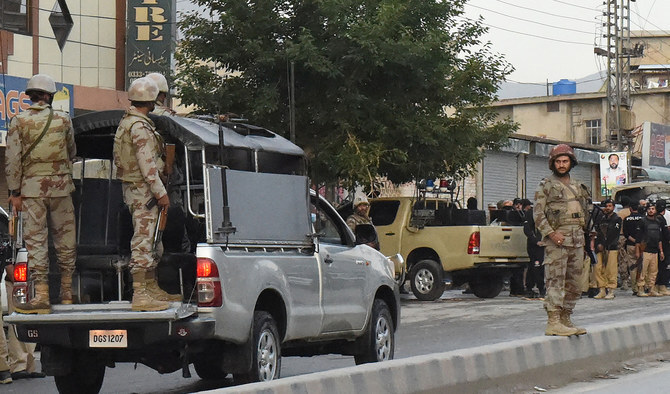
QUETTA: At least seven soldiers of Pakistan’s paramilitary Frontier Corps (FC) were killed in an overnight attack on a security check-post in the mountainous region of Kalat district in the restive southwestern province of Balochistan, according to a local administration official on Saturday.
The province has been the site of a low-level insurgency by separatist militants for over two decades, although militant attacks have intensified significantly in recent months.
Last August, Baloch separatists launched a string of coordinated attacks targeting civilians and military forces, resulting in more than 50 deaths within a few hours. The latest attack on Pakistani security forces follows a deadly suicide bombing last week at the crowded Quetta railway station, which killed over two dozen people, including army personnel and wounded more than 50 others.
“Armed militants attacked a Frontier Corps check-post in Shah Mardan, an area located 60 kilometers from Kalat city at midnight,” Kalat’s Deputy Commissioner Bilal Shabir told Arab News over the phone.
“Seven soldiers of the paramilitary force were killed in the attack and 12 injured,” he continued, sharing the details of the armed assault. “Subsequently, a security clearance operation was carried out in the mountainous area.”
Asked how many attackers were killed in the skirmish, the deputy commissioner said authorities had not received information on that.
In a statement issued on Saturday, the banned separatist group Balochistan Liberation Army (BLA) claimed responsibility for the attack, saying its fighters had targeted the paramilitary post in Kalat.
The BLA, the largest of several Baloch ethnic insurgent groups, seeks independence for the volatile province, which is home to approximately 15 million people and borders Afghanistan to the north and Iran to the west.
The BLA and other Baloch nationalist groups accuse the Pakistani state of unfairly exploiting the province’s rich gas and mineral resources— an allegation denied by successive governments, which claim to have been undertaking development projects to improve residents’ quality of life.
Prime Minister Shehbaz Sharif condemned the attack on FC personnel, calling the attackers enemies of the province’s economic development.
The prime minister also ordered quality medical treatment for those injured in the attack in Kalat, a remote district located about 140 kilometers from Quetta.


![]()

Seven paramilitary soldiers killed in overnight militant attack in Pakistan’s southwest
Short Url
https://arab.news/4tuv5
Seven paramilitary soldiers killed in overnight militant attack in Pakistan’s southwest
- Militants launched an armed assault on a Frontier Corps check-post in the remote district of Kalat
- Balochistan Liberation Army claimed responsibility for the attack, which also left 12 people injured
Latest updates


© 2026 SAUDI RESEARCH & PUBLISHING COMPANY, All Rights Reserved And subject to Terms of Use Agreement.