KSrelief continues humanitarian work in Gaza, Jordan and Yemen

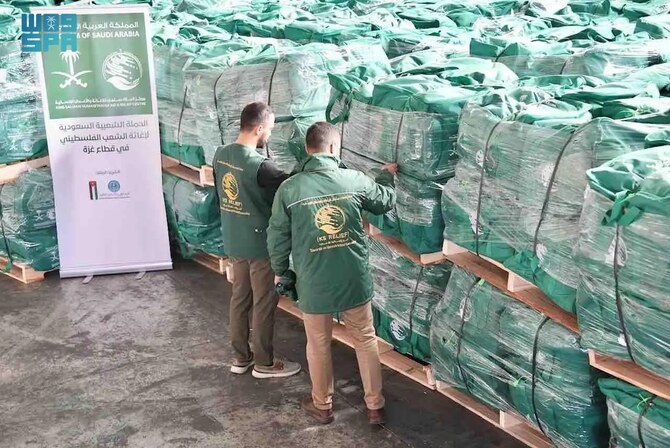
The Saudi aid agency deployed a convoy of 30 trucks loaded with 10,560 shelter bags filled with essential supplies allocated for the Palestinian people. (SPA)
Short Url
Updated 16 November 2024
Follow

KSrelief continues humanitarian work in Gaza, Jordan and Yemen

RIYADH: The King Salman Humanitarian Aid and Relief Center’s (KSrelief) humanitarian activities continue with the delivery of food and medical services in Gaza, Jordan and Yemen.

At the Gaza Strip, the Saudi aid agency deployed a convoy of 30 trucks loaded with 10,560 shelter bags filled with essential supplies allocated for the Palestinian people, and to be distributed through the Jordanian Hashemite Charity Organization.

In Jordan’s Zaatari Camp, KSrelief clinics provided medical services to 2,483 refugee patients. The internal medicine specialists treated 122 patients suffering from diabetes, high blood pressure and asthma; pediatricians received 285 children, while the emergency medical doctors treated 253 patients, among others.

In Hadhramaut governorate of Yemen, KSrelief delivered a new batch of hemodialysis solutions and supplies to the Fatima Babtain Center for kidney failure patients in Sayoun.


Saudi reserve given ‘dark sky’ listing in boost to astrotourism ambitions 

Updated 15 December 2025
Follow

Saudi reserve given ‘dark sky’ listing in boost to astrotourism ambitions 

  • Imam Turki bin Abdullah Royal Reserve Development Authority announced on Monday that the desert received official accreditation from DarkSky International

RIYADH: Saudi Arabia’s Nafud Desert has been listed as one of more than 250 Dark Sky Sites worldwide, which authorities say marks a commitment to protecting the environment from light pollution. 

Imam Turki bin Abdullah Royal Reserve Development Authority announced on Monday that the desert received official accreditation from DarkSky International, the global body committed to tackling light pollution in urban and rural areas. 

Welcoming the accreditation, Ahmed Al-Qarni, official spokesperson at the royal reserve, told Arab News: “It’s a new achievement in the journey of protecting nature and astronomy in Saudi Arabia. 

“The adoption of the Great Nafud Desert in Imam Turki bin Abdullah Royal Reserve by the International DarkSky Association, as the largest site in the Middle East, (represents) a culmination of a precise scientific path, and another step that enhances the Kingdom’s position as a leading destination in sustainability, nature protection, and astronomical tourism.” 

Abouazza El-Mhamdi, associate professor in the physics and astronomy department at King Saud University’s College of Science, said that the announcement is a “a major achievement for both science and tourism. 

“This accreditation protects the pristine night sky from light pollution, creating an invaluable natural laboratory for astronomers,” he added. 

“It provides an ideal Saudi location for adequate Earth-based telescopes and is a prime candidate for detailed site surveys, enabling sensitive observations of stars and galaxies. 

“At the same time, it establishes the reserve as a premier global destination for stargazing and astrotourism, supporting sustainable economic growth.” 

The reserve development authority also posted on X: “Away from the clamor of the lights ... there is a darkness that shines. 

“We are proud of the adoption of the Great Nafud Desert within the Imam Turki bin Abdullah Royal Reserve as one of the dark sky places certified by the DarkSky International.” 

Located within the reserve east of the Hail-Al Jawf road, the Great Nafud Desert covers an area of about 13,416 sq. km, making it one of the largest accredited Dark Sky Sites in the region and one of the least light-polluted sites in the Kingdom, the Saudi Press Agency reported. 

Fulfilling the organization’s criteria was the result of comprehensive scientific work that included field studies, precise astronomical observations, advanced nighttime analyses, and the implementation of specialized engineering practices for managing nighttime lighting and controlling light pollution sources. 

These efforts, undertaken by the authority, are part of its commitment to protecting the desert’s natural nighttime landscapes, enhancing the sustainability of ecosystems and preparing the site to serve as a global model for preserving the natural sky. 

CEO of the Imam Turki bin Abdullah Royal Reserve Development Authority, Engineer Mohammed Al-Shaalan, said in a statement that the accreditation is a culmination of the interest of the country’s leadership in the environment and the protection of natural sites. 

It also reflects the support of Prince Turki bin Mohammed bin Fahd bin Abdulaziz, chairman of the authority’s board of directors, he added. 

Al-Shaalan said that the accreditation represents a significant step that enhances the reserve’s presence on the international map and contributes to the development of astronomical tourism, scientific research, and specialized environmental experiments. 

The area provides visitors and researchers with unique opportunities to observe the night sky and to monitor astronomical phenomena in a natural environment with low light pollution. 

He added that the authority has developed tourism facilities in the desert such as “The Leaf” camp located near the dark sky zone.