

What is Bluesky, the fast-growing social platform welcoming fleeing X users?

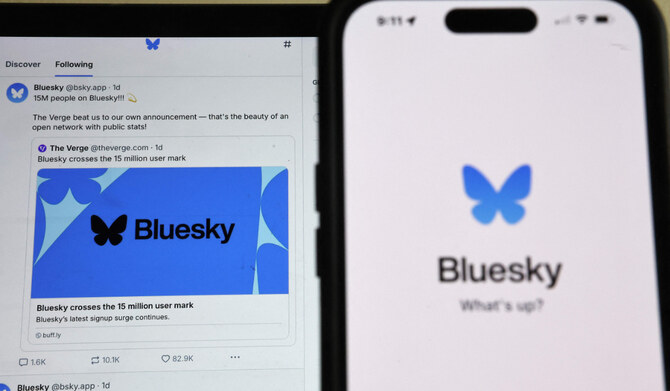
In this photo illustration, the Bluesky logo is displayed on a cell phone and computer monitor on November 14, 2024 in Pasadena, California. (AFP)
Short Url
Updated 16 November 2024
Follow

What is Bluesky, the fast-growing social platform welcoming fleeing X users?

  • Bluesky said in mid-November that its total users surged to 15 million, up from roughly 13 million at the end of October, as some X users look for an alternative platform to post their thoughts and talk to others online

SAN FRANCISCO: Disgruntled X users are again flocking to Bluesky, a newer social media platform that grew out of the former Twitter before billionaire Elon Musk took it over in 2022. While it remains small compared to established online spaces such as X, it has emerged as an alternative for those looking for a different mood, lighter and friendlier and less influenced by Musk.
What is Bluesky?
Championed by former Twitter CEO Jack Dorsey, Bluesky was an invitation-only space until it opened to the public in February. That invite-only period gave the site time to build out moderation tools and other features. The platform resembles Musk’s X, with a “discover” feed and a chronological feed for accounts that users follow. Users can send direct messages and pin posts, as well as find “starter packs” that provide a curated list of people and custom feeds to follow.
Why is Bluesky growing?
Bluesky said in mid-November that its total users surged to 15 million, up from roughly 13 million at the end of October, as some X users look for an alternative platform to post their thoughts and talk to others online. The post-election uptick in users isn’t the first time Bluesky has benefited from people leaving X. The platform gained 2.6 million users in the week after X was banned in Brazil in August — 85 percent of them from Brazil, the company said. About 500,000 new users signed up in one day in October, when X signaled that blocked accounts would be able to see a user’s public posts.
Across the platform, new users — among them journalists, left-leaning politicians and celebrities — have posted memes and shared that they were looking forward to using a space free from advertisements and hate speech. Some said it reminded them of the early days of Twitter more than a decade ago.
Despite Bluesky’s growth, X posted after the election that it had “dominated the global conversation on the US election” and had set new records.
Beyond social networking
Bluesky, though, has bigger ambitions than to supplant X. Beyond the platform itself, it is building a technical foundation — what it calls “a protocol for public conversation” — that could make social networks work across different platforms — also known as interoperability — like email, blogs or phone numbers.
Currently, you can’t cross between social platforms to leave a comment on someone’s account. Twitter users must stay on Twitter and TikTok users must stay on TikTok if they want to interact with accounts on those services. Big Tech companies have largely built moats around their online properties, which helps serve their advertising-focused business models.
Bluesky is trying to reimagine all of this and working toward interoperability.


China’s national security agency in Hong Kong summons international media representatives

Updated 06 December 2025
Follow

China’s national security agency in Hong Kong summons international media representatives

HONG KONG: China’s national security agency in Hong Kong summoned international media representatives for a “regulatory talk” on Saturday, saying some had spread false information and smeared the government in recent reports on a deadly fire and upcoming legislative elections.
Senior journalists from several major outlets operating in the city, including AFP, were summoned to the meeting by the Office for Safeguarding National Security (OSNS), which was opened in 2020 following Beijing’s imposition of a wide-ranging national security law on the city.
Through the OSNS, Beijing’s security agents operate openly in Hong Kong, with powers to investigate and prosecute national security crimes.
“Recently, some foreign media reports on Hong Kong have disregarded facts, spread false information, distorted and smeared the government’s disaster relief and aftermath work, attacked and interfered with the Legislative Council election, (and) provoked social division and confrontation,” an OSNS statement posted online shortly after the meeting said.
At the meeting, an official who did not give his name read out a similar statement to media representatives.
He did not give specific examples of coverage that the OSNS had taken issue with, and did not take questions.
The online OSNS statement urged journalists to “not cross the legal red line.”
“The Office will not tolerate the actions of all anti-China and trouble-making elements in Hong Kong, and ‘don’t say we didn’t warn you’,” it read.
For the past week and a half, news coverage in Hong Kong has been dominated by a deadly blaze on a residential estate which killed at least 159 people.
Authorities have warned against crimes that “exploit the tragedy” and have reportedly arrested at least three people for sedition in the fire’s aftermath.
Dissent in Hong Kong has been all but quashed since Beijing brought in the national security law, after huge and sometimes violent protests in 2019.
Hong Kong’s electoral system was revamped in 2021 to ensure that only “patriots” could hold office, and the upcoming poll on Sunday will select a second batch of lawmakers under those rules.