Seven killed in Pakistan’s northwest as militant’s car bomb explodes accidentally

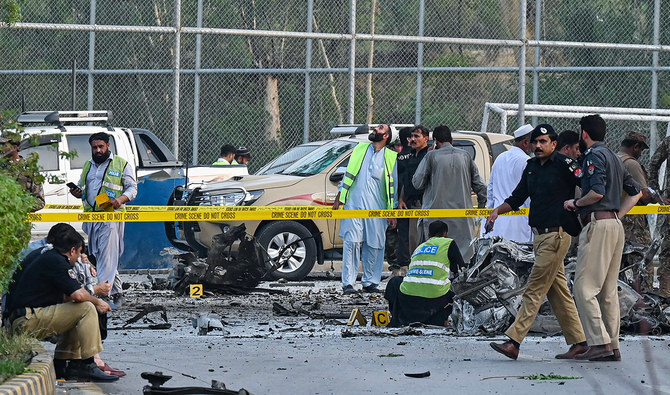
Security personnel gather at the site of the bomb blast in Hayatabad area of Peshawar on July 18, 2023. (AFP/File)
Short Url
Updated 14 November 2024
Follow

Seven killed in Pakistan’s northwest as militant’s car bomb explodes accidentally

  • The explosion took place in Mir Ali where a militant was fitting a bomb in a car at his residence
  • Blast damaged several nearby homes and wounded 14 people, with some in critical condition

PESHAWAR: A powerful car bomb accidentally detonated at the house of a Pakistani Taliban militant in northwestern Pakistan on Thursday, killing at least two children and five suspected militants, police said.
The explosion took place before dawn in the city of Mir Ali in Khyber Pakhtunkhwa province when a man identified a local commander of the militants, Rasool Jan, was fitting a bomb in a car at his house, police official Irfan Khan said.
He said other militants from the Pakistani Taliban group quickly arrived at the scene and removed the bodies of the insurgents who died. Authorities later found the bodies of two children in the rubble of the house, which collapsed in the explosion.
The blast also badly damaged several nearby homes and wounded 14 people, including women. Some of the injured were in critical condition in a hospital, Khan said, but he did not provide details.
The Pakistani Taliban and other insurgents in the region often target security forces with assault rifles, rockets, grenades and suicide car bombings, and Khan said it appeared the car bomb was being prepared for such an attack.
The Pakistani Taliban, known as Tehreek-e-Taliban Pakistan, are separate from the Afghan Taliban but have been emboldened by the group’s takeover of Afghanistan in 2021.
Also Thursday, security forces raided a hideout of insurgents in Harnai, a district in restive southwestern Balochistan province, triggering an intense shootout in which a soldier and three insurgents were killed. During the operation, an army major was killed when a roadside bomb exploded near his vehicle, the military said in a statement.
Pakistan’s President Asif Ali Zardari and Prime Minister Shehbaz Sharif paid tribute to whom they called the “martyred soldiers” in separate statements. They said the fight against terrorism will continue until the elimination of all insurgents.



Pakistan highlights Gwadar transshipment role as shipping routes face disruption over regional tensions

Updated 05 March 2026
Follow

Pakistan highlights Gwadar transshipment role as shipping routes face disruption over regional tensions

  • Pakistani ports possess “untapped potential” to attract global shipping lines for transshipment operations, says minister
  • Pakistan eyes leveraging Gwadar as regional transshipment hub as Iran’s closure of Strait of Hormuz disrupts global maritime trade

KARACHI: Pakistan’s Maritime Affairs Minister Junaid Anwar Chaudhry on Thursday highlighted the importance of the port city of Gwadar’s transshipment role as major shipping routes, including the Strait of Hormuz, face disruption due to Iran’s ongoing conflict with the US and Israel in the Gulf. 

The meeting takes place as Iran has effectively closed the Strait of Hormuz, a strategic waterway that lies between it and Oman. It is one of the world’s most critical oil transit routes, with roughly 20 percent of global oil supplies passing through it. Iran has vowed it will attack any ship that enters the strait, causing energy prices to rise sharply on Monday amid disruptions to tanker traffic in the waterway.

Gwadar is a deep-sea port in Pakistan’s southwestern Balochistan province that lies close to the Strait of Hormuz. Pakistani officials have in the past highlighted Gwadar’s geostrategic position as the shortest trade route to the Gulf and Central Asia, stressing that it has the potential to become a regional transshipment hub.

Chaudhry chaired a high-level meeting of government officials to assess emerging logistical challenges facing Pakistan’s trade, particularly in the energy sector, amid tensions in the Gulf. 

“Special focus was placed on fully leveraging the potential of Gwadar Port as a regional transshipment hub and positioning it as an alternative of regional instability,” Pakistan’s maritime affairs ministry said in a statement. 

The minister said Pakistani ports possessed “significant untapped potential” to attract international shipping lines for transshipment operations, noting that it could also ensure long-term sustainability and growth of the country’s maritime sector.

Participants of the meeting discussed measures to strengthen Pakistan’s position as a viable alternative transit and transshipment destination, as key waterways are affected by the disruption. 

The committee also reviewed proposals to amend relevant rules and regulations to facilitate international transshipment operations through on-dock and off-dock terminals.

The chairmen of the Port Qasim Authority, Karachi Port Trust and Gwadar Port Authority attended the meeting, briefing committee members on the current operational readiness of their ports. They spoke about the available capacity for container transshipment, bulk cargo handling and refueling services at Pakistani ports. 

The port in Gwadar is a central part of the China-Pakistan Economic Corridor (CPEC), under which Beijing has funneled tens of billions of dollars into massive transport, energy and infrastructure projects in Pakistan.

Pakistan has long eyed the deep-sea port as a key asset that can help boost its trade with Central Asian states, the Gulf region and ensure the country earns valuable foreign exchange.